

9 Solar Module Technology
239
400
600
800
1000
1200
0.1
0.2
0.3
0.4
0.5
0.6
0.7
0.8
0.9
1.0
Spectral response SR [A/W]
AM1.5G
Spectral distribution E
AM1.5
[a.u.]
a-Si
QE=1
c-Si
c-Si-HJT
CIGSS
CdTe
Wavelength [nm]
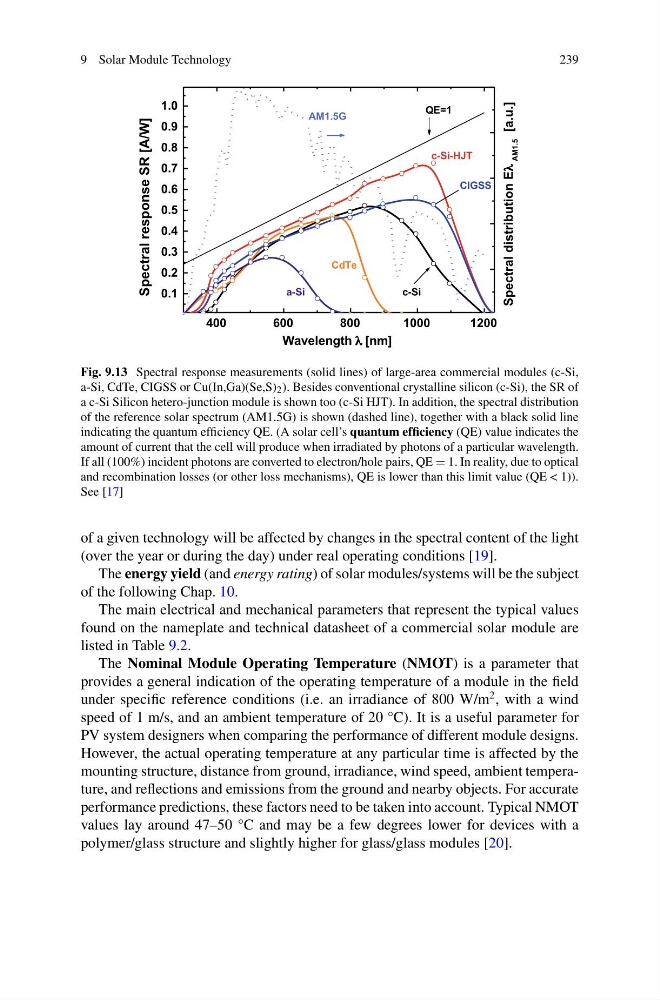
Fig. 9.13 Spectral response measurements (solid lines) of large-area commercial modules (c-Si,
a-Si, CdTe, CIGSS or Cu(In,Ga)(Se,S) 2 ). Besides conventional crystalline silicon (c-Si), the SR of
a c-Si Silicon hetero-junction module is shown too (c-Si HJT). In addition, the spectral distribution
of the reference solar spectrum (AM1.5G) is shown (dashed line), together with a black solid line
indicating the quantum efficiency QE. (A solar cell’s quantum efficiency (QE) value indicates the
amount of current that the cell will produce when irradiated by photons of a particular wavelength.
If all (100%) incident photons are converted to electron/hole pairs, QE = 1. In reality, due to optical
and recombination losses (or other loss mechanisms), QE is lower than this limit value (QE < 1)).
See [17]
of a given technology will be affected by changes in the spectral content of the light
(over the year or during the day) under real operating conditions [19].
The energy yield (and energy rating) of solar modules/systems will be the subject
of the following Chap. 10.
The main electrical and mechanical parameters that represent the typical values
found on the nameplate and technical datasheet of a commercial solar module are
listed in Table 9.2.
The Nominal Module Operating Temperature (NMOT) is a parameter that
provides a general indication of the operating temperature of a module in the field
under specific reference conditions (i.e. an irradiance of 800 W/m
2 , with a wind
speed of 1 m/s, and an ambient temperature of 20 °C). It is a useful parameter for
PV system designers when comparing the performance of different module designs.
However, the actual operating temperature at any particular time is affected by the
mounting structure, distance from ground, irradiance, wind speed, ambient temperature, and reflections and emissions from the ground and nearby objects. For accurate
performance predictions, these factors need to be taken into account. Typical NMOT
values lay around 47–50 °C and may be a few degrees lower for devices with a
polymer/glass structure and slightly higher for glass/glass modules [20].
239
400
600
800
1000
1200
0.1
0.2
0.3
0.4
0.5
0.6
0.7
0.8
0.9
1.0
Spectral response SR [A/W]
AM1.5G
Spectral distribution E
AM1.5
[a.u.]
a-Si
QE=1
c-Si
c-Si-HJT
CIGSS
CdTe
Wavelength [nm]
Fig. 9.13 Spectral response measurements (solid lines) of large-area commercial modules (c-Si,
a-Si, CdTe, CIGSS or Cu(In,Ga)(Se,S) 2 ). Besides conventional crystalline silicon (c-Si), the SR of
a c-Si Silicon hetero-junction module is shown too (c-Si HJT). In addition, the spectral distribution
of the reference solar spectrum (AM1.5G) is shown (dashed line), together with a black solid line
indicating the quantum efficiency QE. (A solar cell’s quantum efficiency (QE) value indicates the
amount of current that the cell will produce when irradiated by photons of a particular wavelength.
If all (100%) incident photons are converted to electron/hole pairs, QE = 1. In reality, due to optical
and recombination losses (or other loss mechanisms), QE is lower than this limit value (QE < 1)).
See [17]
of a given technology will be affected by changes in the spectral content of the light
(over the year or during the day) under real operating conditions [19].
The energy yield (and energy rating) of solar modules/systems will be the subject
of the following Chap. 10.
The main electrical and mechanical parameters that represent the typical values
found on the nameplate and technical datasheet of a commercial solar module are
listed in Table 9.2.
The Nominal Module Operating Temperature (NMOT) is a parameter that
provides a general indication of the operating temperature of a module in the field
under specific reference conditions (i.e. an irradiance of 800 W/m
2 , with a wind
speed of 1 m/s, and an ambient temperature of 20 °C). It is a useful parameter for
PV system designers when comparing the performance of different module designs.
However, the actual operating temperature at any particular time is affected by the
mounting structure, distance from ground, irradiance, wind speed, ambient temperature, and reflections and emissions from the ground and nearby objects. For accurate
performance predictions, these factors need to be taken into account. Typical NMOT
values lay around 47–50 °C and may be a few degrees lower for devices with a
polymer/glass structure and slightly higher for glass/glass modules [20].