

240
A. Virtuani
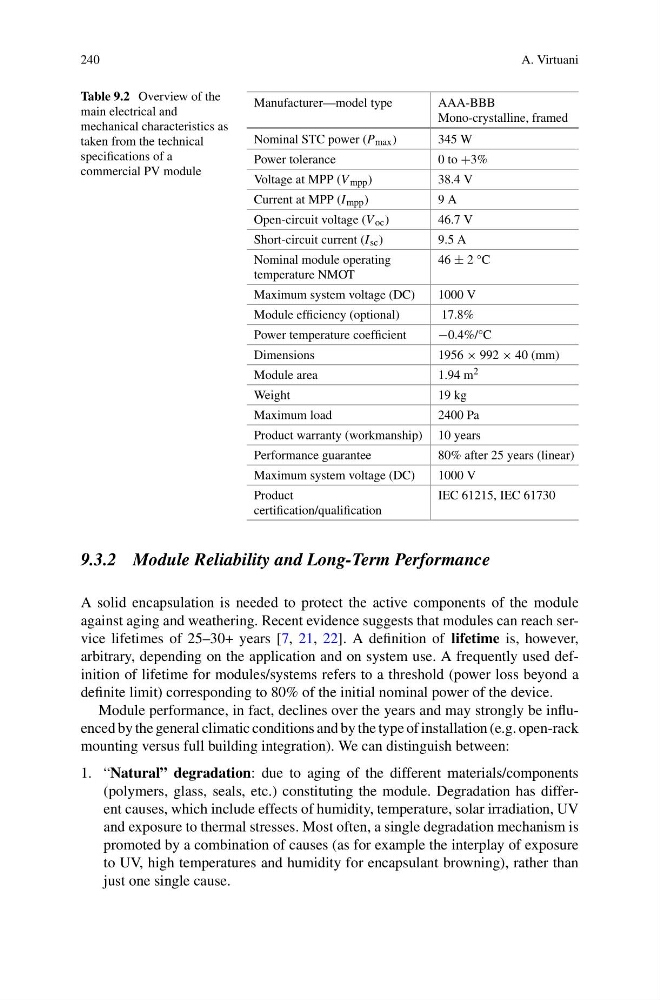
Table 9.2 Overview of the
main electrical and
mechanical characteristics as
taken from the technical
specifications of a
commercial PV module
Manufacturer—model type
AAA-BBB
Mono-crystalline, framed
Nominal STC power (P max )
345 W
Power tolerance
0 to +3%
Voltage at MPP (V mpp )
38.4 V
Current at MPP (I mpp )
9 A
Open-circuit voltage (V oc )
46.7 V
Short-circuit current (I sc )
9.5 A
Nominal module operating
temperature NMOT
46 ± 2 °C
Maximum system voltage (DC)
1000 V
Module efficiency (optional)
17.8%
Power temperature coefficient
−0.4%/°C
Dimensions
1956 × 992 × 40 (mm)
Module area
1.94 m 2
Weight
19 kg
Maximum load
2400 Pa
Product warranty (workmanship) 10 years
Performance guarantee
80% after 25 years (linear)
Maximum system voltage (DC)
1000 V
Product
certification/qualification
IEC 61215, IEC 61730
9.3.2 Module Reliability and Long-Term Performance
A solid encapsulation is needed to protect the active components of the module
against aging and weathering. Recent evidence suggests that modules can reach service lifetimes of 25–30+ years [7, 21, 22]. A definition of lifetime is, however,
arbitrary, depending on the application and on system use. A frequently used definition of lifetime for modules/systems refers to a threshold (power loss beyond a
definite limit) corresponding to 80% of the initial nominal power of the device.
Module performance, in fact, declines over the years and may strongly be influenced by the general climatic conditions and by the type of installation (e.g. open-rack
mounting versus full building integration). We can distinguish between:
1. “Natural” degradation: due to aging of the different materials/components
(polymers, glass, seals, etc.) constituting the module. Degradation has different causes, which include effects of humidity, temperature, solar irradiation, UV
and exposure to thermal stresses. Most often, a single degradation mechanism is
promoted by a combination of causes (as for example the interplay of exposure
to UV, high temperatures and humidity for encapsulant browning), rather than
just one single cause.
A. Virtuani
Table 9.2 Overview of the
main electrical and
mechanical characteristics as
taken from the technical
specifications of a
commercial PV module
Manufacturer—model type
AAA-BBB
Mono-crystalline, framed
Nominal STC power (P max )
345 W
Power tolerance
0 to +3%
Voltage at MPP (V mpp )
38.4 V
Current at MPP (I mpp )
9 A
Open-circuit voltage (V oc )
46.7 V
Short-circuit current (I sc )
9.5 A
Nominal module operating
temperature NMOT
46 ± 2 °C
Maximum system voltage (DC)
1000 V
Module efficiency (optional)
17.8%
Power temperature coefficient
−0.4%/°C
Dimensions
1956 × 992 × 40 (mm)
Module area
1.94 m 2
Weight
19 kg
Maximum load
2400 Pa
Product warranty (workmanship) 10 years
Performance guarantee
80% after 25 years (linear)
Maximum system voltage (DC)
1000 V
Product
certification/qualification
IEC 61215, IEC 61730
9.3.2 Module Reliability and Long-Term Performance
A solid encapsulation is needed to protect the active components of the module
against aging and weathering. Recent evidence suggests that modules can reach service lifetimes of 25–30+ years [7, 21, 22]. A definition of lifetime is, however,
arbitrary, depending on the application and on system use. A frequently used definition of lifetime for modules/systems refers to a threshold (power loss beyond a
definite limit) corresponding to 80% of the initial nominal power of the device.
Module performance, in fact, declines over the years and may strongly be influenced by the general climatic conditions and by the type of installation (e.g. open-rack
mounting versus full building integration). We can distinguish between:
1. “Natural” degradation: due to aging of the different materials/components
(polymers, glass, seals, etc.) constituting the module. Degradation has different causes, which include effects of humidity, temperature, solar irradiation, UV
and exposure to thermal stresses. Most often, a single degradation mechanism is
promoted by a combination of causes (as for example the interplay of exposure
to UV, high temperatures and humidity for encapsulant browning), rather than
just one single cause.