

238
A. Virtuani
AM1.5 spectrum), temperature and irradiance deviations, and slow signal-response
of the device under test (e.g. capacitive effects) that can seriously affect specifically
modules consisting of high-efficiency c-Si solar cells [16, 17].
The actual energy yield of a solar module in real operating conditions is influenced
by several other parameters that can be determined in a laboratory - under controlled
laboratory conditions—or outdoors. These include the module’s angle-of-incidence
(AOI) response (see Fig. 9.9), the low-irradiance performance, the spectral response
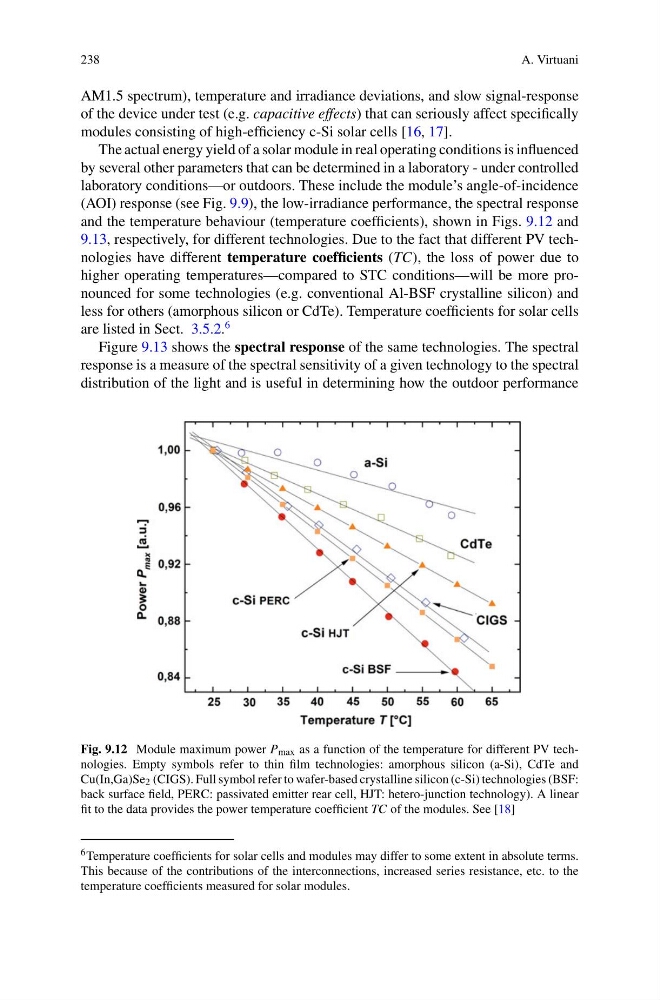
and the temperature behaviour (temperature coefficients), shown in Figs. 9.12 and
9.13, respectively, for different technologies. Due to the fact that different PV technologies have different temperature coefficients (TC), the loss of power due to
higher operating temperatures—compared to STC conditions—will be more pronounced for some technologies (e.g. conventional Al-BSF crystalline silicon) and
less for others (amorphous silicon or CdTe). Temperature coefficients for solar cells
are listed in Sect. 3.5.2.
6
Figure 9.13 shows the spectral response of the same technologies. The spectral
response is a measure of the spectral sensitivity of a given technology to the spectral
distribution of the light and is useful in determining how the outdoor performance
Fig. 9.12 Module maximum power P max as a function of the temperature for different PV technologies. Empty symbols refer to thin film technologies: amorphous silicon (a-Si), CdTe and
Cu(In,Ga)Se 2 (CIGS). Full symbol refer to wafer-based crystalline silicon (c-Si) technologies (BSF:
back surface field, PERC: passivated emitter rear cell, HJT: hetero-junction technology). A linear
fit to the data provides the power temperature coefficient TC of the modules. See [18]
6 Temperature coefficients for solar cells and modules may differ to some extent in absolute terms.
This because of the contributions of the interconnections, increased series resistance, etc. to the
temperature coefficients measured for solar modules.
A. Virtuani
AM1.5 spectrum), temperature and irradiance deviations, and slow signal-response
of the device under test (e.g. capacitive effects) that can seriously affect specifically
modules consisting of high-efficiency c-Si solar cells [16, 17].
The actual energy yield of a solar module in real operating conditions is influenced
by several other parameters that can be determined in a laboratory - under controlled
laboratory conditions—or outdoors. These include the module’s angle-of-incidence
(AOI) response (see Fig. 9.9), the low-irradiance performance, the spectral response
and the temperature behaviour (temperature coefficients), shown in Figs. 9.12 and
9.13, respectively, for different technologies. Due to the fact that different PV technologies have different temperature coefficients (TC), the loss of power due to
higher operating temperatures—compared to STC conditions—will be more pronounced for some technologies (e.g. conventional Al-BSF crystalline silicon) and
less for others (amorphous silicon or CdTe). Temperature coefficients for solar cells
are listed in Sect. 3.5.2.
6
Figure 9.13 shows the spectral response of the same technologies. The spectral
response is a measure of the spectral sensitivity of a given technology to the spectral
distribution of the light and is useful in determining how the outdoor performance
Fig. 9.12 Module maximum power P max as a function of the temperature for different PV technologies. Empty symbols refer to thin film technologies: amorphous silicon (a-Si), CdTe and
Cu(In,Ga)Se 2 (CIGS). Full symbol refer to wafer-based crystalline silicon (c-Si) technologies (BSF:
back surface field, PERC: passivated emitter rear cell, HJT: hetero-junction technology). A linear
fit to the data provides the power temperature coefficient TC of the modules. See [18]
6 Temperature coefficients for solar cells and modules may differ to some extent in absolute terms.
This because of the contributions of the interconnections, increased series resistance, etc. to the
temperature coefficients measured for solar modules.