

210
A. Romeo
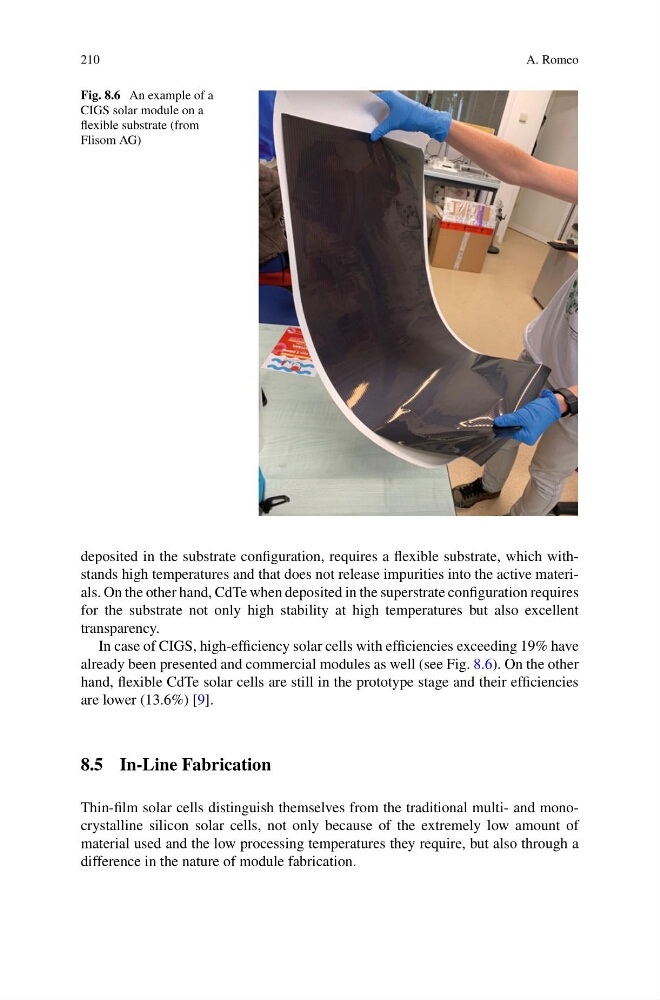
Fig. 8.6 An example of a
CIGS solar module on a
flexible substrate (from
Flisom AG)
deposited in the substrate configuration, requires a flexible substrate, which withstands high temperatures and that does not release impurities into the active materials. On the other hand, CdTe when deposited in the superstrate configuration requires
for the substrate not only high stability at high temperatures but also excellent
transparency.
In case of CIGS, high-efficiency solar cells with efficiencies exceeding 19% have
already been presented and commercial modules as well (see Fig. 8.6). On the other
hand, flexible CdTe solar cells are still in the prototype stage and their efficiencies
are lower (13.6%) [9].
8.5 In-Line Fabrication
Thin-film solar cells distinguish themselves from the traditional multi- and monocrystalline silicon solar cells, not only because of the extremely low amount of
material used and the low processing temperatures they require, but also through a
difference in the nature of module fabrication.
A. Romeo
Fig. 8.6 An example of a
CIGS solar module on a
flexible substrate (from
Flisom AG)
deposited in the substrate configuration, requires a flexible substrate, which withstands high temperatures and that does not release impurities into the active materials. On the other hand, CdTe when deposited in the superstrate configuration requires
for the substrate not only high stability at high temperatures but also excellent
transparency.
In case of CIGS, high-efficiency solar cells with efficiencies exceeding 19% have
already been presented and commercial modules as well (see Fig. 8.6). On the other
hand, flexible CdTe solar cells are still in the prototype stage and their efficiencies
are lower (13.6%) [9].
8.5 In-Line Fabrication
Thin-film solar cells distinguish themselves from the traditional multi- and monocrystalline silicon solar cells, not only because of the extremely low amount of
material used and the low processing temperatures they require, but also through a
difference in the nature of module fabrication.