

8 CdTe and CuInGaSe 2 Thin-Film Solar Cells
209
This, despite the extremely reduced thickness of the entire device, does not allow
for any weight advantage or for shape adaptability to different surfaces.
On the other hand, crystalline silicon solar cells generally have thicknesses above
100 µm, resulting in heavier and rigid structures that cannot be bended and certainly
not rolled.
Now, if thin film solar cells are fabricated on flexible substrates several advantages
result for space as well as for terrestrial applications. Since the absorber can be 2–
10 µm thick, if the solar cell is deposited on a thin and flexible substrate (with a
thickness between 10 and 100 µm) one would obtain significant weight savings
compared to glass substrates.
Moreover, specific power is a very important factor not only for space applications,
but also for terrestrial applications: cells mounted on flexible foil have a special
advantage since they can be wrapped onto any suitably oriented structure reducing
the installation costs.
In this sense it is useful to think in terms of the power to weight ratio (P/W ),
the higher the P/W, the lower is the cost per Watt. At the same time a high P/W
ratio simplifies the embedding of the modules in building structures.
So with thin films it is possible, by choosing a suitable substrate, to obtain
lightweight and adaptable modules. But what kind of substrates can be used?
Typically metal foil or polymer substrates offer the possibility of fabricating
flexible CdTe and CIGS solar cells.
The procedure to fabricate the modules is very similar to the one used for rigid
modules: starting from the flexible substrate the different layers are deposited with the
deposition techniques mentioned above. An important difference is that with flexible
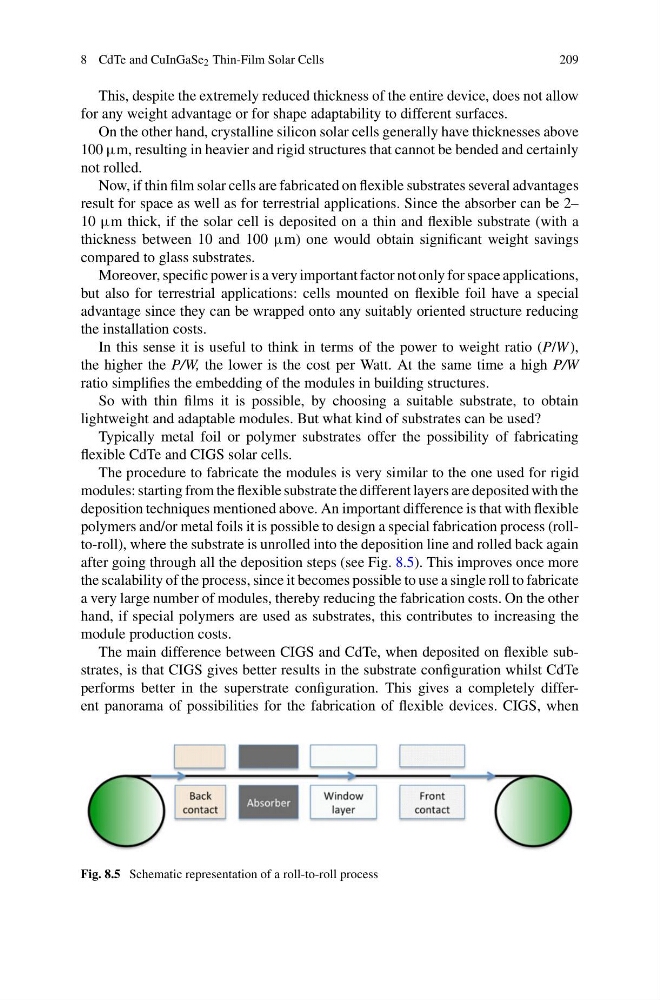
polymers and/or metal foils it is possible to design a special fabrication process (rollto-roll), where the substrate is unrolled into the deposition line and rolled back again
after going through all the deposition steps (see Fig. 8.5). This improves once more
the scalability of the process, since it becomes possible to use a single roll to fabricate
a very large number of modules, thereby reducing the fabrication costs. On the other
hand, if special polymers are used as substrates, this contributes to increasing the
module production costs.
The main difference between CIGS and CdTe, when deposited on flexible substrates, is that CIGS gives better results in the substrate configuration whilst CdTe
performs better in the superstrate configuration. This gives a completely different panorama of possibilities for the fabrication of flexible devices. CIGS, when
Fig. 8.5 Schematic representation of a roll-to-roll process
209
This, despite the extremely reduced thickness of the entire device, does not allow
for any weight advantage or for shape adaptability to different surfaces.
On the other hand, crystalline silicon solar cells generally have thicknesses above
100 µm, resulting in heavier and rigid structures that cannot be bended and certainly
not rolled.
Now, if thin film solar cells are fabricated on flexible substrates several advantages
result for space as well as for terrestrial applications. Since the absorber can be 2–
10 µm thick, if the solar cell is deposited on a thin and flexible substrate (with a
thickness between 10 and 100 µm) one would obtain significant weight savings
compared to glass substrates.
Moreover, specific power is a very important factor not only for space applications,
but also for terrestrial applications: cells mounted on flexible foil have a special
advantage since they can be wrapped onto any suitably oriented structure reducing
the installation costs.
In this sense it is useful to think in terms of the power to weight ratio (P/W ),
the higher the P/W, the lower is the cost per Watt. At the same time a high P/W
ratio simplifies the embedding of the modules in building structures.
So with thin films it is possible, by choosing a suitable substrate, to obtain
lightweight and adaptable modules. But what kind of substrates can be used?
Typically metal foil or polymer substrates offer the possibility of fabricating
flexible CdTe and CIGS solar cells.
The procedure to fabricate the modules is very similar to the one used for rigid
modules: starting from the flexible substrate the different layers are deposited with the
deposition techniques mentioned above. An important difference is that with flexible
polymers and/or metal foils it is possible to design a special fabrication process (rollto-roll), where the substrate is unrolled into the deposition line and rolled back again
after going through all the deposition steps (see Fig. 8.5). This improves once more
the scalability of the process, since it becomes possible to use a single roll to fabricate
a very large number of modules, thereby reducing the fabrication costs. On the other
hand, if special polymers are used as substrates, this contributes to increasing the
module production costs.
The main difference between CIGS and CdTe, when deposited on flexible substrates, is that CIGS gives better results in the substrate configuration whilst CdTe
performs better in the superstrate configuration. This gives a completely different panorama of possibilities for the fabrication of flexible devices. CIGS, when
Fig. 8.5 Schematic representation of a roll-to-roll process