

8 CdTe and CuInGaSe 2 Thin-Film Solar Cells
199
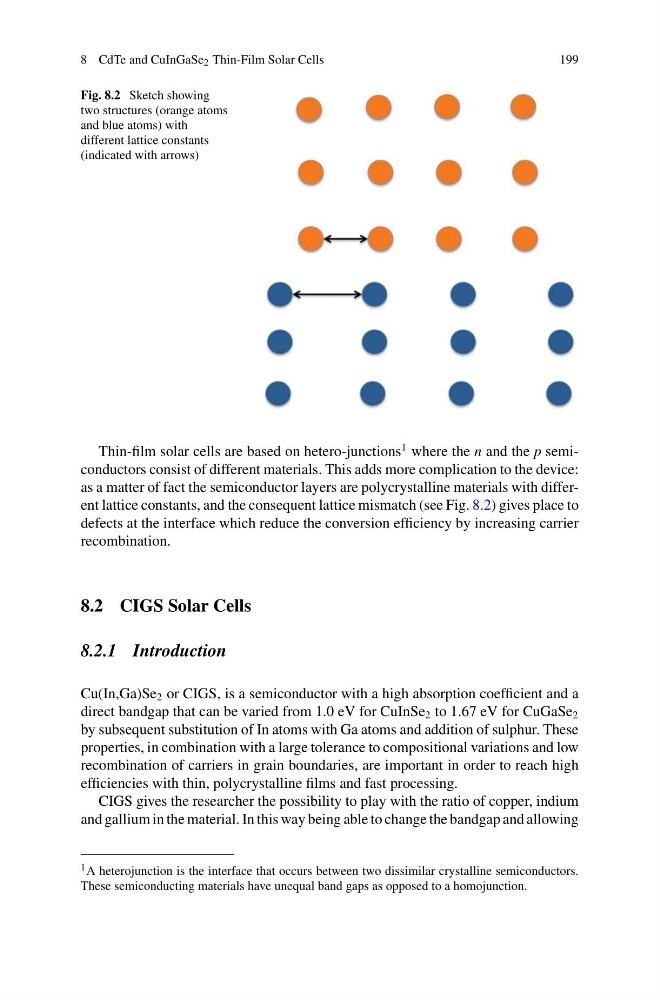
Fig. 8.2 Sketch showing
two structures (orange atoms
and blue atoms) with
different lattice constants
(indicated with arrows)
Thin-film solar cells are based on hetero-junctions
1 where the n and the p semiconductors consist of different materials. This adds more complication to the device:
as a matter of fact the semiconductor layers are polycrystalline materials with different lattice constants, and the consequent lattice mismatch (see Fig. 8.2) gives place to
defects at the interface which reduce the conversion efficiency by increasing carrier
recombination.
8.2 CIGS Solar Cells
8.2.1 Introduction
Cu(In,Ga)Se 2 or CIGS, is a semiconductor with a high absorption coefficient and a
direct bandgap that can be varied from 1.0 eV for CuInSe 2 to 1.67 eV for CuGaSe 2
by subsequent substitution of In atoms with Ga atoms and addition of sulphur. These
properties, in combination with a large tolerance to compositional variations and low
recombination of carriers in grain boundaries, are important in order to reach high
efficiencies with thin, polycrystalline films and fast processing.
CIGS gives the researcher the possibility to play with the ratio of copper, indium
and gallium in the material. In this way being able to change the bandgap and allowing
1 A heterojunction is the interface that occurs between two dissimilar crystalline semiconductors.
These semiconducting materials have unequal band gaps as opposed to a homojunction.
199
Fig. 8.2 Sketch showing
two structures (orange atoms
and blue atoms) with
different lattice constants
(indicated with arrows)
Thin-film solar cells are based on hetero-junctions
1 where the n and the p semiconductors consist of different materials. This adds more complication to the device:
as a matter of fact the semiconductor layers are polycrystalline materials with different lattice constants, and the consequent lattice mismatch (see Fig. 8.2) gives place to
defects at the interface which reduce the conversion efficiency by increasing carrier
recombination.
8.2 CIGS Solar Cells
8.2.1 Introduction
Cu(In,Ga)Se 2 or CIGS, is a semiconductor with a high absorption coefficient and a
direct bandgap that can be varied from 1.0 eV for CuInSe 2 to 1.67 eV for CuGaSe 2
by subsequent substitution of In atoms with Ga atoms and addition of sulphur. These
properties, in combination with a large tolerance to compositional variations and low
recombination of carriers in grain boundaries, are important in order to reach high
efficiencies with thin, polycrystalline films and fast processing.
CIGS gives the researcher the possibility to play with the ratio of copper, indium
and gallium in the material. In this way being able to change the bandgap and allowing
1 A heterojunction is the interface that occurs between two dissimilar crystalline semiconductors.
These semiconducting materials have unequal band gaps as opposed to a homojunction.