

186
S. Leu and D. Sontag
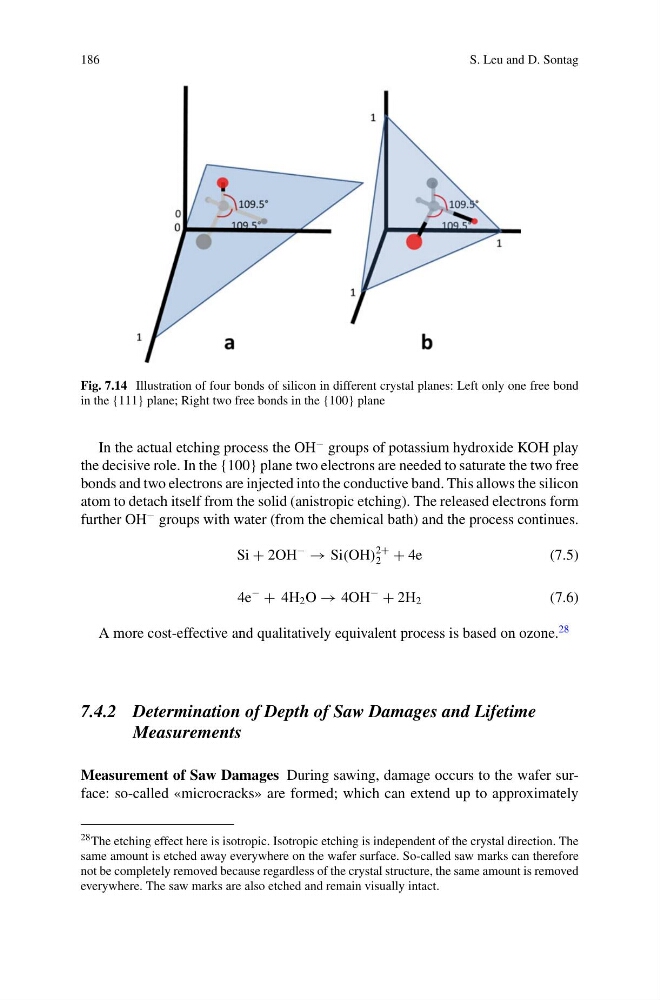
Fig. 7.14 Illustration of four bonds of silicon in different crystal planes: Left only one free bond
in the {111} plane; Right two free bonds in the {100} plane
In the actual etching process the OH
− groups of potassium hydroxide KOH play
the decisive role. In the {100} plane two electrons are needed to saturate the two free
bonds and two electrons are injected into the conductive band. This allows the silicon
atom to detach itself from the solid (anistropic etching). The released electrons form
further OH
− groups with water (from the chemical bath) and the process continues.
Si + 2OH
−
→ Si(OH)
2+
2 + 4e
(7.5)
4e
−
+ 4H 2 O → 4OH
−
+ 2H 2
(7.6)
A more cost-effective and qualitatively equivalent process is based on ozone.
28
7.4.2 Determination of Depth of Saw Damages and Lifetime
Measurements
Measurement of Saw Damages During sawing, damage occurs to the wafer surface: so-called «microcracks» are formed; which can extend up to approximately
28 The etching effect here is isotropic. Isotropic etching is independent of the crystal direction. The
same amount is etched away everywhere on the wafer surface. So-called saw marks can therefore
not be completely removed because regardless of the crystal structure, the same amount is removed
everywhere. The saw marks are also etched and remain visually intact.
S. Leu and D. Sontag
Fig. 7.14 Illustration of four bonds of silicon in different crystal planes: Left only one free bond
in the {111} plane; Right two free bonds in the {100} plane
In the actual etching process the OH
− groups of potassium hydroxide KOH play
the decisive role. In the {100} plane two electrons are needed to saturate the two free
bonds and two electrons are injected into the conductive band. This allows the silicon
atom to detach itself from the solid (anistropic etching). The released electrons form
further OH
− groups with water (from the chemical bath) and the process continues.
Si + 2OH
−
→ Si(OH)
2+
2 + 4e
(7.5)
4e
−
+ 4H 2 O → 4OH
−
+ 2H 2
(7.6)
A more cost-effective and qualitatively equivalent process is based on ozone.
28
7.4.2 Determination of Depth of Saw Damages and Lifetime
Measurements
Measurement of Saw Damages During sawing, damage occurs to the wafer surface: so-called «microcracks» are formed; which can extend up to approximately
28 The etching effect here is isotropic. Isotropic etching is independent of the crystal direction. The
same amount is etched away everywhere on the wafer surface. So-called saw marks can therefore
not be completely removed because regardless of the crystal structure, the same amount is removed
everywhere. The saw marks are also etched and remain visually intact.