

7 Crystalline Silicon Solar Cells: Heterojunction Cells
165
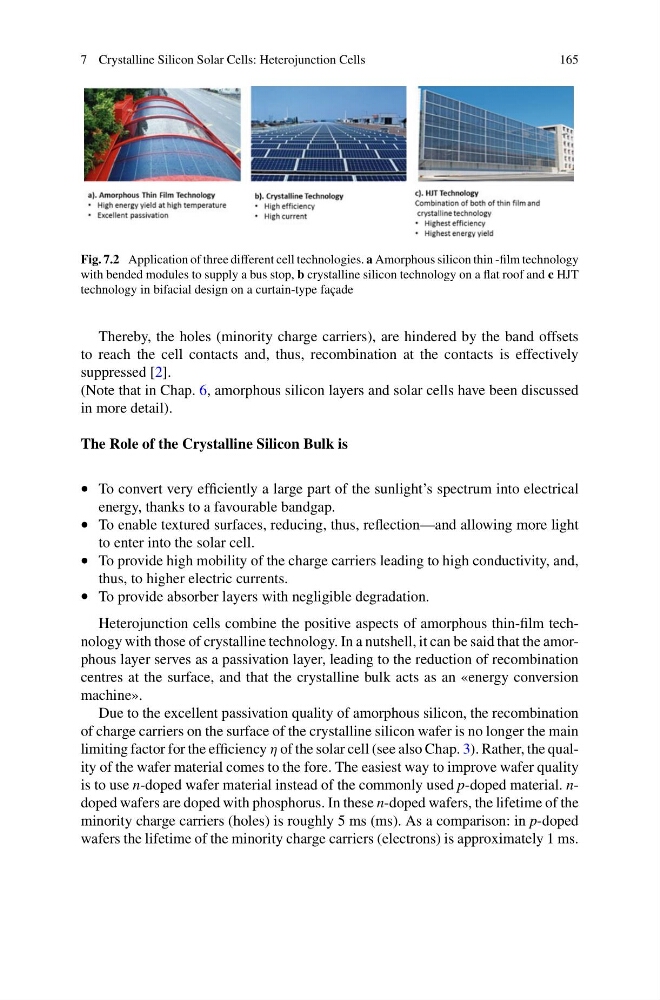
Fig. 7.2 Application of three different cell technologies. a Amorphous silicon thin -film technology
with bended modules to supply a bus stop, b crystalline silicon technology on a flat roof and c HJT
technology in bifacial design on a curtain-type façade
Thereby, the holes (minority charge carriers), are hindered by the band offsets
to reach the cell contacts and, thus, recombination at the contacts is effectively
suppressed [2].
(Note that in Chap. 6, amorphous silicon layers and solar cells have been discussed
in more detail).
The Role of the Crystalline Silicon Bulk is
• To convert very efficiently a large part of the sunlight’s spectrum into electrical
energy, thanks to a favourable bandgap.
• To enable textured surfaces, reducing, thus, reflection—and allowing more light
to enter into the solar cell.
• To provide high mobility of the charge carriers leading to high conductivity, and,
thus, to higher electric currents.
• To provide absorber layers with negligible degradation.
Heterojunction cells combine the positive aspects of amorphous thin-film technology with those of crystalline technology. In a nutshell, it can be said that the amorphous layer serves as a passivation layer, leading to the reduction of recombination
centres at the surface, and that the crystalline bulk acts as an «energy conversion
machine».
Due to the excellent passivation quality of amorphous silicon, the recombination
of charge carriers on the surface of the crystalline silicon wafer is no longer the main
limiting factor for the efficiency η of the solar cell (see also Chap. 3). Rather, the quality of the wafer material comes to the fore. The easiest way to improve wafer quality
is to use n-doped wafer material instead of the commonly used p-doped material. ndoped wafers are doped with phosphorus. In these n-doped wafers, the lifetime of the
minority charge carriers (holes) is roughly 5 ms (ms). As a comparison: in p-doped
wafers the lifetime of the minority charge carriers (electrons) is approximately 1 ms.
165
Fig. 7.2 Application of three different cell technologies. a Amorphous silicon thin -film technology
with bended modules to supply a bus stop, b crystalline silicon technology on a flat roof and c HJT
technology in bifacial design on a curtain-type façade
Thereby, the holes (minority charge carriers), are hindered by the band offsets
to reach the cell contacts and, thus, recombination at the contacts is effectively
suppressed [2].
(Note that in Chap. 6, amorphous silicon layers and solar cells have been discussed
in more detail).
The Role of the Crystalline Silicon Bulk is
• To convert very efficiently a large part of the sunlight’s spectrum into electrical
energy, thanks to a favourable bandgap.
• To enable textured surfaces, reducing, thus, reflection—and allowing more light
to enter into the solar cell.
• To provide high mobility of the charge carriers leading to high conductivity, and,
thus, to higher electric currents.
• To provide absorber layers with negligible degradation.
Heterojunction cells combine the positive aspects of amorphous thin-film technology with those of crystalline technology. In a nutshell, it can be said that the amorphous layer serves as a passivation layer, leading to the reduction of recombination
centres at the surface, and that the crystalline bulk acts as an «energy conversion
machine».
Due to the excellent passivation quality of amorphous silicon, the recombination
of charge carriers on the surface of the crystalline silicon wafer is no longer the main
limiting factor for the efficiency η of the solar cell (see also Chap. 3). Rather, the quality of the wafer material comes to the fore. The easiest way to improve wafer quality
is to use n-doped wafer material instead of the commonly used p-doped material. ndoped wafers are doped with phosphorus. In these n-doped wafers, the lifetime of the
minority charge carriers (holes) is roughly 5 ms (ms). As a comparison: in p-doped
wafers the lifetime of the minority charge carriers (electrons) is approximately 1 ms.