

164
S. Leu and D. Sontag
This can be obtained with the heterojunction cell. Heterojunction technology
(HJT) combines the positive characteristics of amorphous thin-film technology with
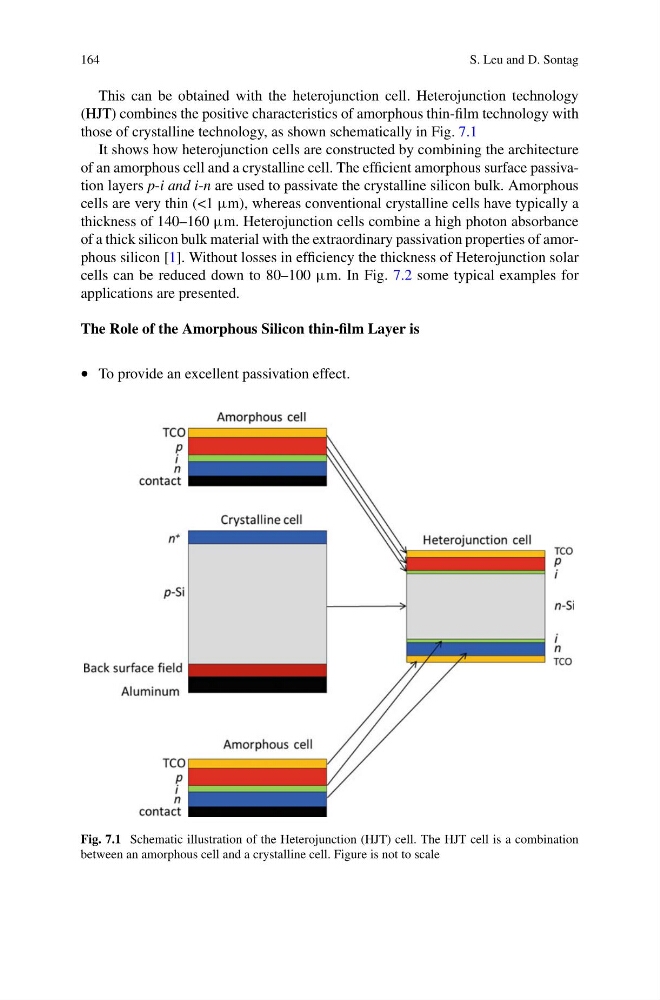
those of crystalline technology, as shown schematically in Fig. 7.1
It shows how heterojunction cells are constructed by combining the architecture
of an amorphous cell and a crystalline cell. The efficient amorphous surface passivation layers p-i and i-n are used to passivate the crystalline silicon bulk. Amorphous
cells are very thin (<1 μm), whereas conventional crystalline cells have typically a
thickness of 140–160 μm. Heterojunction cells combine a high photon absorbance
of a thick silicon bulk material with the extraordinary passivation properties of amorphous silicon [1]. Without losses in efficiency the thickness of Heterojunction solar
cells can be reduced down to 80–100 μm. In Fig. 7.2 some typical examples for
applications are presented.
The Role of the Amorphous Silicon thin-film Layer is
• To provide an excellent passivation effect.
Fig. 7.1 Schematic illustration of the Heterojunction (HJT) cell. The HJT cell is a combination
between an amorphous cell and a crystalline cell. Figure is not to scale
S. Leu and D. Sontag
This can be obtained with the heterojunction cell. Heterojunction technology
(HJT) combines the positive characteristics of amorphous thin-film technology with
those of crystalline technology, as shown schematically in Fig. 7.1
It shows how heterojunction cells are constructed by combining the architecture
of an amorphous cell and a crystalline cell. The efficient amorphous surface passivation layers p-i and i-n are used to passivate the crystalline silicon bulk. Amorphous
cells are very thin (<1 μm), whereas conventional crystalline cells have typically a
thickness of 140–160 μm. Heterojunction cells combine a high photon absorbance
of a thick silicon bulk material with the extraordinary passivation properties of amorphous silicon [1]. Without losses in efficiency the thickness of Heterojunction solar
cells can be reduced down to 80–100 μm. In Fig. 7.2 some typical examples for
applications are presented.
The Role of the Amorphous Silicon thin-film Layer is
• To provide an excellent passivation effect.
Fig. 7.1 Schematic illustration of the Heterojunction (HJT) cell. The HJT cell is a combination
between an amorphous cell and a crystalline cell. Figure is not to scale