

5 Crystalline Silicon Solar Cells: Homojunction Cells
135
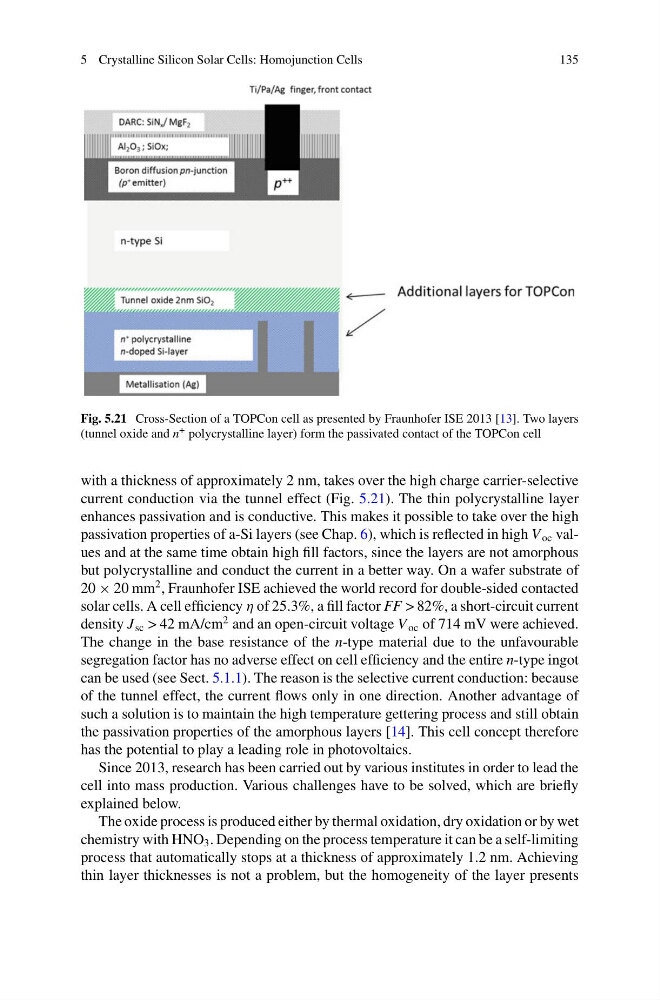
Fig. 5.21 Cross-Section of a TOPCon cell as presented by Fraunhofer ISE 2013 [13]. Two layers
(tunnel oxide and n + polycrystalline layer) form the passivated contact of the TOPCon cell
with a thickness of approximately 2 nm, takes over the high charge carrier-selective
current conduction via the tunnel effect (Fig. 5.21). The thin polycrystalline layer
enhances passivation and is conductive. This makes it possible to take over the high
passivation properties of a-Si layers (see Chap. 6), which is reflected in high V oc values and at the same time obtain high fill factors, since the layers are not amorphous
but polycrystalline and conduct the current in a better way. On a wafer substrate of
20 × 20 mm
2 , Fraunhofer ISE achieved the world record for double-sided contacted
solar cells. A cell efficiency η of 25.3%, a fill factor FF > 82%, a short-circuit current
density J sc > 42 mA/cm
2 and an open-circuit voltage V oc of 714 mV were achieved.
The change in the base resistance of the n-type material due to the unfavourable
segregation factor has no adverse effect on cell efficiency and the entire n-type ingot
can be used (see Sect. 5.1.1). The reason is the selective current conduction: because
of the tunnel effect, the current flows only in one direction. Another advantage of
such a solution is to maintain the high temperature gettering process and still obtain
the passivation properties of the amorphous layers [14]. This cell concept therefore
has the potential to play a leading role in photovoltaics.
Since 2013, research has been carried out by various institutes in order to lead the
cell into mass production. Various challenges have to be solved, which are briefly
explained below.
The oxide process is produced either by thermal oxidation, dry oxidation or by wet
chemistry with HNO 3 . Depending on the process temperature it can be a self-limiting
process that automatically stops at a thickness of approximately 1.2 nm. Achieving
thin layer thicknesses is not a problem, but the homogeneity of the layer presents
135
Fig. 5.21 Cross-Section of a TOPCon cell as presented by Fraunhofer ISE 2013 [13]. Two layers
(tunnel oxide and n + polycrystalline layer) form the passivated contact of the TOPCon cell
with a thickness of approximately 2 nm, takes over the high charge carrier-selective
current conduction via the tunnel effect (Fig. 5.21). The thin polycrystalline layer
enhances passivation and is conductive. This makes it possible to take over the high
passivation properties of a-Si layers (see Chap. 6), which is reflected in high V oc values and at the same time obtain high fill factors, since the layers are not amorphous
but polycrystalline and conduct the current in a better way. On a wafer substrate of
20 × 20 mm
2 , Fraunhofer ISE achieved the world record for double-sided contacted
solar cells. A cell efficiency η of 25.3%, a fill factor FF > 82%, a short-circuit current
density J sc > 42 mA/cm
2 and an open-circuit voltage V oc of 714 mV were achieved.
The change in the base resistance of the n-type material due to the unfavourable
segregation factor has no adverse effect on cell efficiency and the entire n-type ingot
can be used (see Sect. 5.1.1). The reason is the selective current conduction: because
of the tunnel effect, the current flows only in one direction. Another advantage of
such a solution is to maintain the high temperature gettering process and still obtain
the passivation properties of the amorphous layers [14]. This cell concept therefore
has the potential to play a leading role in photovoltaics.
Since 2013, research has been carried out by various institutes in order to lead the
cell into mass production. Various challenges have to be solved, which are briefly
explained below.
The oxide process is produced either by thermal oxidation, dry oxidation or by wet
chemistry with HNO 3 . Depending on the process temperature it can be a self-limiting
process that automatically stops at a thickness of approximately 1.2 nm. Achieving
thin layer thicknesses is not a problem, but the homogeneity of the layer presents