

94
S. Leu and D. Sontag
mm]) or simply . Since the sheet resistance R s refers to a surface, one writes ohm/,
where is dimensionless. R s gives an indication of how the metallization is to be realized. And as mentioned before it is easy to measure. If, for example, the phosphorous
is driven into the p-type silicon for formation of the pn-junction
19 a sheet resistivity
between 97 and 205 / results. 97 / can be achieved, for example, with a
phosphorus concentration of 8 × 10
19 ; 205 / with a phosphorus concentration
of 3.3 × 10
19 (low concentration). 97 / leads in our example to a specific resistance of 31 × 10
−3
mm (4.24) and the semiconductor can be contacted optimally
with silver fingers. A higher sheet resistivity of e.g. 205 / cannot be optimally
contacted without losing efficiency. The reason for this is that the dark current J o
increases strongly at very low doping concentrations under the metal contacts [7].
This leads to low cell efficiencies. In this way the pn-junction can be evaluated by
means of sheet resistivity.
4. Surface Recombination
A large part of the recombination within solar cells can be attributed to surface
recombination. The neighbouring lattice atoms are missing on the surface, so that
foreign atoms, especially oxygen, can accumulate. Additionally, doping with foreign atoms, for example with phosphorous, also contaminates the surface and even
intensify the recombination. As an example: In the case of a p-type silicon wafer, the
phosphorus dopant enters from the surface. Finally, and most importantly, the metal
contacts are lying on the surface—these contacts introduce additional contaminants
and, act, thus as very active recombination centres. In the metal contacts (like in
all metals), the Fermi level E F lies within the Conduction Band. Therefore, there
are very many free electrons in these contacts which are just ready and waiting to
swallow all holes, which reach the metal layer. Metal contacts are, thus, zones of
very high surface recombination. The theoretic treatment of surface recombination
is similar to that of SRH recombination. For the production of solar cells, the reduction of surface recombination by passivation of the electrically active recombination
centres has the highest priority. The surface recombination velocity S is a variable
with the unit cm s
−1 ; it indicates how fast charge carriers recombine on the surface.
Surface recombination can be calculated for electrons (e) or for holes (h). In the
following it is calculated for holes. In p-type bulk material electrons are the minority
carriers, but at the front-surface holes are the minority carriers because of the doping
used for the formation of the pn-junction. For holes, surface recombination velocity
S h depends on the capture cross-section σ h , on the density of electrons at the surface
n e and on the thermal velocity ν th according to the following equations:
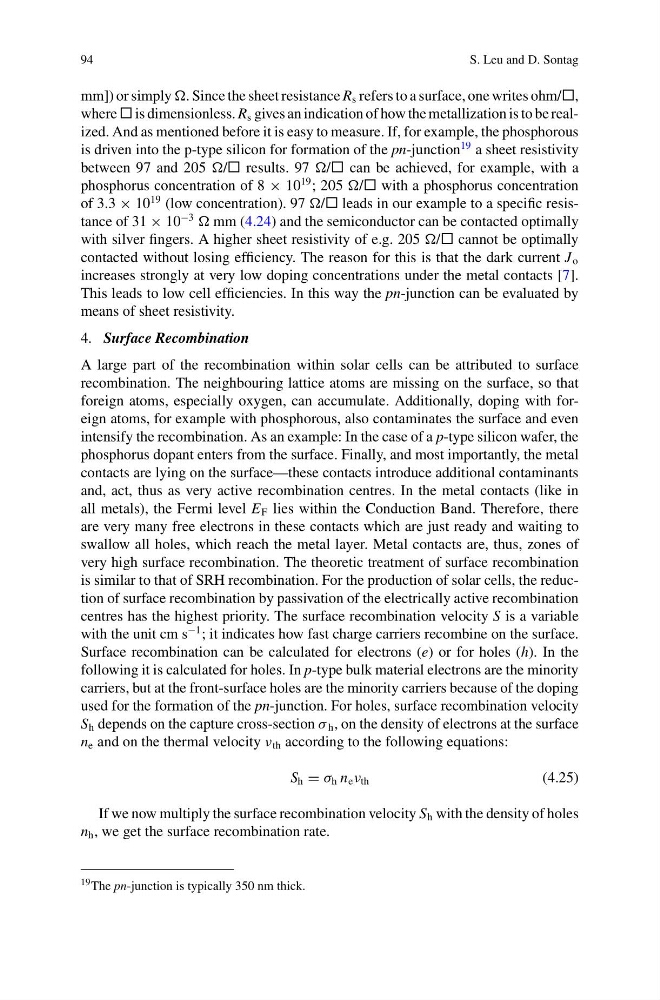
S h = σ h n e ν th
(4.25)
If we now multiply the surface recombination velocity S h with the density of holes
n h , we get the surface recombination rate.
19 The pn-junction is typically 350 nm thick.
S. Leu and D. Sontag
mm]) or simply . Since the sheet resistance R s refers to a surface, one writes ohm/,
where is dimensionless. R s gives an indication of how the metallization is to be realized. And as mentioned before it is easy to measure. If, for example, the phosphorous
is driven into the p-type silicon for formation of the pn-junction
19 a sheet resistivity
between 97 and 205 / results. 97 / can be achieved, for example, with a
phosphorus concentration of 8 × 10
19 ; 205 / with a phosphorus concentration
of 3.3 × 10
19 (low concentration). 97 / leads in our example to a specific resistance of 31 × 10
−3
mm (4.24) and the semiconductor can be contacted optimally
with silver fingers. A higher sheet resistivity of e.g. 205 / cannot be optimally
contacted without losing efficiency. The reason for this is that the dark current J o
increases strongly at very low doping concentrations under the metal contacts [7].
This leads to low cell efficiencies. In this way the pn-junction can be evaluated by
means of sheet resistivity.
4. Surface Recombination
A large part of the recombination within solar cells can be attributed to surface
recombination. The neighbouring lattice atoms are missing on the surface, so that
foreign atoms, especially oxygen, can accumulate. Additionally, doping with foreign atoms, for example with phosphorous, also contaminates the surface and even
intensify the recombination. As an example: In the case of a p-type silicon wafer, the
phosphorus dopant enters from the surface. Finally, and most importantly, the metal
contacts are lying on the surface—these contacts introduce additional contaminants
and, act, thus as very active recombination centres. In the metal contacts (like in
all metals), the Fermi level E F lies within the Conduction Band. Therefore, there
are very many free electrons in these contacts which are just ready and waiting to
swallow all holes, which reach the metal layer. Metal contacts are, thus, zones of
very high surface recombination. The theoretic treatment of surface recombination
is similar to that of SRH recombination. For the production of solar cells, the reduction of surface recombination by passivation of the electrically active recombination
centres has the highest priority. The surface recombination velocity S is a variable
with the unit cm s
−1 ; it indicates how fast charge carriers recombine on the surface.
Surface recombination can be calculated for electrons (e) or for holes (h). In the
following it is calculated for holes. In p-type bulk material electrons are the minority
carriers, but at the front-surface holes are the minority carriers because of the doping
used for the formation of the pn-junction. For holes, surface recombination velocity
S h depends on the capture cross-section σ h , on the density of electrons at the surface
n e and on the thermal velocity ν th according to the following equations:
S h = σ h n e ν th
(4.25)
If we now multiply the surface recombination velocity S h with the density of holes
n h , we get the surface recombination rate.
19 The pn-junction is typically 350 nm thick.