

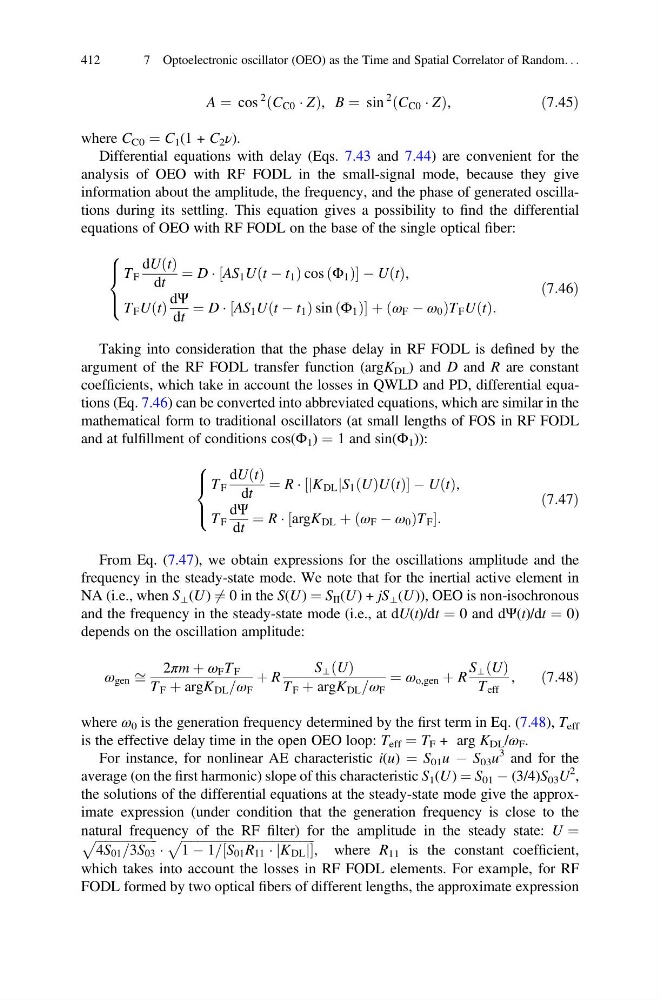
A ¼ cos
2 C C0 Á Z
ð
Þ, B ¼ sin
2 C C0 Á Z
ð
Þ,
ð7:45Þ
where C C0 ¼ C 1 (1 + C 2 ν).
Differential equations with delay (Eqs. 7.43 and 7.44) are convenient for the
analysis of OEO with RF FODL in the small-signal mode, because they give
information about the amplitude, the frequency, and the phase of generated oscillations during its settling. This equation gives a possibility to find the differential
equations of OEO with RF FODL on the base of the single optical fiber:
T F
dU t
ð Þ
dt
¼ D Á AS 1 U t À t 1
ð
Þcos Φ 1
ð Þ
½
À U t
ð Þ,
T F U t
ð Þ
dΨ
dt
¼ D Á AS 1 U t À t 1
ð
Þsin Φ 1
ð Þ
½
þω F À ω 0
ð
Þ T F U t
ð Þ:
8
> <
> :
ð7:46Þ
Taking into consideration that the phase delay in RF FODL is defined by the
argument of the RF FODL transfer function (argK DL ) and D and R are constant
coefficients, which take in account the losses in QWLD and PD, differential equations (Eq. 7.46) can be converted into abbreviated equations, which are similar in the
mathematical form to traditional oscillators (at small lengths of FOS in RF FODL
and at fulfillment of conditions cos(Φ 1 ) ¼ 1 and sin(Φ 1 )):
T F
dU t
ð Þ
dt
¼ R Á K DL
j
jS 1 U
ð ÞU t
ð Þ
½
À U t
ð Þ,
T F
dΨ
dt
¼ R Á argK DL þ ω F À ω 0
ð
Þ T F
½
:
8
> <
> :
ð7:47Þ
From Eq. (7.47), we obtain expressions for the oscillations amplitude and the
frequency in the steady-state mode. We note that for the inertial active element in
NA (i.e., when S ⊥ (U ) 6 ¼ 0 in the S(U ) ¼ S II (U ) + jS ⊥ (U )), OEO is non-isochronous
and the frequency in the steady-state mode (i.e., at dU(t)/dt ¼ 0 and dΨ(t)/dt ¼ 0)
depends on the oscillation amplitude:
ω gen ffi
2πm þ ω F T F
T F þ argK DL =ω F
þ R
S ⊥ U
ð Þ
T F þ argK DL =ω F
¼ ω o,gen þ R
S ⊥ U
ð Þ
T eff
,
ð7:48Þ
where ω 0 is the generation frequency determined by the first term in Eq. (7.48), T eff
is the effective delay time in the open OEO loop: T eff ¼ T F + arg K DL /ω F .
For instance, for nonlinear AE characteristic i(u) ¼ S 01 u À S 03 u
3 and for the
average (on the first harmonic) slope of this characteristic S 1 (U ) ¼ S 01 À (3/4)S 03 U
2 ,
the solutions of the differential equations at the steady-state mode give the approximate expression (under condition that the generation frequency is close to the
natural frequency of the RF filter) for the amplitude in the steady state: U ¼
ffiffiffiffiffiffiffiffiffiffiffiffiffiffiffiffiffiffiffi ffi
4S 01 =3S 03
p
Á
ffiffiffiffiffiffiffiffiffiffiffiffiffiffiffiffiffiffiffiffiffiffiffiffiffiffiffiffiffiffiffiffiffiffiffiffiffiffiffiffiffiffi ffi
1 À 1= S 01 R 11 Á K DL
j
j
½
p
, where R 11 is the constant coefficient,
which takes into account the losses in RF FODL elements. For example, for RF
FODL formed by two optical fibers of different lengths, the approximate expression
412
7 Optoelectronic oscillator (OEO) as the Time and Spatial Correlator of Random. . .
2 C C0 Á Z
ð
Þ, B ¼ sin
2 C C0 Á Z
ð
Þ,
ð7:45Þ
where C C0 ¼ C 1 (1 + C 2 ν).
Differential equations with delay (Eqs. 7.43 and 7.44) are convenient for the
analysis of OEO with RF FODL in the small-signal mode, because they give
information about the amplitude, the frequency, and the phase of generated oscillations during its settling. This equation gives a possibility to find the differential
equations of OEO with RF FODL on the base of the single optical fiber:
T F
dU t
ð Þ
dt
¼ D Á AS 1 U t À t 1
ð
Þcos Φ 1
ð Þ
½
À U t
ð Þ,
T F U t
ð Þ
dΨ
dt
¼ D Á AS 1 U t À t 1
ð
Þsin Φ 1
ð Þ
½
þω F À ω 0
ð
Þ T F U t
ð Þ:
8
> <
> :
ð7:46Þ
Taking into consideration that the phase delay in RF FODL is defined by the
argument of the RF FODL transfer function (argK DL ) and D and R are constant
coefficients, which take in account the losses in QWLD and PD, differential equations (Eq. 7.46) can be converted into abbreviated equations, which are similar in the
mathematical form to traditional oscillators (at small lengths of FOS in RF FODL
and at fulfillment of conditions cos(Φ 1 ) ¼ 1 and sin(Φ 1 )):
T F
dU t
ð Þ
dt
¼ R Á K DL
j
jS 1 U
ð ÞU t
ð Þ
½
À U t
ð Þ,
T F
dΨ
dt
¼ R Á argK DL þ ω F À ω 0
ð
Þ T F
½
:
8
> <
> :
ð7:47Þ
From Eq. (7.47), we obtain expressions for the oscillations amplitude and the
frequency in the steady-state mode. We note that for the inertial active element in
NA (i.e., when S ⊥ (U ) 6 ¼ 0 in the S(U ) ¼ S II (U ) + jS ⊥ (U )), OEO is non-isochronous
and the frequency in the steady-state mode (i.e., at dU(t)/dt ¼ 0 and dΨ(t)/dt ¼ 0)
depends on the oscillation amplitude:
ω gen ffi
2πm þ ω F T F
T F þ argK DL =ω F
þ R
S ⊥ U
ð Þ
T F þ argK DL =ω F
¼ ω o,gen þ R
S ⊥ U
ð Þ
T eff
,
ð7:48Þ
where ω 0 is the generation frequency determined by the first term in Eq. (7.48), T eff
is the effective delay time in the open OEO loop: T eff ¼ T F + arg K DL /ω F .
For instance, for nonlinear AE characteristic i(u) ¼ S 01 u À S 03 u
3 and for the
average (on the first harmonic) slope of this characteristic S 1 (U ) ¼ S 01 À (3/4)S 03 U
2 ,
the solutions of the differential equations at the steady-state mode give the approximate expression (under condition that the generation frequency is close to the
natural frequency of the RF filter) for the amplitude in the steady state: U ¼
ffiffiffiffiffiffiffiffiffiffiffiffiffiffiffiffiffiffiffi ffi
4S 01 =3S 03
p
Á
ffiffiffiffiffiffiffiffiffiffiffiffiffiffiffiffiffiffiffiffiffiffiffiffiffiffiffiffiffiffiffiffiffiffiffiffiffiffiffiffiffiffi ffi
1 À 1= S 01 R 11 Á K DL
j
j
½
p
, where R 11 is the constant coefficient,
which takes into account the losses in RF FODL elements. For example, for RF
FODL formed by two optical fibers of different lengths, the approximate expression
412
7 Optoelectronic oscillator (OEO) as the Time and Spatial Correlator of Random. . .