

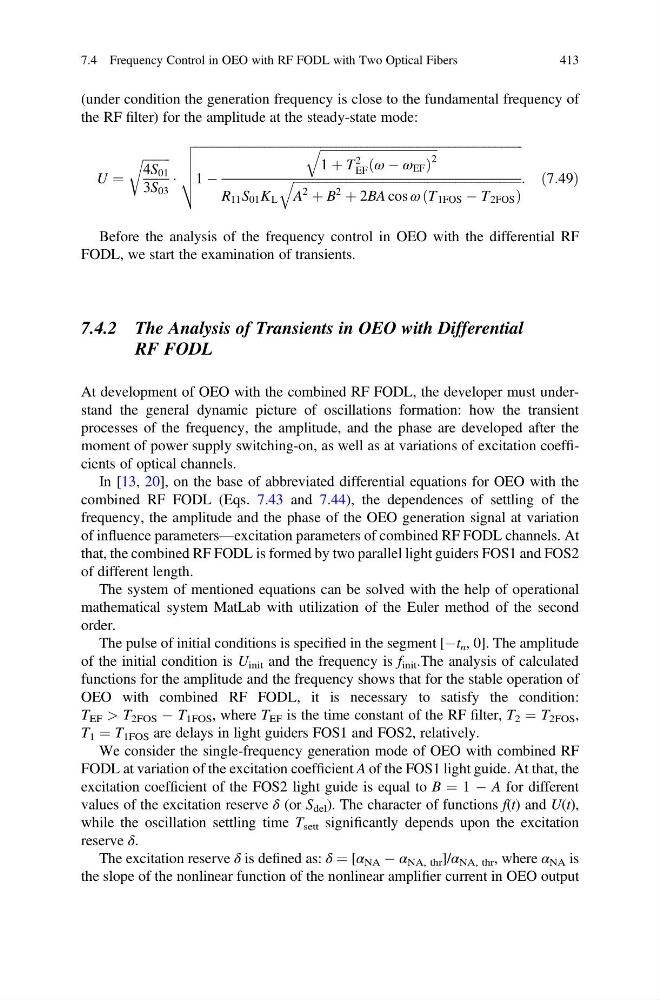
(under condition the generation frequency is close to the fundamental frequency of
the RF filter) for the amplitude at the steady-state mode:
U ¼
ffiffiffiffiffiffiffiffi ffi
4S 01
3S 03
r
Á
ffiffiffiffiffiffiffiffiffiffiffiffiffiffiffiffiffiffiffiffiffiffiffiffiffiffiffiffiffiffiffiffiffiffiffiffiffiffiffiffiffiffiffiffiffiffiffiffiffiffiffiffiffiffiffiffiffiffiffiffiffiffiffiffiffiffiffiffiffiffiffiffiffiffiffiffiffiffiffiffiffiffiffiffiffiffiffiffiffiffiffiffiffiffiffiffiffiffiffiffiffiffiffiffi ffi
1 À
ffiffiffiffiffiffiffiffiffiffiffiffiffiffiffiffiffiffiffiffiffiffiffiffiffiffiffiffiffiffiffiffiffiffiffiffiffiffi
1 þ T
2
EF ω À ω EF
ð
Þ
2
q
R 11 S 01 K L
ffiffiffiffiffiffiffiffiffiffiffiffiffiffiffiffiffiffiffiffiffiffiffiffiffiffiffiffiffiffiffiffiffiffiffiffiffiffiffiffiffiffiffiffiffiffiffiffiffiffiffiffiffiffiffiffiffiffiffiffiffiffiffiffiffiffiffiffiffiffiffiffiffi
A
2
þ B
2
þ 2BA cos ω T 1FOS À T 2FOS
ð
Þ
q
v
u
u
u
t
: ð7:49Þ
Before the analysis of the frequency control in OEO with the differential RF
FODL, we start the examination of transients.
7.4.2 The Analysis of Transients in OEO with Differential
RF FODL
At development of OEO with the combined RF FODL, the developer must understand the general dynamic picture of oscillations formation: how the transient
processes of the frequency, the amplitude, and the phase are developed after the
moment of power supply switching-on, as well as at variations of excitation coefficients of optical channels.
In [13, 20], on the base of abbreviated differential equations for OEO with the
combined RF FODL (Eqs. 7.43 and 7.44), the dependences of settling of the
frequency, the amplitude and the phase of the OEO generation signal at variation
of influence parameters—excitation parameters of combined RF FODL channels. At
that, the combined RF FODL is formed by two parallel light guiders FOS1 and FOS2
of different length.
The system of mentioned equations can be solved with the help of operational
mathematical system MatLab with utilization of the Euler method of the second
order.
The pulse of initial conditions is specified in the segment [Àt n , 0]. The amplitude
of the initial condition is U init and the frequency is f init .The analysis of calculated
functions for the amplitude and the frequency shows that for the stable operation of
OEO with combined RF FODL, it is necessary to satisfy the condition:
T EF > T 2FOS À T 1FOS , where T EF is the time constant of the RF filter, T 2 ¼ T 2FOS ,
T 1 ¼ T 1FOS are delays in light guiders FOS1 and FOS2, relatively.
We consider the single-frequency generation mode of OEO with combined RF
FODL at variation of the excitation coefficient A of the FOS1 light guide. At that, the
excitation coefficient of the FOS2 light guide is equal to B ¼ 1 À A for different
values of the excitation reserve δ (or S del ). The character of functions f(t) and U(t),
while the oscillation settling time T sett significantly depends upon the excitation
reserve δ.
The excitation reserve δ is defined as: δ ¼ [α NA À α NA, thr ]/α NA, thr , where α NA is
the slope of the nonlinear function of the nonlinear amplifier current in OEO output
7.4 Frequency Control in OEO with RF FODL with Two Optical Fibers
413
the RF filter) for the amplitude at the steady-state mode:
U ¼
ffiffiffiffiffiffiffiffi ffi
4S 01
3S 03
r
Á
ffiffiffiffiffiffiffiffiffiffiffiffiffiffiffiffiffiffiffiffiffiffiffiffiffiffiffiffiffiffiffiffiffiffiffiffiffiffiffiffiffiffiffiffiffiffiffiffiffiffiffiffiffiffiffiffiffiffiffiffiffiffiffiffiffiffiffiffiffiffiffiffiffiffiffiffiffiffiffiffiffiffiffiffiffiffiffiffiffiffiffiffiffiffiffiffiffiffiffiffiffiffiffiffi ffi
1 À
ffiffiffiffiffiffiffiffiffiffiffiffiffiffiffiffiffiffiffiffiffiffiffiffiffiffiffiffiffiffiffiffiffiffiffiffiffiffi
1 þ T
2
EF ω À ω EF
ð
Þ
2
q
R 11 S 01 K L
ffiffiffiffiffiffiffiffiffiffiffiffiffiffiffiffiffiffiffiffiffiffiffiffiffiffiffiffiffiffiffiffiffiffiffiffiffiffiffiffiffiffiffiffiffiffiffiffiffiffiffiffiffiffiffiffiffiffiffiffiffiffiffiffiffiffiffiffiffiffiffiffiffi
A
2
þ B
2
þ 2BA cos ω T 1FOS À T 2FOS
ð
Þ
q
v
u
u
u
t
: ð7:49Þ
Before the analysis of the frequency control in OEO with the differential RF
FODL, we start the examination of transients.
7.4.2 The Analysis of Transients in OEO with Differential
RF FODL
At development of OEO with the combined RF FODL, the developer must understand the general dynamic picture of oscillations formation: how the transient
processes of the frequency, the amplitude, and the phase are developed after the
moment of power supply switching-on, as well as at variations of excitation coefficients of optical channels.
In [13, 20], on the base of abbreviated differential equations for OEO with the
combined RF FODL (Eqs. 7.43 and 7.44), the dependences of settling of the
frequency, the amplitude and the phase of the OEO generation signal at variation
of influence parameters—excitation parameters of combined RF FODL channels. At
that, the combined RF FODL is formed by two parallel light guiders FOS1 and FOS2
of different length.
The system of mentioned equations can be solved with the help of operational
mathematical system MatLab with utilization of the Euler method of the second
order.
The pulse of initial conditions is specified in the segment [Àt n , 0]. The amplitude
of the initial condition is U init and the frequency is f init .The analysis of calculated
functions for the amplitude and the frequency shows that for the stable operation of
OEO with combined RF FODL, it is necessary to satisfy the condition:
T EF > T 2FOS À T 1FOS , where T EF is the time constant of the RF filter, T 2 ¼ T 2FOS ,
T 1 ¼ T 1FOS are delays in light guiders FOS1 and FOS2, relatively.
We consider the single-frequency generation mode of OEO with combined RF
FODL at variation of the excitation coefficient A of the FOS1 light guide. At that, the
excitation coefficient of the FOS2 light guide is equal to B ¼ 1 À A for different
values of the excitation reserve δ (or S del ). The character of functions f(t) and U(t),
while the oscillation settling time T sett significantly depends upon the excitation
reserve δ.
The excitation reserve δ is defined as: δ ¼ [α NA À α NA, thr ]/α NA, thr , where α NA is
the slope of the nonlinear function of the nonlinear amplifier current in OEO output
7.4 Frequency Control in OEO with RF FODL with Two Optical Fibers
413