

7.2.7 The Model of Nonsymmetrical Waveguides in MZ
Optical Channels
The above-considered theoretical model is used for mathematical modeling of fields
in passive nonsymmetrical waveguides. The permittivity is specified by the expression (Eq. 7.9), and the geometrical dimensions in the waveguide transverse section
are shown in Fig. 7.6b, c. For calculation of the field in the waveguide transverse
section in the near field, we used the expression (Eq. 7.32). Two nonsymmetrical
optical waveguides Ch1 and Сh2 were excited in the input by the source with finite
dimensions.
In waveguides Ch1 and Сh2, relatively, two oscillations propagated, which
correspond to expression (Eq. 7.2) and had the following spatial coordinates:
E 1L (t, h, y, x) ¼ |E 1L (h, y, x)| cos [2πν Á t + φ 0L1 (h, y, x)]; and with phase shift π/2
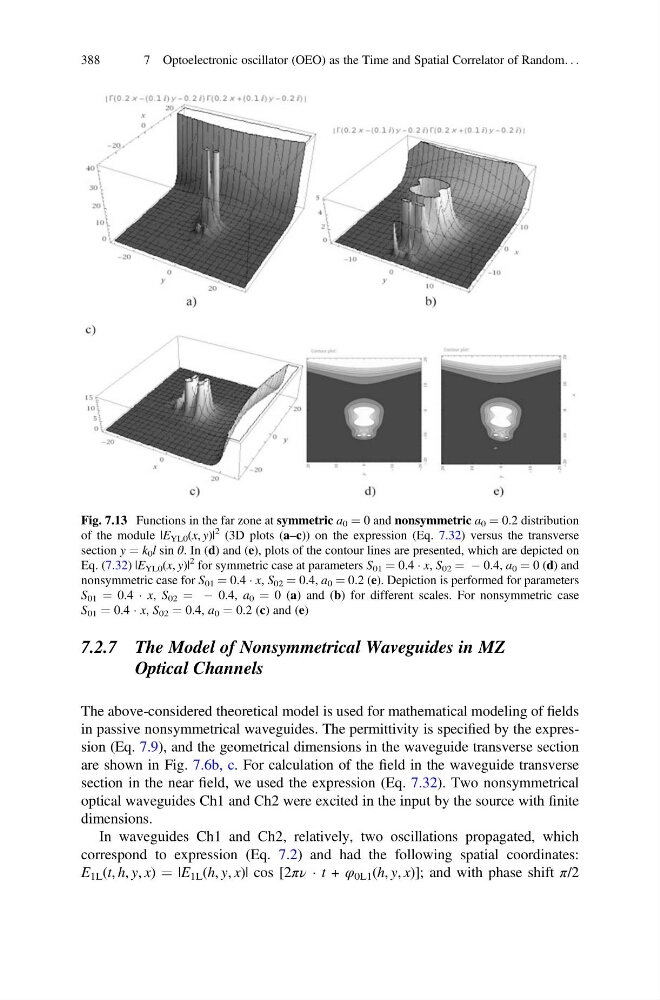
Fig. 7.13 Functions in the far zone at symmetric a 0 ¼ 0 and nonsymmetric a 0 ¼ 0.2 distribution
of the module |E YL0 (x, y)|
2 (3D plots (a–c)) on the expression (Eq. 7.32) versus the transverse
section y ¼ k 0 l sin θ. In (d) and (e), plots of the contour lines are presented, which are depicted on
Eq. (7.32) |E YL0 (x, y)|
2 for symmetric case at parameters S 01 ¼ 0.4 Á x, S 02 ¼ À 0.4, a 0 ¼ 0 (d) and
nonsymmetric case for S 01 ¼ 0.4 Á x, S 02 ¼ 0.4, a 0 ¼ 0.2 (e). Depiction is performed for parameters
S 01 ¼ 0.4 Á x, S 02 ¼ À 0.4, a 0 ¼ 0 (a) and (b) for different scales. For nonsymmetric case
S 01 ¼ 0.4 Á x, S 02 ¼ 0.4, a 0 ¼ 0.2 (c) and (e)
388
7 Optoelectronic oscillator (OEO) as the Time and Spatial Correlator of Random. . .
Optical Channels
The above-considered theoretical model is used for mathematical modeling of fields
in passive nonsymmetrical waveguides. The permittivity is specified by the expression (Eq. 7.9), and the geometrical dimensions in the waveguide transverse section
are shown in Fig. 7.6b, c. For calculation of the field in the waveguide transverse
section in the near field, we used the expression (Eq. 7.32). Two nonsymmetrical
optical waveguides Ch1 and Сh2 were excited in the input by the source with finite
dimensions.
In waveguides Ch1 and Сh2, relatively, two oscillations propagated, which
correspond to expression (Eq. 7.2) and had the following spatial coordinates:
E 1L (t, h, y, x) ¼ |E 1L (h, y, x)| cos [2πν Á t + φ 0L1 (h, y, x)]; and with phase shift π/2
Fig. 7.13 Functions in the far zone at symmetric a 0 ¼ 0 and nonsymmetric a 0 ¼ 0.2 distribution
of the module |E YL0 (x, y)|
2 (3D plots (a–c)) on the expression (Eq. 7.32) versus the transverse
section y ¼ k 0 l sin θ. In (d) and (e), plots of the contour lines are presented, which are depicted on
Eq. (7.32) |E YL0 (x, y)|
2 for symmetric case at parameters S 01 ¼ 0.4 Á x, S 02 ¼ À 0.4, a 0 ¼ 0 (d) and
nonsymmetric case for S 01 ¼ 0.4 Á x, S 02 ¼ 0.4, a 0 ¼ 0.2 (e). Depiction is performed for parameters
S 01 ¼ 0.4 Á x, S 02 ¼ À 0.4, a 0 ¼ 0 (a) and (b) for different scales. For nonsymmetric case
S 01 ¼ 0.4 Á x, S 02 ¼ 0.4, a 0 ¼ 0.2 (c) and (e)
388
7 Optoelectronic oscillator (OEO) as the Time and Spatial Correlator of Random. . .