

laser with the external electro-optical modulator is, for example, the Mach–Zehnder
modulator (Figs. 6.1 and 6.2).
The laser optical emission (the carrier) passes to the input of the optical modulator
(MZ), in which the emission is modulated by the electrical signal u ¼ u RF (t). Then
the optical emission passes to the photodetector (PD) input through the optical
modulator and FOS. RF oscillations (the subcarrier) obtained in the PD output
pass through the nonlinear amplifier (NA), the frequency-selective filter (F) and
are directed in this loop system through the directional coupler (C) to the microwave
input of the MZ modulator.
In the OEO system, when the self-excitation conditions are satisfied, in the RF
part of such an oscillator, the RF oscillations arise u ¼ u RF (t). At that, to the RF input
of MZ from the NA output through C, the RF signal is applied during the oscillation
generation process and the instantaneous voltage of this signal is:
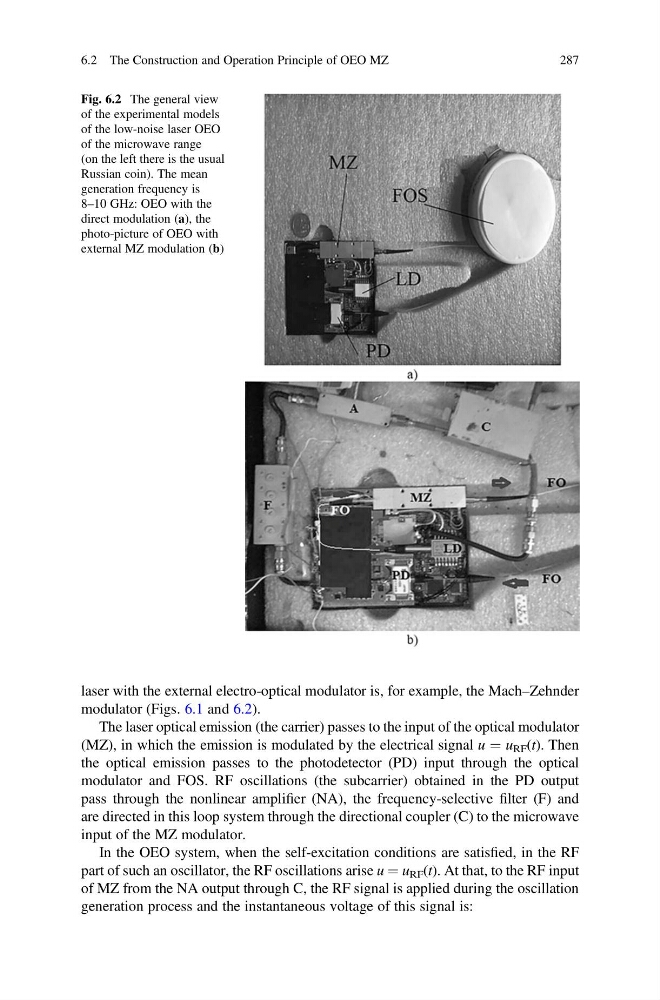
Fig. 6.2 The general view
of the experimental models
of the low-noise laser OEO
of the microwave range
(on the left there is the usual
Russian coin). The mean
generation frequency is
8–10 GHz: OEO with the
direct modulation (a), the
photo-picture of OEO with
external MZ modulation (b)
6.2 The Construction and Operation Principle of OEO MZ
287
modulator (Figs. 6.1 and 6.2).
The laser optical emission (the carrier) passes to the input of the optical modulator
(MZ), in which the emission is modulated by the electrical signal u ¼ u RF (t). Then
the optical emission passes to the photodetector (PD) input through the optical
modulator and FOS. RF oscillations (the subcarrier) obtained in the PD output
pass through the nonlinear amplifier (NA), the frequency-selective filter (F) and
are directed in this loop system through the directional coupler (C) to the microwave
input of the MZ modulator.
In the OEO system, when the self-excitation conditions are satisfied, in the RF
part of such an oscillator, the RF oscillations arise u ¼ u RF (t). At that, to the RF input
of MZ from the NA output through C, the RF signal is applied during the oscillation
generation process and the instantaneous voltage of this signal is:
Fig. 6.2 The general view
of the experimental models
of the low-noise laser OEO
of the microwave range
(on the left there is the usual
Russian coin). The mean
generation frequency is
8–10 GHz: OEO with the
direct modulation (a), the
photo-picture of OEO with
external MZ modulation (b)
6.2 The Construction and Operation Principle of OEO MZ
287