

of 1 kHz, allow the conclusion that OEO is the secondary frequency standard and
already now, it competes with the low-noise microwave oscillators with the dielectric resonators on the sapphire crystals on generation frequencies 8–70 GHz. At
present, the methods of the phase stabilization of OEO oscillations are developed. At
the same time, the problem of the laser (or the laser diode) optical emission
influence, which is the base element of OEO, upon the spectral characteristics of
OEO RF generation is not enough studied.
In this Section, we perform the analysis of OEO operation with the electro-optical
Mach–Zehnder modulator with the purpose to obtain in this structure the extremely
low RF phase noises. At first, we investigate the features of the structure and
characteristics of the MZ modulator. We emphasize that in this section, ОЕО MZ
is examined as the system of two different types of oscillators—the optical quantum
oscillator (OQO) with the generation frequency about v 0 ¼ 200 THz and the RF
oscillator (RFO) with the generation frequency f 0 ¼ 4–100 GHz. At that, OQO is the
“pumping source” for RFO.
6.2 The Construction and Operation Principle of OEO MZ
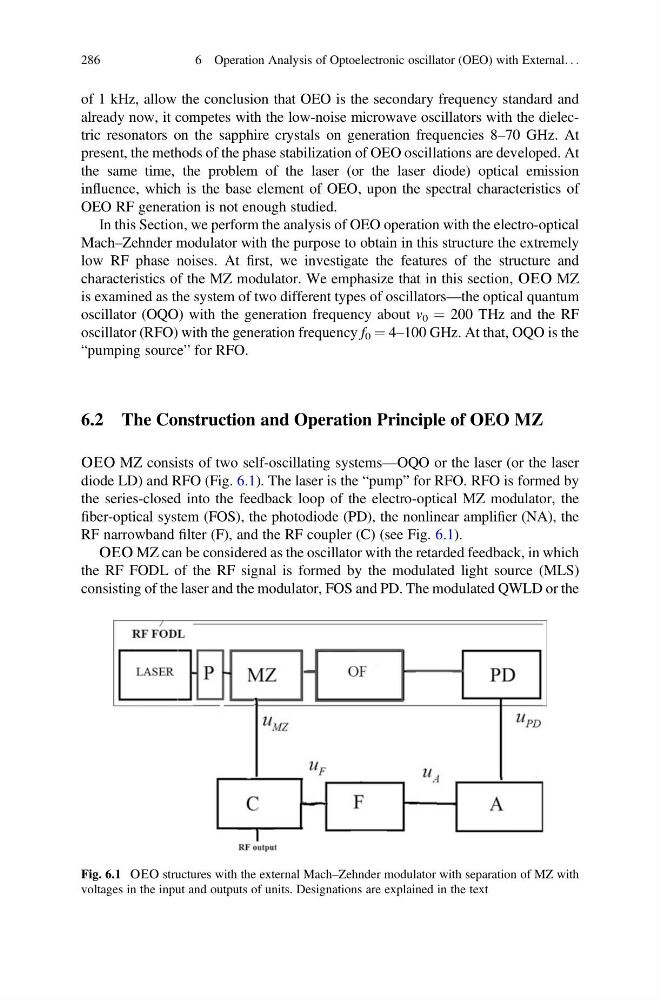
ОЕО MZ consists of two self-oscillating systems—OQO or the laser (or the laser
diode LD) and RFO (Fig. 6.1). The laser is the “pump” for RFO. RFO is formed by
the series-closed into the feedback loop of the electro-optical MZ modulator, the
fiber-optical system (FOS), the photodiode (PD), the nonlinear amplifier (NA), the
RF narrowband filter (F), and the RF coupler (C) (see Fig. 6.1).
ОЕО MZ can be considered as the oscillator with the retarded feedback, in which
the RF FODL of the RF signal is formed by the modulated light source (MLS)
consisting of the laser and the modulator, FOS and PD. The modulated QWLD or the
Fig. 6.1 ОЕО structures with the external Mach–Zehnder modulator with separation of MZ with
voltages in the input and outputs of units. Designations are explained in the text
286
6 Operation Analysis of Optoelectronic oscillator (OEO) with External. . .
already now, it competes with the low-noise microwave oscillators with the dielectric resonators on the sapphire crystals on generation frequencies 8–70 GHz. At
present, the methods of the phase stabilization of OEO oscillations are developed. At
the same time, the problem of the laser (or the laser diode) optical emission
influence, which is the base element of OEO, upon the spectral characteristics of
OEO RF generation is not enough studied.
In this Section, we perform the analysis of OEO operation with the electro-optical
Mach–Zehnder modulator with the purpose to obtain in this structure the extremely
low RF phase noises. At first, we investigate the features of the structure and
characteristics of the MZ modulator. We emphasize that in this section, ОЕО MZ
is examined as the system of two different types of oscillators—the optical quantum
oscillator (OQO) with the generation frequency about v 0 ¼ 200 THz and the RF
oscillator (RFO) with the generation frequency f 0 ¼ 4–100 GHz. At that, OQO is the
“pumping source” for RFO.
6.2 The Construction and Operation Principle of OEO MZ
ОЕО MZ consists of two self-oscillating systems—OQO or the laser (or the laser
diode LD) and RFO (Fig. 6.1). The laser is the “pump” for RFO. RFO is formed by
the series-closed into the feedback loop of the electro-optical MZ modulator, the
fiber-optical system (FOS), the photodiode (PD), the nonlinear amplifier (NA), the
RF narrowband filter (F), and the RF coupler (C) (see Fig. 6.1).
ОЕО MZ can be considered as the oscillator with the retarded feedback, in which
the RF FODL of the RF signal is formed by the modulated light source (MLS)
consisting of the laser and the modulator, FOS and PD. The modulated QWLD or the
Fig. 6.1 ОЕО structures with the external Mach–Zehnder modulator with separation of MZ with
voltages in the input and outputs of units. Designations are explained in the text
286
6 Operation Analysis of Optoelectronic oscillator (OEO) with External. . .