

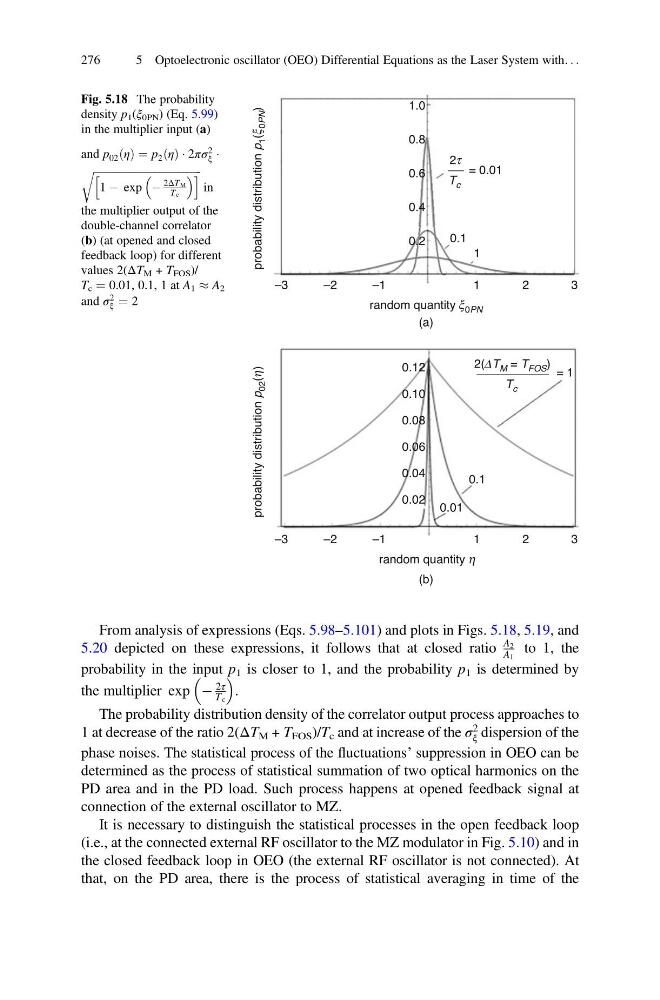
From analysis of expressions (Eqs. 5.98–5.101) and plots in Figs. 5.18, 5.19, and
5.20 depicted on these expressions, it follows that at closed ratio
A 2
A 1
to 1, the
probability in the input p 1 is closer to 1, and the probability p 1 is determined by
the multiplier exp À
2τ
T c
.
The probability distribution density of the correlator output process approaches to
1 at decrease of the ratio 2(ΔT M + T FOS )/T c and at increase of the σ
2
ξ dispersion of the
phase noises. The statistical process of the fluctuations’ suppression in OEO can be
determined as the process of statistical summation of two optical harmonics on the
PD area and in the PD load. Such process happens at opened feedback signal at
connection of the external oscillator to MZ.
It is necessary to distinguish the statistical processes in the open feedback loop
(i.e., at the connected external RF oscillator to the MZ modulator in Fig. 5.10) and in
the closed feedback loop in OEO (the external RF oscillator is not connected). At
that, on the PD area, there is the process of statistical averaging in time of the
2
1
–1
0.8
= 0.01
2τ
T c
0.6
0.4
0.1
1
0.2
1.0
random quantity ξ 0PN
(a)
(b)
probability distribution p
1 (ξ
0PN )
–2
–3
3
2
1
–1
0.08
= 1
2(ΔT M = T FOS )
T c
0.06
0.04
0.1
0.01
0.02
0.10
0.12
random quantity η
probability distribution p
02 (η)
–2
–3
3
Fig. 5.18 The probability
density p 1 (ξ 0PN ) (Eq. 5.99)
in the multiplier input (a)
and p 02 η
ð Þ ¼ p 2 η
ð Þ Á 2πσ
2
ξ Á
ffiffiffiffiffiffiffiffiffiffiffiffiffiffiffiffiffiffiffiffiffiffiffiffiffiffiffiffiffiffiffiffiffiffiffiffiffiffiffiffi ffi
1 À exp À
2ΔTM
Tc
h
i
r
in
the multiplier output of the
double-channel correlator
(b) (at opened and closed
feedback loop) for different
values 2(ΔT M + T FOS )/
T c ¼ 0.01, 0.1, 1 at A 1 % A 2
and σ
2
ξ ¼ 2
276
5 Optoelectronic oscillator (OEO) Differential Equations as the Laser System with. . .
5.20 depicted on these expressions, it follows that at closed ratio
A 2
A 1
to 1, the
probability in the input p 1 is closer to 1, and the probability p 1 is determined by
the multiplier exp À
2τ
T c
.
The probability distribution density of the correlator output process approaches to
1 at decrease of the ratio 2(ΔT M + T FOS )/T c and at increase of the σ
2
ξ dispersion of the
phase noises. The statistical process of the fluctuations’ suppression in OEO can be
determined as the process of statistical summation of two optical harmonics on the
PD area and in the PD load. Such process happens at opened feedback signal at
connection of the external oscillator to MZ.
It is necessary to distinguish the statistical processes in the open feedback loop
(i.e., at the connected external RF oscillator to the MZ modulator in Fig. 5.10) and in
the closed feedback loop in OEO (the external RF oscillator is not connected). At
that, on the PD area, there is the process of statistical averaging in time of the
2
1
–1
0.8
= 0.01
2τ
T c
0.6
0.4
0.1
1
0.2
1.0
random quantity ξ 0PN
(a)
(b)
probability distribution p
1 (ξ
0PN )
–2
–3
3
2
1
–1
0.08
= 1
2(ΔT M = T FOS )
T c
0.06
0.04
0.1
0.01
0.02
0.10
0.12
random quantity η
probability distribution p
02 (η)
–2
–3
3
Fig. 5.18 The probability
density p 1 (ξ 0PN ) (Eq. 5.99)
in the multiplier input (a)
and p 02 η
ð Þ ¼ p 2 η
ð Þ Á 2πσ
2
ξ Á
ffiffiffiffiffiffiffiffiffiffiffiffiffiffiffiffiffiffiffiffiffiffiffiffiffiffiffiffiffiffiffiffiffiffiffiffiffiffiffiffi ffi
1 À exp À
2ΔTM
Tc
h
i
r
in
the multiplier output of the
double-channel correlator
(b) (at opened and closed
feedback loop) for different
values 2(ΔT M + T FOS )/
T c ¼ 0.01, 0.1, 1 at A 1 % A 2
and σ
2
ξ ¼ 2
276
5 Optoelectronic oscillator (OEO) Differential Equations as the Laser System with. . .