

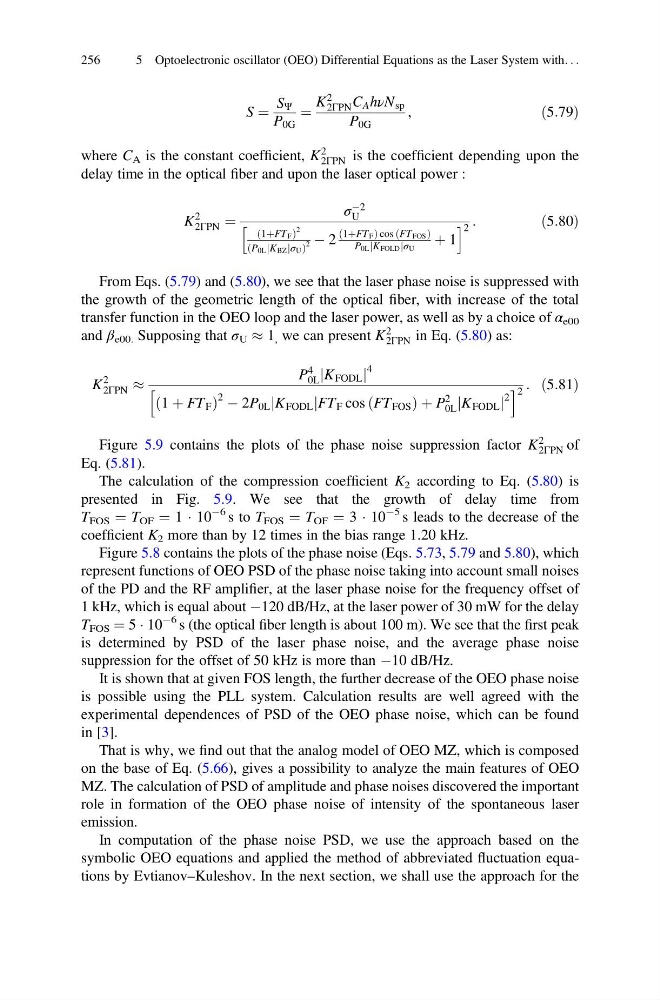
S ¼
S Ψ
P 0G
¼
K
2
2ΓPN C A hνN sp
P 0G
,
ð5:79Þ
where C A is the constant coefficient, K
2
2ΓPN is the coefficient depending upon the
delay time in the optical fiber and upon the laser optical power :
K
2
2ΓPN ¼
σ
À2
U
1þFT F
ð
Þ
2
P 0L K BZ
j
jσ U
ð
Þ
2 À 2
1þFT F
ð
Þcos FT FOS
ð
Þ
P 0L K FOLD
j
j σ U
þ 1
h
i 2 :
ð5:80Þ
From Eqs. (5.79) and (5.80), we see that the laser phase noise is suppressed with
the growth of the geometric length of the optical fiber, with increase of the total
transfer function in the OEO loop and the laser power, as well as by a choice of α e00
and β e00. Supposing that σ U % 1 , we can present K
2
2ΓPN in Eq. (5.80) as:
K
2
2ΓPN %
P
4
0L K FODL
j
j
4
1 þ FT F
ð
Þ
2 À 2P 0L K FODL
j
jFT F cos FT FOS
ð
ÞþP
2
0L K FODL
j
j
2
h
i 2 : ð5:81Þ
Figure 5.9 contains the plots of the phase noise suppression factor K
2
2ΓPN of
Eq. (5.81).
The calculation of the compression coefficient K 2 according to Eq. (5.80) is
presented in Fig. 5.9. We see that the growth of delay time from
T FOS ¼ T OF ¼ 1 Á 10
À6 s to T FOS ¼ T OF ¼ 3 Á 10
À5 s leads to the decrease of the
coefficient K 2 more than by 12 times in the bias range 1.20 kHz.
Figure 5.8 contains the plots of the phase noise (Eqs. 5.73, 5.79 and 5.80), which
represent functions of OEO PSD of the phase noise taking into account small noises
of the PD and the RF amplifier, at the laser phase noise for the frequency offset of
1 kHz, which is equal about À120 dB/Hz, at the laser power of 30 mW for the delay
T FOS ¼ 5 Á 10
À6 s (the optical fiber length is about 100 m). We see that the first peak
is determined by PSD of the laser phase noise, and the average phase noise
suppression for the offset of 50 kHz is more than À10 dB/Hz.
It is shown that at given FOS length, the further decrease of the OEO phase noise
is possible using the PLL system. Calculation results are well agreed with the
experimental dependences of PSD of the OEO phase noise, which can be found
in [3].
That is why, we find out that the analog model of OEO MZ, which is composed
on the base of Eq. (5.66), gives a possibility to analyze the main features of OEO
MZ. The calculation of PSD of amplitude and phase noises discovered the important
role in formation of the OEO phase noise of intensity of the spontaneous laser
emission.
In computation of the phase noise PSD, we use the approach based on the
symbolic OEO equations and applied the method of abbreviated fluctuation equations by Evtianov–Kuleshov. In the next section, we shall use the approach for the
256
5 Optoelectronic oscillator (OEO) Differential Equations as the Laser System with. . .
S Ψ
P 0G
¼
K
2
2ΓPN C A hνN sp
P 0G
,
ð5:79Þ
where C A is the constant coefficient, K
2
2ΓPN is the coefficient depending upon the
delay time in the optical fiber and upon the laser optical power :
K
2
2ΓPN ¼
σ
À2
U
1þFT F
ð
Þ
2
P 0L K BZ
j
jσ U
ð
Þ
2 À 2
1þFT F
ð
Þcos FT FOS
ð
Þ
P 0L K FOLD
j
j σ U
þ 1
h
i 2 :
ð5:80Þ
From Eqs. (5.79) and (5.80), we see that the laser phase noise is suppressed with
the growth of the geometric length of the optical fiber, with increase of the total
transfer function in the OEO loop and the laser power, as well as by a choice of α e00
and β e00. Supposing that σ U % 1 , we can present K
2
2ΓPN in Eq. (5.80) as:
K
2
2ΓPN %
P
4
0L K FODL
j
j
4
1 þ FT F
ð
Þ
2 À 2P 0L K FODL
j
jFT F cos FT FOS
ð
ÞþP
2
0L K FODL
j
j
2
h
i 2 : ð5:81Þ
Figure 5.9 contains the plots of the phase noise suppression factor K
2
2ΓPN of
Eq. (5.81).
The calculation of the compression coefficient K 2 according to Eq. (5.80) is
presented in Fig. 5.9. We see that the growth of delay time from
T FOS ¼ T OF ¼ 1 Á 10
À6 s to T FOS ¼ T OF ¼ 3 Á 10
À5 s leads to the decrease of the
coefficient K 2 more than by 12 times in the bias range 1.20 kHz.
Figure 5.8 contains the plots of the phase noise (Eqs. 5.73, 5.79 and 5.80), which
represent functions of OEO PSD of the phase noise taking into account small noises
of the PD and the RF amplifier, at the laser phase noise for the frequency offset of
1 kHz, which is equal about À120 dB/Hz, at the laser power of 30 mW for the delay
T FOS ¼ 5 Á 10
À6 s (the optical fiber length is about 100 m). We see that the first peak
is determined by PSD of the laser phase noise, and the average phase noise
suppression for the offset of 50 kHz is more than À10 dB/Hz.
It is shown that at given FOS length, the further decrease of the OEO phase noise
is possible using the PLL system. Calculation results are well agreed with the
experimental dependences of PSD of the OEO phase noise, which can be found
in [3].
That is why, we find out that the analog model of OEO MZ, which is composed
on the base of Eq. (5.66), gives a possibility to analyze the main features of OEO
MZ. The calculation of PSD of amplitude and phase noises discovered the important
role in formation of the OEO phase noise of intensity of the spontaneous laser
emission.
In computation of the phase noise PSD, we use the approach based on the
symbolic OEO equations and applied the method of abbreviated fluctuation equations by Evtianov–Kuleshov. In the next section, we shall use the approach for the
256
5 Optoelectronic oscillator (OEO) Differential Equations as the Laser System with. . .