

opened OEO loop, T FODL % T FOS is the total oscillations delay time in the opened
OEO loop including the delay in FOS, y M is the normalized input electrical conductance of the MZ modulator.
If we consider the case for Eq. (5.73), when the imaginary part Y aIm ¼ 0, P 0L |
K FODL | % 1 and there is the small delay, i.e., cos
2 (FT L ) % 1. We recall, that here, we
consider the case of generation of the first harmonic in the OEO MZ, and accordingly, the first harmonic of the voltage acts on the electrical input of MZ. Then the
expression for PSD (Eq. 5.73) takes the classic form:
S ¼
S PLIm
1 þ T F F À α e00 þ β e00 P 0G
ð
Þ
2
%
S PLIm
P 0G T F F
ð
Þ
2
:
ð5:76Þ
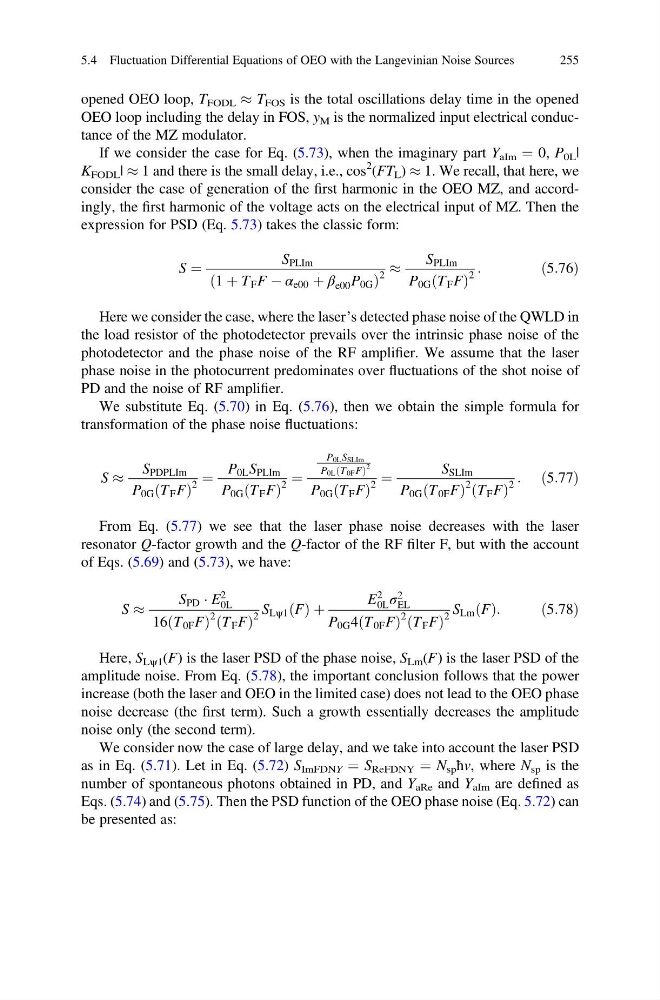
Here we consider the case, where the laser’s detected phase noise of the QWLD in
the load resistor of the photodetector prevails over the intrinsic phase noise of the
photodetector and the phase noise of the RF amplifier. We assume that the laser
phase noise in the photocurrent predominates over fluctuations of the shot noise of
PD and the noise of RF amplifier.
We substitute Eq. (5.70) in Eq. (5.76), then we obtain the simple formula for
transformation of the phase noise fluctuations:
S %
S PDPLIm
P 0G T F F
ð
Þ
2
¼
P 0L S PLIm
P 0G T F F
ð
Þ
2
¼
P 0L S SLIm
P 0L T 0F F
ð
Þ
2
P 0G T F F
ð
Þ
2
¼
S SLIm
P 0G T 0F F
ð
Þ
2 T F F
ð
Þ
2
: ð5:77Þ
From Eq. (5.77) we see that the laser phase noise decreases with the laser
resonator Q-factor growth and the Q-factor of the RF filter F, but with the account
of Eqs. (5.69) and (5.73), we have:
S %
S PD Á E
2
0L
16 T 0F F
ð
Þ
2 T F F
ð
Þ
2
S Lψ1 F
ð Þ þ
E
2
0L σ
2
EL
P 0G 4 T 0F F
ð
Þ
2 T F F
ð
Þ
2
S Lm F
ð Þ:
ð5:78Þ
Here, S Lψ1 (F) is the laser PSD of the phase noise, S Lm (F) is the laser PSD of the
amplitude noise. From Eq. (5.78), the important conclusion follows that the power
increase (both the laser and OEO in the limited case) does not lead to the OEO phase
noise decrease (the first term). Such a growth essentially decreases the amplitude
noise only (the second term).
We consider now the case of large delay, and we take into account the laser PSD
as in Eq. (5.71). Let in Eq. (5.72) S ImFDNY ¼ S ReFDNY ¼ N sp ħv, where N sp is the
number of spontaneous photons obtained in PD, and Y aRe and Y aIm are defined as
Eqs. (5.74) and (5.75). Then the PSD function of the OEO phase noise (Eq. 5.72) can
be presented as:
5.4 Fluctuation Differential Equations of OEO with the Langevinian Noise Sources
255
OEO loop including the delay in FOS, y M is the normalized input electrical conductance of the MZ modulator.
If we consider the case for Eq. (5.73), when the imaginary part Y aIm ¼ 0, P 0L |
K FODL | % 1 and there is the small delay, i.e., cos
2 (FT L ) % 1. We recall, that here, we
consider the case of generation of the first harmonic in the OEO MZ, and accordingly, the first harmonic of the voltage acts on the electrical input of MZ. Then the
expression for PSD (Eq. 5.73) takes the classic form:
S ¼
S PLIm
1 þ T F F À α e00 þ β e00 P 0G
ð
Þ
2
%
S PLIm
P 0G T F F
ð
Þ
2
:
ð5:76Þ
Here we consider the case, where the laser’s detected phase noise of the QWLD in
the load resistor of the photodetector prevails over the intrinsic phase noise of the
photodetector and the phase noise of the RF amplifier. We assume that the laser
phase noise in the photocurrent predominates over fluctuations of the shot noise of
PD and the noise of RF amplifier.
We substitute Eq. (5.70) in Eq. (5.76), then we obtain the simple formula for
transformation of the phase noise fluctuations:
S %
S PDPLIm
P 0G T F F
ð
Þ
2
¼
P 0L S PLIm
P 0G T F F
ð
Þ
2
¼
P 0L S SLIm
P 0L T 0F F
ð
Þ
2
P 0G T F F
ð
Þ
2
¼
S SLIm
P 0G T 0F F
ð
Þ
2 T F F
ð
Þ
2
: ð5:77Þ
From Eq. (5.77) we see that the laser phase noise decreases with the laser
resonator Q-factor growth and the Q-factor of the RF filter F, but with the account
of Eqs. (5.69) and (5.73), we have:
S %
S PD Á E
2
0L
16 T 0F F
ð
Þ
2 T F F
ð
Þ
2
S Lψ1 F
ð Þ þ
E
2
0L σ
2
EL
P 0G 4 T 0F F
ð
Þ
2 T F F
ð
Þ
2
S Lm F
ð Þ:
ð5:78Þ
Here, S Lψ1 (F) is the laser PSD of the phase noise, S Lm (F) is the laser PSD of the
amplitude noise. From Eq. (5.78), the important conclusion follows that the power
increase (both the laser and OEO in the limited case) does not lead to the OEO phase
noise decrease (the first term). Such a growth essentially decreases the amplitude
noise only (the second term).
We consider now the case of large delay, and we take into account the laser PSD
as in Eq. (5.71). Let in Eq. (5.72) S ImFDNY ¼ S ReFDNY ¼ N sp ħv, where N sp is the
number of spontaneous photons obtained in PD, and Y aRe and Y aIm are defined as
Eqs. (5.74) and (5.75). Then the PSD function of the OEO phase noise (Eq. 5.72) can
be presented as:
5.4 Fluctuation Differential Equations of OEO with the Langevinian Noise Sources
255