

The first equation in Eq. (5.67) has a feature consisting in the fact that it reminds
on the form of well-studied equations in the radio electronic double-circuit autonomous oscillator with the arc-wise cubic characteristic of the nonlinear inertial
element of AC voltage as the function of the current. But, coefficients included in
Eq. (5.67) are expressed through AC components of the laser physical quantities: the
population, the dipole moment, the lifetime on the upper operation level, the time
constant of the laser optical filter, Langevinian sources of the optical noise, the
polarization.
The transfer from Eq. (5.67) to differential abbreviated equations permits not only
to determinate of the laser power |E 0L |
2 in the steady-state mode as E 0L
j j
2 ¼
α 00
β 00
Â
1 À
1
α 00 β 00
, but also to record abbreviated equations with fluctuations, from which
we below obtain expressions for PSD of phase and amplitude noises. At that, the
laser emission intensity is determined by expression E 0L
j j
2 ¼
α 00
β 00
1 À
1
α 00 β 00
. Thus,
the coefficient (α 00 /β 00 ) has the clear physical sense for lasers. The larger the
amplitude of the output optical oscillation and the higher a ratio of time constant
of the laser optical filter to the carrier lifetime on the upper operation level, then the
higher a ratio of the relative excess of population and its level at excitation.
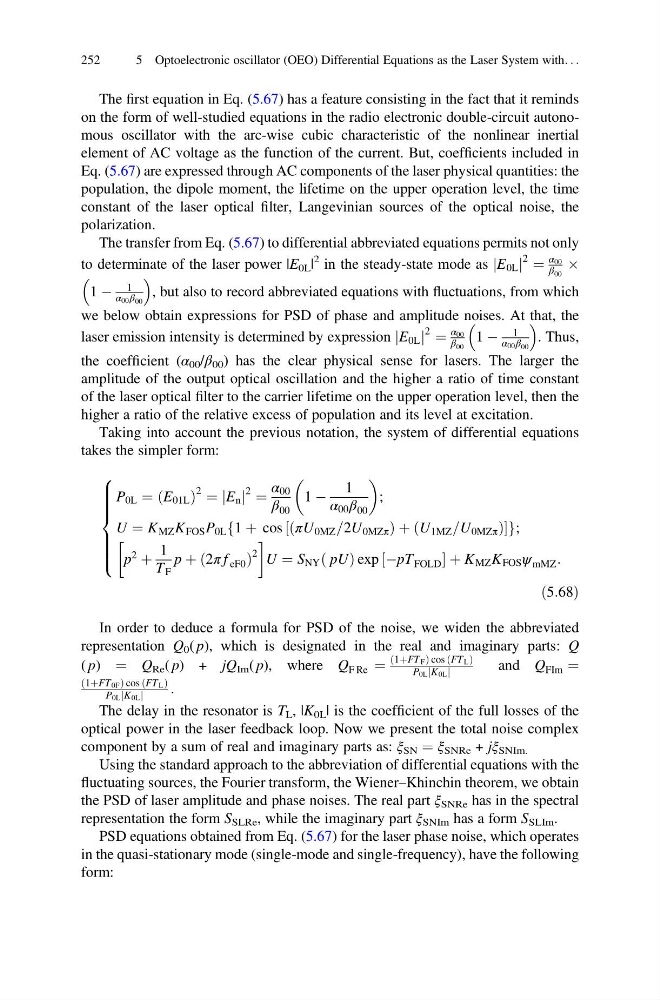
Taking into account the previous notation, the system of differential equations
takes the simpler form:
P 0L ¼ E 01L
ð
Þ
2 ¼ E n
j j
2 ¼
α 00
β 00
1 À
1
α 00 β 00
;
U ¼ K MZ K FOS P 0L 1 þ cos πU 0MZ =2U 0MZπ
ð
Þ þU 1MZ =U 0MZπ
ð
Þ
½
f
g ;
p
2
þ
1
T F
p þ 2π f eF0
ð
Þ
2
!
U ¼ S NY pU
ð
Þexp ÀpT FOLD
½
þK MZ K FOS ψ mMZ :
8
> > > > > <
> > > > > :
ð5:68Þ
In order to deduce a formula for PSD of the noise, we widen the abbreviated
representation Q 0 ( p), which is designated in the real and imaginary parts: Q
( p) ¼ Q Re ( p) + jQ Im ( p), where Q F Re ¼
1þFT F
ð
Þcos FT L
ð
Þ
P 0L K 0L
j
j
and Q FIm ¼
1þFT 0F
ð
Þ cos FT L
ð
Þ
P 0L K 0L
j
j
:
The delay in the resonator is T L , |K 0L | is the coefficient of the full losses of the
optical power in the laser feedback loop. Now we present the total noise complex
component by a sum of real and imaginary parts as: ξ SN ¼ ξ SNRe + jξ SNIm.
Using the standard approach to the abbreviation of differential equations with the
fluctuating sources, the Fourier transform, the Wiener–Khinchin theorem, we obtain
the PSD of laser amplitude and phase noises. The real part ξ SNRe has in the spectral
representation the form S SLRe , while the imaginary part ξ SNIm has a form S SLIm .
PSD equations obtained from Eq. (5.67) for the laser phase noise, which operates
in the quasi-stationary mode (single-mode and single-frequency), have the following
form:
252
5 Optoelectronic oscillator (OEO) Differential Equations as the Laser System with. . .
on the form of well-studied equations in the radio electronic double-circuit autonomous oscillator with the arc-wise cubic characteristic of the nonlinear inertial
element of AC voltage as the function of the current. But, coefficients included in
Eq. (5.67) are expressed through AC components of the laser physical quantities: the
population, the dipole moment, the lifetime on the upper operation level, the time
constant of the laser optical filter, Langevinian sources of the optical noise, the
polarization.
The transfer from Eq. (5.67) to differential abbreviated equations permits not only
to determinate of the laser power |E 0L |
2 in the steady-state mode as E 0L
j j
2 ¼
α 00
β 00
Â
1 À
1
α 00 β 00
, but also to record abbreviated equations with fluctuations, from which
we below obtain expressions for PSD of phase and amplitude noises. At that, the
laser emission intensity is determined by expression E 0L
j j
2 ¼
α 00
β 00
1 À
1
α 00 β 00
. Thus,
the coefficient (α 00 /β 00 ) has the clear physical sense for lasers. The larger the
amplitude of the output optical oscillation and the higher a ratio of time constant
of the laser optical filter to the carrier lifetime on the upper operation level, then the
higher a ratio of the relative excess of population and its level at excitation.
Taking into account the previous notation, the system of differential equations
takes the simpler form:
P 0L ¼ E 01L
ð
Þ
2 ¼ E n
j j
2 ¼
α 00
β 00
1 À
1
α 00 β 00
;
U ¼ K MZ K FOS P 0L 1 þ cos πU 0MZ =2U 0MZπ
ð
Þ þU 1MZ =U 0MZπ
ð
Þ
½
f
g ;
p
2
þ
1
T F
p þ 2π f eF0
ð
Þ
2
!
U ¼ S NY pU
ð
Þexp ÀpT FOLD
½
þK MZ K FOS ψ mMZ :
8
> > > > > <
> > > > > :
ð5:68Þ
In order to deduce a formula for PSD of the noise, we widen the abbreviated
representation Q 0 ( p), which is designated in the real and imaginary parts: Q
( p) ¼ Q Re ( p) + jQ Im ( p), where Q F Re ¼
1þFT F
ð
Þcos FT L
ð
Þ
P 0L K 0L
j
j
and Q FIm ¼
1þFT 0F
ð
Þ cos FT L
ð
Þ
P 0L K 0L
j
j
:
The delay in the resonator is T L , |K 0L | is the coefficient of the full losses of the
optical power in the laser feedback loop. Now we present the total noise complex
component by a sum of real and imaginary parts as: ξ SN ¼ ξ SNRe + jξ SNIm.
Using the standard approach to the abbreviation of differential equations with the
fluctuating sources, the Fourier transform, the Wiener–Khinchin theorem, we obtain
the PSD of laser amplitude and phase noises. The real part ξ SNRe has in the spectral
representation the form S SLRe , while the imaginary part ξ SNIm has a form S SLIm .
PSD equations obtained from Eq. (5.67) for the laser phase noise, which operates
in the quasi-stationary mode (single-mode and single-frequency), have the following
form:
252
5 Optoelectronic oscillator (OEO) Differential Equations as the Laser System with. . .