

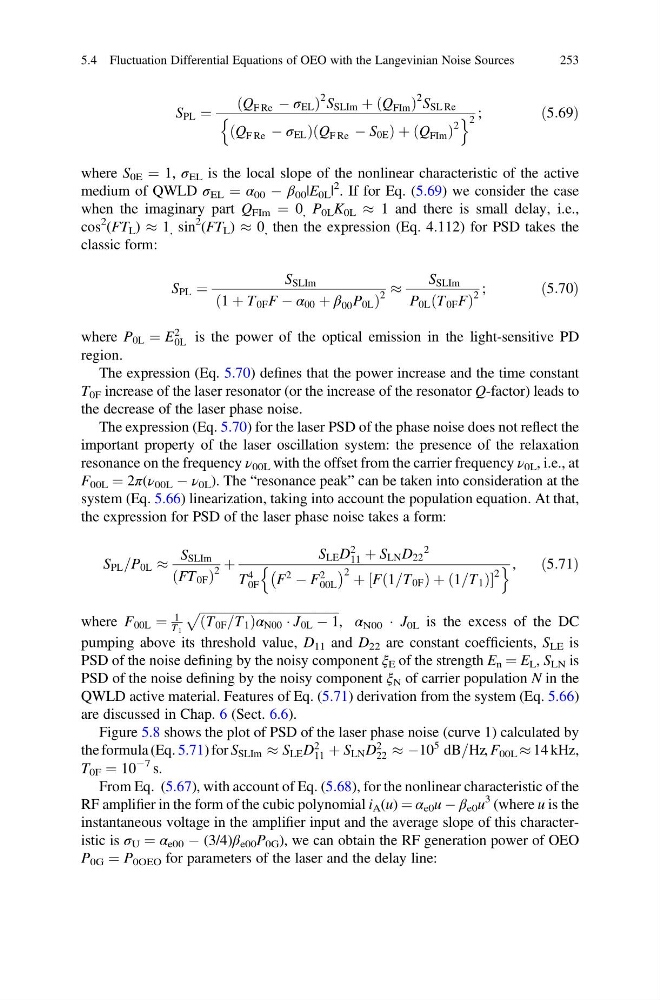
S PL ¼
Q F Re À σ EL
ð
Þ
2 S SLIm þ Q FIm
ð
Þ
2 S SL Re
Q F Re À σ EL
ð
ÞQ F Re À S 0E
ð
Þþ Q FIm
ð
Þ
2
n
o 2 ;
ð5:69Þ
where S 0E ¼ 1, σ EL is the local slope of the nonlinear characteristic of the active
medium of QWLD σ EL ¼ α 00 À β 00 |E 0L |
2 . If for Eq. (5.69) we consider the case
when the imaginary part Q FIm ¼ 0 , P 0L K 0L % 1 and there is small delay, i.e.,
cos
2 (FT L ) % 1 , sin
2 (FT L ) % 0 , then the expression (Eq. 4.112) for PSD takes the
classic form:
S PL ¼
S SLIm
1 þ T 0F F À α 00 þ β 00 P 0L
ð
Þ
2
%
S SLIm
P 0L T 0F F
ð
Þ
2
;
ð5:70Þ
where P 0L ¼ E
2
0L is the power of the optical emission in the light-sensitive PD
region.
The expression (Eq. 5.70) defines that the power increase and the time constant
T 0F increase of the laser resonator (or the increase of the resonator Q-factor) leads to
the decrease of the laser phase noise.
The expression (Eq. 5.70) for the laser PSD of the phase noise does not reflect the
important property of the laser oscillation system: the presence of the relaxation
resonance on the frequency ν 00L with the offset from the carrier frequency ν 0L , i.e., at
F 00L ¼ 2π(ν 00L À ν 0L ). The “resonance peak” can be taken into consideration at the
system (Eq. 5.66) linearization, taking into account the population equation. At that,
the expression for PSD of the laser phase noise takes a form:
S PL =P 0L %
S SLIm
FT 0F
ð
Þ
2
þ
S LE D
2
11 þ S LN D 22
2
T
4
0F
F
2
À F
2
00L
À
Á 2 þ F 1=T 0F
ð
Þþ 1=T 1
ð
Þ
½
2
n
o ,
ð5:71Þ
where F 00L ¼
1
T 1
ffiffiffiffiffiffiffiffiffiffiffiffiffiffiffiffiffiffiffiffiffiffiffiffiffiffiffiffiffiffiffiffiffiffiffiffiffiffiffiffiffiffiffiffiffi
T 0F =T 1
ð
Þα N00 Á J 0L À 1
p
, α N00 Á J 0L is the excess of the DC
pumping above its threshold value, D 11 and D 22 are constant coefficients, S LE is
PSD of the noise defining by the noisy component ξ E of the strength E n ¼ E L , S LN is
PSD of the noise defining by the noisy component ξ N of carrier population N in the
QWLD active material. Features of Eq. (5.71) derivation from the system (Eq. 5.66)
are discussed in Chap. 6 (Sect. 6.6).
Figure 5.8 shows the plot of PSD of the laser phase noise (curve 1) calculated by
the formula (Eq. 5.71) for S SLIm % S LE D
2
11 þ S LN D
2
22 % À10
5 dB=Hz, F 00L % 14 kHz,
T 0F ¼ 10
À7 s.
From Eq. (5.67), with account of Eq. (5.68), for the nonlinear characteristic of the
RF amplifier in the form of the cubic polynomial i A (u) ¼ α e0 u À β e0 u
3 (where u is the
instantaneous voltage in the amplifier input and the average slope of this characteristic is σ U ¼ α e00 À (3/4)β e00 P 0G ), we can obtain the RF generation power of OEO
P 0G ¼ P 0OEO for parameters of the laser and the delay line:
5.4 Fluctuation Differential Equations of OEO with the Langevinian Noise Sources
253
Q F Re À σ EL
ð
Þ
2 S SLIm þ Q FIm
ð
Þ
2 S SL Re
Q F Re À σ EL
ð
ÞQ F Re À S 0E
ð
Þþ Q FIm
ð
Þ
2
n
o 2 ;
ð5:69Þ
where S 0E ¼ 1, σ EL is the local slope of the nonlinear characteristic of the active
medium of QWLD σ EL ¼ α 00 À β 00 |E 0L |
2 . If for Eq. (5.69) we consider the case
when the imaginary part Q FIm ¼ 0 , P 0L K 0L % 1 and there is small delay, i.e.,
cos
2 (FT L ) % 1 , sin
2 (FT L ) % 0 , then the expression (Eq. 4.112) for PSD takes the
classic form:
S PL ¼
S SLIm
1 þ T 0F F À α 00 þ β 00 P 0L
ð
Þ
2
%
S SLIm
P 0L T 0F F
ð
Þ
2
;
ð5:70Þ
where P 0L ¼ E
2
0L is the power of the optical emission in the light-sensitive PD
region.
The expression (Eq. 5.70) defines that the power increase and the time constant
T 0F increase of the laser resonator (or the increase of the resonator Q-factor) leads to
the decrease of the laser phase noise.
The expression (Eq. 5.70) for the laser PSD of the phase noise does not reflect the
important property of the laser oscillation system: the presence of the relaxation
resonance on the frequency ν 00L with the offset from the carrier frequency ν 0L , i.e., at
F 00L ¼ 2π(ν 00L À ν 0L ). The “resonance peak” can be taken into consideration at the
system (Eq. 5.66) linearization, taking into account the population equation. At that,
the expression for PSD of the laser phase noise takes a form:
S PL =P 0L %
S SLIm
FT 0F
ð
Þ
2
þ
S LE D
2
11 þ S LN D 22
2
T
4
0F
F
2
À F
2
00L
À
Á 2 þ F 1=T 0F
ð
Þþ 1=T 1
ð
Þ
½
2
n
o ,
ð5:71Þ
where F 00L ¼
1
T 1
ffiffiffiffiffiffiffiffiffiffiffiffiffiffiffiffiffiffiffiffiffiffiffiffiffiffiffiffiffiffiffiffiffiffiffiffiffiffiffiffiffiffiffiffiffi
T 0F =T 1
ð
Þα N00 Á J 0L À 1
p
, α N00 Á J 0L is the excess of the DC
pumping above its threshold value, D 11 and D 22 are constant coefficients, S LE is
PSD of the noise defining by the noisy component ξ E of the strength E n ¼ E L , S LN is
PSD of the noise defining by the noisy component ξ N of carrier population N in the
QWLD active material. Features of Eq. (5.71) derivation from the system (Eq. 5.66)
are discussed in Chap. 6 (Sect. 6.6).
Figure 5.8 shows the plot of PSD of the laser phase noise (curve 1) calculated by
the formula (Eq. 5.71) for S SLIm % S LE D
2
11 þ S LN D
2
22 % À10
5 dB=Hz, F 00L % 14 kHz,
T 0F ¼ 10
À7 s.
From Eq. (5.67), with account of Eq. (5.68), for the nonlinear characteristic of the
RF amplifier in the form of the cubic polynomial i A (u) ¼ α e0 u À β e0 u
3 (where u is the
instantaneous voltage in the amplifier input and the average slope of this characteristic is σ U ¼ α e00 À (3/4)β e00 P 0G ), we can obtain the RF generation power of OEO
P 0G ¼ P 0OEO for parameters of the laser and the delay line:
5.4 Fluctuation Differential Equations of OEO with the Langevinian Noise Sources
253