

the value of noise sources, but to increase the Q-factor of the optical resonator. The
growth of the resonator Q-factor will significantly decrease of the laser modulation
band in radio frequency. The excessive increase of the optical resonator Q-factor
leads in OEO DM (Fig. 5.6a) to decrease of the oscillation amplitude. In OEO MZ,
the external modulation is used. The optical modulation index does not depend upon
the growth of the optical resonator Q-factor. The increase of optical resonator Qfactor will lead to improvement of the oscillation spectrum purity or to decrease of
the laser phase noise. Another principal peculiarity, which can be deduced from the
analysis of the presented analog model of OEO MZ (Fig. 5.6b) is the fact that carrier
fluctuations’ suppression can be performed in the feedback loop of population. The
increase of the time constant of the carrier lifetime on the upper energy level T 1 also
leads to significant decrease of the laser phase noise. In the OEO MZ structure, we
have a possibility to use the high-coherent fiber-optical lasers with the large carrier
lifetime of T 1 ¼ 0.1 – 100 μs. As we mentioned earlier, the compact modern ОЕО
MZ uses the semiconductor QWLD with the spectral line width from 1 kHz to
10 MHz. The compact commercial samples of the semiconductor lasers appeared
with the spectral line width of 10–500 Hz.
Let us transfer to simplification of the differential equation system (Eq. 5.66) with
the aim to obtain the evident results for PSD of amplitude and phase noises for
OEO MZ.
5.4.7.1 Differential Fluctuation Equations for OEO MZ
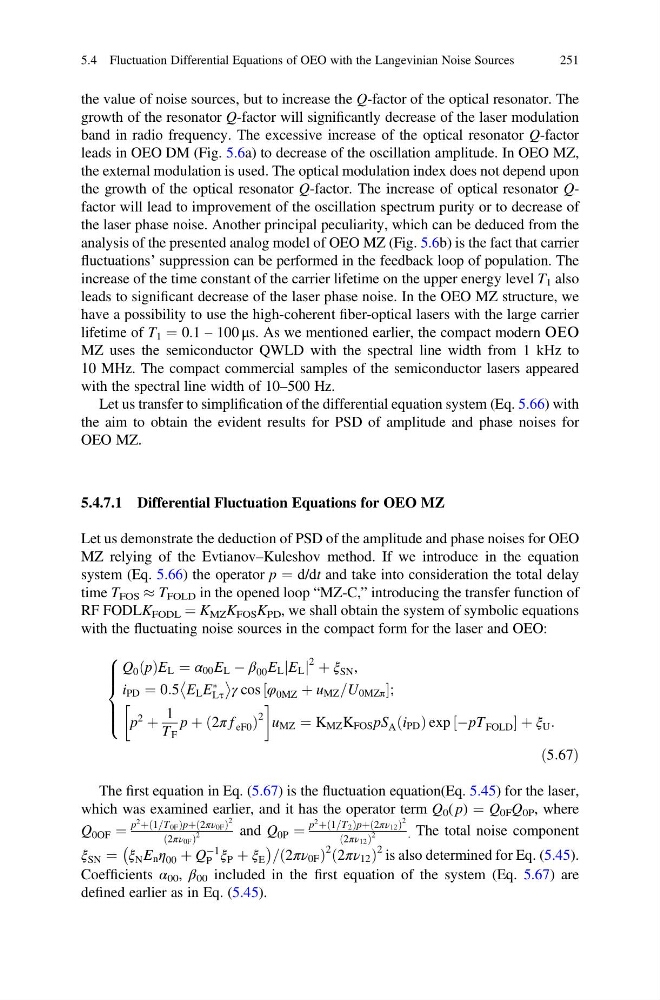
Let us demonstrate the deduction of PSD of the amplitude and phase noises for OEO
MZ relying of the Evtianov–Kuleshov method. If we introduce in the equation
system (Eq. 5.66) the operator p ¼ d/dt and take into consideration the total delay
time T FOS % T FOLD in the opened loop “MZ-C,” introducing the transfer function of
RF FODLK FODL ¼ K MZ K FOS K PD , we shall obtain the system of symbolic equations
with the fluctuating noise sources in the compact form for the laser and OEO:
Q 0 p
ð ÞE L ¼ α 00 E L À β 00 E L E L
j j
2 þ ξ SN ,
i PD ¼ 0:5 E L E
Ã
Lτ
γ cos φ 0MZ þ u MZ =U 0MZπ
½
;
p
2
þ
1
T F
p þ 2π f eF0
ð
Þ
2
!
u MZ ¼ K MZ K FOS pS A i PD
ð Þexp ÀpT FOLD
½
þξ U :
8
> > > <
> > > :
ð5:67Þ
The first equation in Eq. (5.67) is the fluctuation equation(Eq. 5.45) for the laser,
which was examined earlier, and it has the operator term Q 0 ( p) ¼ Q 0F Q 0P , where
Q 0OF ¼
p
2 þ 1=T 0F
ð
Þ pþ 2πν 0F
ð
Þ
2
2πν 0F
ð
Þ
2
and Q 0P ¼
p
2 þ 1=T 2
ð
Þpþ 2πν 12
ð
Þ
2
2πν 12
ð
Þ
2
. The total noise component
ξ SN ¼ ξ N E n η 00 þ Q
À1
P ξ P þ ξ E
À
Á = 2πν 0F
ð
Þ
2 2πν 12
ð
Þ
2 is also determined for Eq. (5.45).
Coefficients α 00 , β 00 included in the first equation of the system (Eq. 5.67) are
defined earlier as in Eq. (5.45).
5.4 Fluctuation Differential Equations of OEO with the Langevinian Noise Sources
251
growth of the resonator Q-factor will significantly decrease of the laser modulation
band in radio frequency. The excessive increase of the optical resonator Q-factor
leads in OEO DM (Fig. 5.6a) to decrease of the oscillation amplitude. In OEO MZ,
the external modulation is used. The optical modulation index does not depend upon
the growth of the optical resonator Q-factor. The increase of optical resonator Qfactor will lead to improvement of the oscillation spectrum purity or to decrease of
the laser phase noise. Another principal peculiarity, which can be deduced from the
analysis of the presented analog model of OEO MZ (Fig. 5.6b) is the fact that carrier
fluctuations’ suppression can be performed in the feedback loop of population. The
increase of the time constant of the carrier lifetime on the upper energy level T 1 also
leads to significant decrease of the laser phase noise. In the OEO MZ structure, we
have a possibility to use the high-coherent fiber-optical lasers with the large carrier
lifetime of T 1 ¼ 0.1 – 100 μs. As we mentioned earlier, the compact modern ОЕО
MZ uses the semiconductor QWLD with the spectral line width from 1 kHz to
10 MHz. The compact commercial samples of the semiconductor lasers appeared
with the spectral line width of 10–500 Hz.
Let us transfer to simplification of the differential equation system (Eq. 5.66) with
the aim to obtain the evident results for PSD of amplitude and phase noises for
OEO MZ.
5.4.7.1 Differential Fluctuation Equations for OEO MZ
Let us demonstrate the deduction of PSD of the amplitude and phase noises for OEO
MZ relying of the Evtianov–Kuleshov method. If we introduce in the equation
system (Eq. 5.66) the operator p ¼ d/dt and take into consideration the total delay
time T FOS % T FOLD in the opened loop “MZ-C,” introducing the transfer function of
RF FODLK FODL ¼ K MZ K FOS K PD , we shall obtain the system of symbolic equations
with the fluctuating noise sources in the compact form for the laser and OEO:
Q 0 p
ð ÞE L ¼ α 00 E L À β 00 E L E L
j j
2 þ ξ SN ,
i PD ¼ 0:5 E L E
Ã
Lτ
γ cos φ 0MZ þ u MZ =U 0MZπ
½
;
p
2
þ
1
T F
p þ 2π f eF0
ð
Þ
2
!
u MZ ¼ K MZ K FOS pS A i PD
ð Þexp ÀpT FOLD
½
þξ U :
8
> > > <
> > > :
ð5:67Þ
The first equation in Eq. (5.67) is the fluctuation equation(Eq. 5.45) for the laser,
which was examined earlier, and it has the operator term Q 0 ( p) ¼ Q 0F Q 0P , where
Q 0OF ¼
p
2 þ 1=T 0F
ð
Þ pþ 2πν 0F
ð
Þ
2
2πν 0F
ð
Þ
2
and Q 0P ¼
p
2 þ 1=T 2
ð
Þpþ 2πν 12
ð
Þ
2
2πν 12
ð
Þ
2
. The total noise component
ξ SN ¼ ξ N E n η 00 þ Q
À1
P ξ P þ ξ E
À
Á = 2πν 0F
ð
Þ
2 2πν 12
ð
Þ
2 is also determined for Eq. (5.45).
Coefficients α 00 , β 00 included in the first equation of the system (Eq. 5.67) are
defined earlier as in Eq. (5.45).
5.4 Fluctuation Differential Equations of OEO with the Langevinian Noise Sources
251