

μ
2
opt E
3
10n þ 6πμ opt Á Δν Á E
2
10n þ Δν
2
þ
1
Q
2
0F
E 10n ¼ E 100in :
ð4:78Þ
which in our variables x ¼ E 10n and s ¼ j(ν/ν 0F ) has a form: μ
2
opt x
3
Æ 6πμ opt s Á
x
2
þ xs
2
¼ E 100in . For the whispering-gallery modes: μ opt ¼
6Á2πν
8n 2 χ
3
ð Þ , where χ
(3) is
the susceptibility of the optical resonator material, n is the refraction index of the
resonator material, ν is the laser optical frequency.
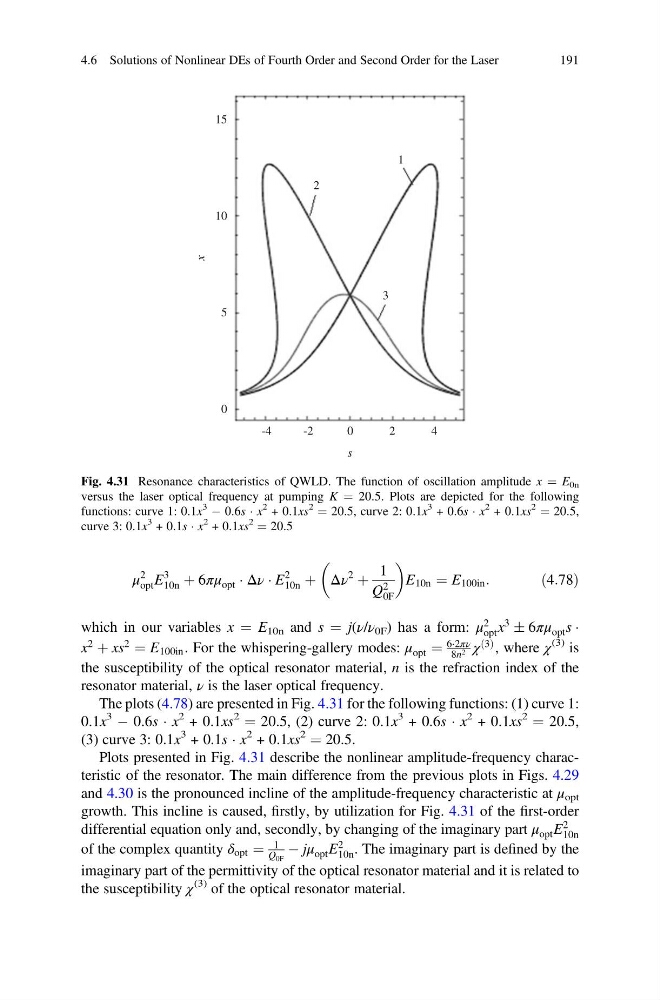
The plots (4.78) are presented in Fig. 4.31 for the following functions: (1) curve 1:
0.1x
3
À 0.6s Á x
2 + 0.1xs
2
¼ 20.5, (2) curve 2: 0.1x
3 + 0.6s Á x
2 + 0.1xs
2
¼ 20.5,
(3) curve 3: 0.1x
3 + 0.1s Á x
2 + 0.1xs
2 ¼ 20.5.
Plots presented in Fig. 4.31 describe the nonlinear amplitude-frequency characteristic of the resonator. The main difference from the previous plots in Figs. 4.29
and 4.30 is the pronounced incline of the amplitude-frequency characteristic at μ opt
growth. This incline is caused, firstly, by utilization for Fig. 4.31 of the first-order
differential equation only and, secondly, by changing of the imaginary part μ opt E
2
10n
of the complex quantity δ opt ¼
1
Q 0F
À jμ opt E
2
10n . The imaginary part is defined by the
imaginary part of the permittivity of the optical resonator material and it is related to
the susceptibility χ
(3) of the optical resonator material.
15
10
2
3
1
5
x
0
-4
-2
0
s
2
4
Fig. 4.31 Resonance characteristics of QWLD. The function of oscillation amplitude x ¼ E 0n
versus the laser optical frequency at pumping K ¼ 20.5. Plots are depicted for the following
functions: curve 1: 0.1x
3 À 0.6s Á x
2 + 0.1xs
2 ¼ 20.5, curve 2: 0.1x
3 + 0.6s Á x
2 + 0.1xs
2 ¼ 20.5,
curve 3: 0.1x
3 + 0.1s Á x
2 + 0.1xs
2 ¼ 20.5
4.6 Solutions of Nonlinear DEs of Fourth Order and Second Order for the Laser
191
2
opt E
3
10n þ 6πμ opt Á Δν Á E
2
10n þ Δν
2
þ
1
Q
2
0F
E 10n ¼ E 100in :
ð4:78Þ
which in our variables x ¼ E 10n and s ¼ j(ν/ν 0F ) has a form: μ
2
opt x
3
Æ 6πμ opt s Á
x
2
þ xs
2
¼ E 100in . For the whispering-gallery modes: μ opt ¼
6Á2πν
8n 2 χ
3
ð Þ , where χ
(3) is
the susceptibility of the optical resonator material, n is the refraction index of the
resonator material, ν is the laser optical frequency.
The plots (4.78) are presented in Fig. 4.31 for the following functions: (1) curve 1:
0.1x
3
À 0.6s Á x
2 + 0.1xs
2
¼ 20.5, (2) curve 2: 0.1x
3 + 0.6s Á x
2 + 0.1xs
2
¼ 20.5,
(3) curve 3: 0.1x
3 + 0.1s Á x
2 + 0.1xs
2 ¼ 20.5.
Plots presented in Fig. 4.31 describe the nonlinear amplitude-frequency characteristic of the resonator. The main difference from the previous plots in Figs. 4.29
and 4.30 is the pronounced incline of the amplitude-frequency characteristic at μ opt
growth. This incline is caused, firstly, by utilization for Fig. 4.31 of the first-order
differential equation only and, secondly, by changing of the imaginary part μ opt E
2
10n
of the complex quantity δ opt ¼
1
Q 0F
À jμ opt E
2
10n . The imaginary part is defined by the
imaginary part of the permittivity of the optical resonator material and it is related to
the susceptibility χ
(3) of the optical resonator material.
15
10
2
3
1
5
x
0
-4
-2
0
s
2
4
Fig. 4.31 Resonance characteristics of QWLD. The function of oscillation amplitude x ¼ E 0n
versus the laser optical frequency at pumping K ¼ 20.5. Plots are depicted for the following
functions: curve 1: 0.1x
3 À 0.6s Á x
2 + 0.1xs
2 ¼ 20.5, curve 2: 0.1x
3 + 0.6s Á x
2 + 0.1xs
2 ¼ 20.5,
curve 3: 0.1x
3 + 0.1s Á x
2 + 0.1xs
2 ¼ 20.5
4.6 Solutions of Nonlinear DEs of Fourth Order and Second Order for the Laser
191