

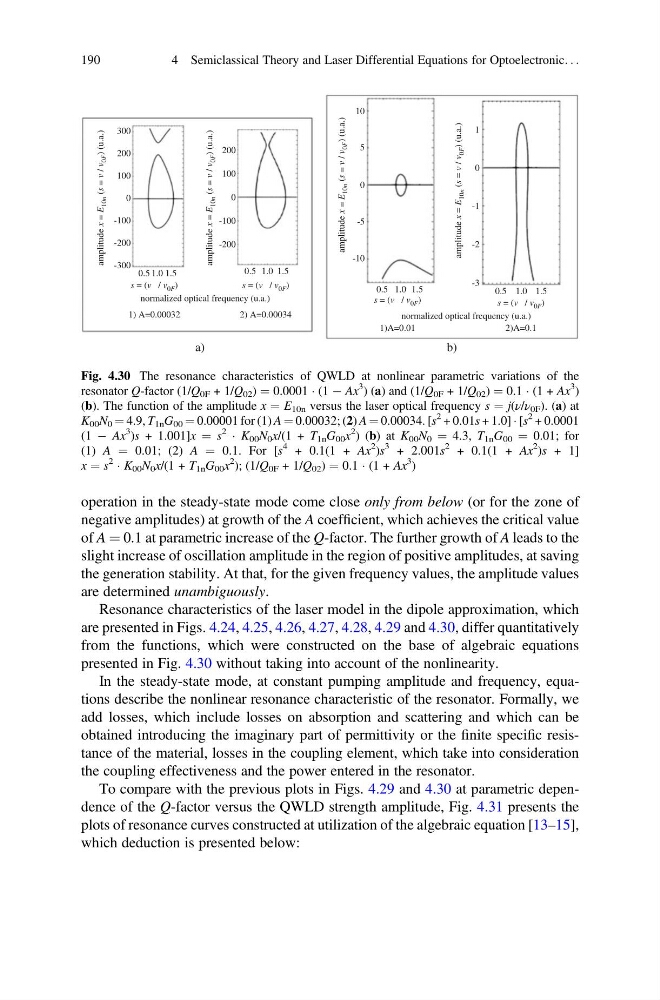
operation in the steady-state mode come close only from below (or for the zone of
negative amplitudes) at growth of the A coefficient, which achieves the critical value
of A ¼ 0.1 at parametric increase of the Q-factor. The further growth of A leads to the
slight increase of oscillation amplitude in the region of positive amplitudes, at saving
the generation stability. At that, for the given frequency values, the amplitude values
are determined unambiguously.
Resonance characteristics of the laser model in the dipole approximation, which
are presented in Figs. 4.24, 4.25, 4.26, 4.27, 4.28, 4.29 and 4.30, differ quantitatively
from the functions, which were constructed on the base of algebraic equations
presented in Fig. 4.30 without taking into account of the nonlinearity.
In the steady-state mode, at constant pumping amplitude and frequency, equations describe the nonlinear resonance characteristic of the resonator. Formally, we
add losses, which include losses on absorption and scattering and which can be
obtained introducing the imaginary part of permittivity or the finite specific resistance of the material, losses in the coupling element, which take into consideration
the coupling effectiveness and the power entered in the resonator.
To compare with the previous plots in Figs. 4.29 and 4.30 at parametric dependence of the Q-factor versus the QWLD strength amplitude, Fig. 4.31 presents the
plots of resonance curves constructed at utilization of the algebraic equation [13–15],
which deduction is presented below:
300
200
100
0
-100
-200
-300
0.5 1.0 1.5
200
10
5
0
-5
1
0
-1
-2
-3
-10
100
0
-100
-200
0.5 1.0 1.5
s = (v / v 0F )
s = (v / v 0F )
normalized optical frequency (u.a.)
a)
b)
1) A=0.00032
2) A=0.00034
0.5 1.0 1.5
0.5 1.0 1.5
s = (v / v 0F )
s = (v / v 0F )
normalized optical frequency (u.a.)
1)A=0.01
2)A=0.1
amplitude
x =
E
10n (s =
v /
v
0F ) (u.a.)
amplitude
x =
E
10n (s =
v /
v
0F ) (u.a.)
amplitude
x =
E
10n (s =
v /
v
0F ) (u.a.)
amplitude
x =
E
10n (s =
v /
v
0F ) (u.a.)
Fig. 4.30 The resonance characteristics of QWLD at nonlinear parametric variations of the
resonator Q-factor (1/Q 0F + 1/Q 02 ) ¼ 0.0001 Á (1 À Ax
3
) (a) and (1/Q 0F + 1/Q 02 ) ¼ 0.1 Á (1 + Ax
3
)
(b). The function of the amplitude x ¼ E 10n versus the laser optical frequency s ¼ j(ν/ν 0F ). (a) at
K 00 N 0 ¼ 4.9, T 1n G 00 ¼ 0.00001 for (1) A ¼ 0.00032; (2) A ¼ 0.00034. [s
2 + 0.01s + 1.0] Á [s
2 + 0.0001
(1 À Ax
3
)s + 1.001]x ¼ s
2 Á K 00 N 0 x/(1 + T 1n G 00 x
2
) (b) at K 00 N 0 ¼ 4.3, T 1n G 00 ¼ 0.01; for
(1) A ¼ 0.01; (2) A ¼ 0.1. For [s
4 + 0.1(1 + Ax
2
)s
3 + 2.001s
2 + 0.1(1 + Ax
2
)s + 1]
x ¼ s
2 Á K 00 N 0 x/(1 + T 1n G 00 x
2
); (1/Q 0F + 1/Q 02 ) ¼ 0.1 Á (1 + Ax
3 )
190
4 Semiclassical Theory and Laser Differential Equations for Optoelectronic. . .
negative amplitudes) at growth of the A coefficient, which achieves the critical value
of A ¼ 0.1 at parametric increase of the Q-factor. The further growth of A leads to the
slight increase of oscillation amplitude in the region of positive amplitudes, at saving
the generation stability. At that, for the given frequency values, the amplitude values
are determined unambiguously.
Resonance characteristics of the laser model in the dipole approximation, which
are presented in Figs. 4.24, 4.25, 4.26, 4.27, 4.28, 4.29 and 4.30, differ quantitatively
from the functions, which were constructed on the base of algebraic equations
presented in Fig. 4.30 without taking into account of the nonlinearity.
In the steady-state mode, at constant pumping amplitude and frequency, equations describe the nonlinear resonance characteristic of the resonator. Formally, we
add losses, which include losses on absorption and scattering and which can be
obtained introducing the imaginary part of permittivity or the finite specific resistance of the material, losses in the coupling element, which take into consideration
the coupling effectiveness and the power entered in the resonator.
To compare with the previous plots in Figs. 4.29 and 4.30 at parametric dependence of the Q-factor versus the QWLD strength amplitude, Fig. 4.31 presents the
plots of resonance curves constructed at utilization of the algebraic equation [13–15],
which deduction is presented below:
300
200
100
0
-100
-200
-300
0.5 1.0 1.5
200
10
5
0
-5
1
0
-1
-2
-3
-10
100
0
-100
-200
0.5 1.0 1.5
s = (v / v 0F )
s = (v / v 0F )
normalized optical frequency (u.a.)
a)
b)
1) A=0.00032
2) A=0.00034
0.5 1.0 1.5
0.5 1.0 1.5
s = (v / v 0F )
s = (v / v 0F )
normalized optical frequency (u.a.)
1)A=0.01
2)A=0.1
amplitude
x =
E
10n (s =
v /
v
0F ) (u.a.)
amplitude
x =
E
10n (s =
v /
v
0F ) (u.a.)
amplitude
x =
E
10n (s =
v /
v
0F ) (u.a.)
amplitude
x =
E
10n (s =
v /
v
0F ) (u.a.)
Fig. 4.30 The resonance characteristics of QWLD at nonlinear parametric variations of the
resonator Q-factor (1/Q 0F + 1/Q 02 ) ¼ 0.0001 Á (1 À Ax
3
) (a) and (1/Q 0F + 1/Q 02 ) ¼ 0.1 Á (1 + Ax
3
)
(b). The function of the amplitude x ¼ E 10n versus the laser optical frequency s ¼ j(ν/ν 0F ). (a) at
K 00 N 0 ¼ 4.9, T 1n G 00 ¼ 0.00001 for (1) A ¼ 0.00032; (2) A ¼ 0.00034. [s
2 + 0.01s + 1.0] Á [s
2 + 0.0001
(1 À Ax
3
)s + 1.001]x ¼ s
2 Á K 00 N 0 x/(1 + T 1n G 00 x
2
) (b) at K 00 N 0 ¼ 4.3, T 1n G 00 ¼ 0.01; for
(1) A ¼ 0.01; (2) A ¼ 0.1. For [s
4 + 0.1(1 + Ax
2
)s
3 + 2.001s
2 + 0.1(1 + Ax
2
)s + 1]
x ¼ s
2 Á K 00 N 0 x/(1 + T 1n G 00 x
2
); (1/Q 0F + 1/Q 02 ) ¼ 0.1 Á (1 + Ax
3 )
190
4 Semiclassical Theory and Laser Differential Equations for Optoelectronic. . .