

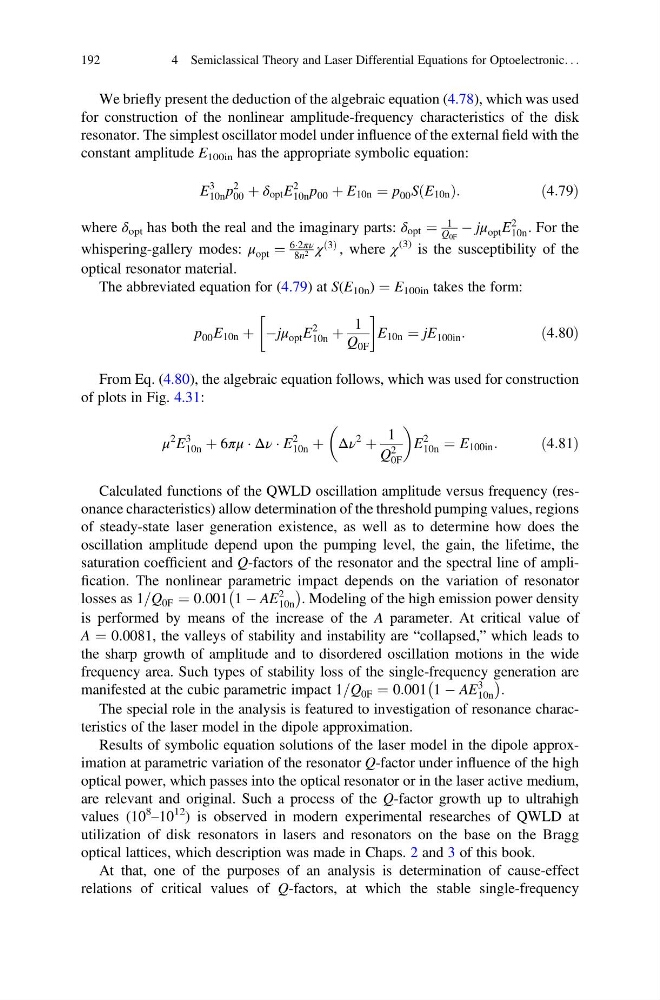
We briefly present the deduction of the algebraic equation (4.78), which was used
for construction of the nonlinear amplitude-frequency characteristics of the disk
resonator. The simplest oscillator model under influence of the external field with the
constant amplitude E 100in has the appropriate symbolic equation:
E
3
10n p
2
00 þ δ opt E
2
10n p 00 þ E 10n ¼ p 00 S E 10n
ð
Þ:
ð4:79Þ
where δ opt has both the real and the imaginary parts: δ opt ¼
1
Q 0F
À jμ opt E
2
10n . For the
whispering-gallery modes: μ opt ¼
6Á2πν
8n 2 χ
3
ð Þ , where χ
(3) is the susceptibility of the
optical resonator material.
The abbreviated equation for (4.79) at S(E 10n ) ¼ E 100in takes the form:
p 00 E 10n þ Àjμ opt E
2
10n þ
1
Q 0F
!
E 10n ¼ jE 100in :
ð4:80Þ
From Eq. (4.80), the algebraic equation follows, which was used for construction
of plots in Fig. 4.31:
μ
2 E
3
10n þ 6πμ Á Δν Á E
2
10n þ Δν
2
þ
1
Q
2
0F
E
2
10n ¼ E 100in :
ð4:81Þ
Calculated functions of the QWLD oscillation amplitude versus frequency (resonance characteristics) allow determination of the threshold pumping values, regions
of steady-state laser generation existence, as well as to determine how does the
oscillation amplitude depend upon the pumping level, the gain, the lifetime, the
saturation coefficient and Q-factors of the resonator and the spectral line of amplification. The nonlinear parametric impact depends on the variation of resonator
losses as 1=Q 0F ¼ 0:001 1 À AE
2
10n
À
Á
. Modeling of the high emission power density
is performed by means of the increase of the A parameter. At critical value of
A ¼ 0.0081, the valleys of stability and instability are “collapsed,” which leads to
the sharp growth of amplitude and to disordered oscillation motions in the wide
frequency area. Such types of stability loss of the single-frequency generation are
manifested at the cubic parametric impact 1=Q 0F ¼ 0:001 1 À AE
3
10n
À
Á
.
The special role in the analysis is featured to investigation of resonance characteristics of the laser model in the dipole approximation.
Results of symbolic equation solutions of the laser model in the dipole approximation at parametric variation of the resonator Q-factor under influence of the high
optical power, which passes into the optical resonator or in the laser active medium,
are relevant and original. Such a process of the Q-factor growth up to ultrahigh
values (10
8
–10
12 ) is observed in modern experimental researches of QWLD at
utilization of disk resonators in lasers and resonators on the base on the Bragg
optical lattices, which description was made in Chaps. 2 and 3 of this book.
At that, one of the purposes of an analysis is determination of cause-effect
relations of critical values of Q-factors, at which the stable single-frequency
192
4 Semiclassical Theory and Laser Differential Equations for Optoelectronic. . .
for construction of the nonlinear amplitude-frequency characteristics of the disk
resonator. The simplest oscillator model under influence of the external field with the
constant amplitude E 100in has the appropriate symbolic equation:
E
3
10n p
2
00 þ δ opt E
2
10n p 00 þ E 10n ¼ p 00 S E 10n
ð
Þ:
ð4:79Þ
where δ opt has both the real and the imaginary parts: δ opt ¼
1
Q 0F
À jμ opt E
2
10n . For the
whispering-gallery modes: μ opt ¼
6Á2πν
8n 2 χ
3
ð Þ , where χ
(3) is the susceptibility of the
optical resonator material.
The abbreviated equation for (4.79) at S(E 10n ) ¼ E 100in takes the form:
p 00 E 10n þ Àjμ opt E
2
10n þ
1
Q 0F
!
E 10n ¼ jE 100in :
ð4:80Þ
From Eq. (4.80), the algebraic equation follows, which was used for construction
of plots in Fig. 4.31:
μ
2 E
3
10n þ 6πμ Á Δν Á E
2
10n þ Δν
2
þ
1
Q
2
0F
E
2
10n ¼ E 100in :
ð4:81Þ
Calculated functions of the QWLD oscillation amplitude versus frequency (resonance characteristics) allow determination of the threshold pumping values, regions
of steady-state laser generation existence, as well as to determine how does the
oscillation amplitude depend upon the pumping level, the gain, the lifetime, the
saturation coefficient and Q-factors of the resonator and the spectral line of amplification. The nonlinear parametric impact depends on the variation of resonator
losses as 1=Q 0F ¼ 0:001 1 À AE
2
10n
À
Á
. Modeling of the high emission power density
is performed by means of the increase of the A parameter. At critical value of
A ¼ 0.0081, the valleys of stability and instability are “collapsed,” which leads to
the sharp growth of amplitude and to disordered oscillation motions in the wide
frequency area. Such types of stability loss of the single-frequency generation are
manifested at the cubic parametric impact 1=Q 0F ¼ 0:001 1 À AE
3
10n
À
Á
.
The special role in the analysis is featured to investigation of resonance characteristics of the laser model in the dipole approximation.
Results of symbolic equation solutions of the laser model in the dipole approximation at parametric variation of the resonator Q-factor under influence of the high
optical power, which passes into the optical resonator or in the laser active medium,
are relevant and original. Such a process of the Q-factor growth up to ultrahigh
values (10
8
–10
12 ) is observed in modern experimental researches of QWLD at
utilization of disk resonators in lasers and resonators on the base on the Bragg
optical lattices, which description was made in Chaps. 2 and 3 of this book.
At that, one of the purposes of an analysis is determination of cause-effect
relations of critical values of Q-factors, at which the stable single-frequency
192
4 Semiclassical Theory and Laser Differential Equations for Optoelectronic. . .