

in Figs. 4.27 and 4.28 with the quadratic nonlinearity of the S E 10n
ð
Þ ¼
E 10n
ð
Þ
2 K 00 N 0
1þT 1n G 00 E
2
10n
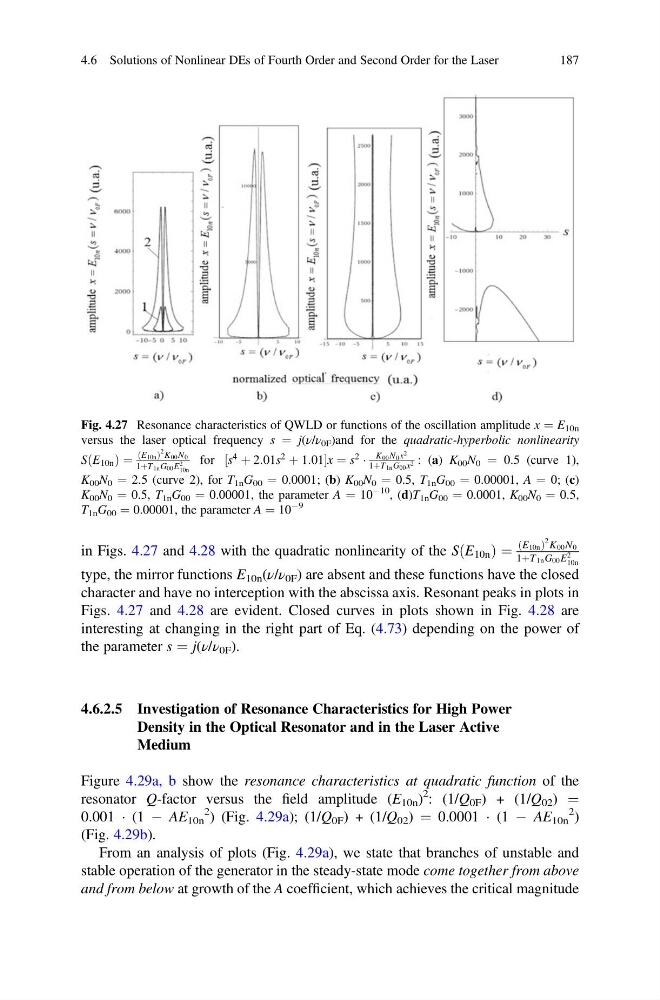
type, the mirror functions E 10n (ν/ν 0F ) are absent and these functions have the closed
character and have no interception with the abscissa axis. Resonant peaks in plots in
Figs. 4.27 and 4.28 are evident. Closed curves in plots shown in Fig. 4.28 are
interesting at changing in the right part of Eq. (4.73) depending on the power of
the parameter s ¼ j(ν/ν 0F ).
4.6.2.5 Investigation of Resonance Characteristics for High Power
Density in the Optical Resonator and in the Laser Active
Medium
Figure 4.29a, b show the resonance characteristics at quadratic function of the
resonator Q-factor versus the field amplitude (E 10n )
2 : (1/Q 0F ) + (1/Q 02 ) ¼
0.001 Á (1 À AE 10n
2 ) (Fig. 4.29a); (1/Q 0F ) + (1/Q 02 ) ¼ 0.0001 Á (1 À AE 10n
2 )
(Fig. 4.29b).
From an analysis of plots (Fig. 4.29a), we state that branches of unstable and
stable operation of the generator in the steady-state mode come together from above
and from below at growth of the A coefficient, which achieves the critical magnitude
Fig. 4.27 Resonance characteristics of QWLD or functions of the oscillation amplitude x ¼ E 10n
versus the laser optical frequency s ¼ j(ν/ν 0F )and for the quadratic-hyperbolic nonlinearity
S E 10n
ð
Þ¼
E10n
ð
Þ
2 K00N0
1þT1nG00E
2
10n
for s
4 þ 2:01s
2 þ 1:01
½
x ¼ s
2 Á
K00N0x 2
1þT1nG00x 2 : (a) K 00 N 0 ¼ 0.5 (curve 1),
K 00 N 0 ¼ 2.5 (curve 2), for T 1n G 00 ¼ 0.0001; (b) K 00 N 0 ¼ 0.5, T 1n G 00 ¼ 0.00001, A ¼ 0; (c)
K 00 N 0 ¼ 0.5, T 1n G 00 ¼ 0.00001, the parameter A ¼ 10
À10
, (d)T 1n G 00 ¼ 0.0001, K 00 N 0 ¼ 0.5,
T 1n G 00 ¼ 0.00001, the parameter A ¼ 10
À9
4.6 Solutions of Nonlinear DEs of Fourth Order and Second Order for the Laser
187
ð
Þ ¼
E 10n
ð
Þ
2 K 00 N 0
1þT 1n G 00 E
2
10n
type, the mirror functions E 10n (ν/ν 0F ) are absent and these functions have the closed
character and have no interception with the abscissa axis. Resonant peaks in plots in
Figs. 4.27 and 4.28 are evident. Closed curves in plots shown in Fig. 4.28 are
interesting at changing in the right part of Eq. (4.73) depending on the power of
the parameter s ¼ j(ν/ν 0F ).
4.6.2.5 Investigation of Resonance Characteristics for High Power
Density in the Optical Resonator and in the Laser Active
Medium
Figure 4.29a, b show the resonance characteristics at quadratic function of the
resonator Q-factor versus the field amplitude (E 10n )
2 : (1/Q 0F ) + (1/Q 02 ) ¼
0.001 Á (1 À AE 10n
2 ) (Fig. 4.29a); (1/Q 0F ) + (1/Q 02 ) ¼ 0.0001 Á (1 À AE 10n
2 )
(Fig. 4.29b).
From an analysis of plots (Fig. 4.29a), we state that branches of unstable and
stable operation of the generator in the steady-state mode come together from above
and from below at growth of the A coefficient, which achieves the critical magnitude
Fig. 4.27 Resonance characteristics of QWLD or functions of the oscillation amplitude x ¼ E 10n
versus the laser optical frequency s ¼ j(ν/ν 0F )and for the quadratic-hyperbolic nonlinearity
S E 10n
ð
Þ¼
E10n
ð
Þ
2 K00N0
1þT1nG00E
2
10n
for s
4 þ 2:01s
2 þ 1:01
½
x ¼ s
2 Á
K00N0x 2
1þT1nG00x 2 : (a) K 00 N 0 ¼ 0.5 (curve 1),
K 00 N 0 ¼ 2.5 (curve 2), for T 1n G 00 ¼ 0.0001; (b) K 00 N 0 ¼ 0.5, T 1n G 00 ¼ 0.00001, A ¼ 0; (c)
K 00 N 0 ¼ 0.5, T 1n G 00 ¼ 0.00001, the parameter A ¼ 10
À10
, (d)T 1n G 00 ¼ 0.0001, K 00 N 0 ¼ 0.5,
T 1n G 00 ¼ 0.00001, the parameter A ¼ 10
À9
4.6 Solutions of Nonlinear DEs of Fourth Order and Second Order for the Laser
187