

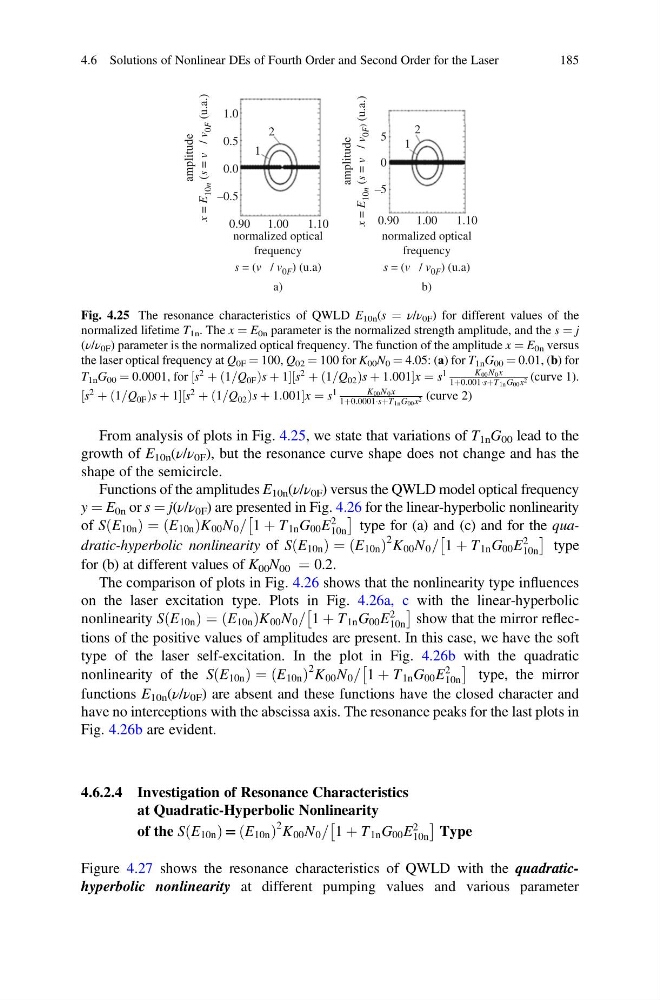
From analysis of plots in Fig. 4.25, we state that variations of T 1n G 00 lead to the
growth of E 10n (ν/ν 0F ), but the resonance curve shape does not change and has the
shape of the semicircle.
Functions of the amplitudes E 10n (ν/ν 0F ) versus the QWLD model optical frequency
y ¼ E 0n or s ¼ j(ν/ν 0F ) are presented in Fig. 4.26 for the linear-hyperbolic nonlinearity
of S E 10n
ð
Þ ¼ E 10n
ð
ÞK 00 N 0 = 1 þ T 1n G 00 E
2
10n
Â
Ã
type for (a) and (c) and for the quadratic-hyperbolic nonlinearity of S E 10n
ð
Þ ¼ E 10n
ð
Þ
2 K 00 N 0 = 1 þ T 1n G 00 E
2
10n
Â
Ã
type
for (b) at different values of K 00 N 00 ¼ 0.2.
The comparison of plots in Fig. 4.26 shows that the nonlinearity type influences
on the laser excitation type. Plots in Fig. 4.26a, c with the linear-hyperbolic
nonlinearity S E 10n
ð
Þ ¼ E 10n
ð
ÞK 00 N 0 = 1 þ T 1n G 00 E
2
10n
Â
Ã
show that the mirror reflections of the positive values of amplitudes are present. In this case, we have the soft
type of the laser self-excitation. In the plot in Fig. 4.26b with the quadratic
nonlinearity of the S E 10n
ð
Þ ¼ E 10n
ð
Þ
2 K 00 N 0 = 1 þ T 1n G 00 E
2
10n
Â
Ã
type, the mirror
functions E 10n (ν/ν 0F ) are absent and these functions have the closed character and
have no interceptions with the abscissa axis. The resonance peaks for the last plots in
Fig. 4.26b are evident.
4.6.2.4 Investigation of Resonance Characteristics
at Quadratic-Hyperbolic Nonlinearity
of the S E 10n
ð
Þ= E 10n
ð
Þ
2 K 00 N 0 = 1 þ T 1n G 00 E
2
10n
Â
Ã
Type
Figure 4.27 shows the resonance characteristics of QWLD with the quadratichyperbolic nonlinearity at different pumping values and various parameter
1.0
5
2
1
0
–5
0.5
2
1
0.0
–0.5
amplitude
x =
E
10n (s =
v /
v
0F (u.a.)
amplitude
x =
E
10n (s =
v /
v
0F )
(u.a.)
0.90
normalized optical
frequency
s = (v / v 0F ) (u.a)
1.00
a)
1.10
0.90
normalized optical
frequency
s = (v / v 0F ) (u.a)
1.00
b)
1.10
Fig. 4.25 The resonance characteristics of QWLD E 10n (s ¼ ν/ν 0F ) for different values of the
normalized lifetime T 1n . The x ¼ E 0n parameter is the normalized strength amplitude, and the s ¼ j
(ν/ν 0F ) parameter is the normalized optical frequency. The function of the amplitude x ¼ E 0n versus
the laser optical frequency at Q 0F ¼ 100, Q 02 ¼ 100 for K 00 N 0 ¼ 4.05: (а) for T 1n G 00 ¼ 0.01, (b) for
T 1n G 00 ¼ 0.0001, for s
2 þ 1=Q 0F
ð
Þ s þ 1
½
s
2 þ 1=Q 02
ð
Þs þ 1:001
½
x ¼ s
1
K00N0x
1þ0:001ÁsþT1nG00x 2 (curve 1).
s
2 þ 1=Q 0F
ð
Þ s þ 1
½
s
2 þ 1=Q 02
ð
Þs þ 1:001
½
x ¼ s
1
K00N0x
1þ0:0001ÁsþT1nG00x 2 (curve 2)
4.6 Solutions of Nonlinear DEs of Fourth Order and Second Order for the Laser
185
growth of E 10n (ν/ν 0F ), but the resonance curve shape does not change and has the
shape of the semicircle.
Functions of the amplitudes E 10n (ν/ν 0F ) versus the QWLD model optical frequency
y ¼ E 0n or s ¼ j(ν/ν 0F ) are presented in Fig. 4.26 for the linear-hyperbolic nonlinearity
of S E 10n
ð
Þ ¼ E 10n
ð
ÞK 00 N 0 = 1 þ T 1n G 00 E
2
10n
Â
Ã
type for (a) and (c) and for the quadratic-hyperbolic nonlinearity of S E 10n
ð
Þ ¼ E 10n
ð
Þ
2 K 00 N 0 = 1 þ T 1n G 00 E
2
10n
Â
Ã
type
for (b) at different values of K 00 N 00 ¼ 0.2.
The comparison of plots in Fig. 4.26 shows that the nonlinearity type influences
on the laser excitation type. Plots in Fig. 4.26a, c with the linear-hyperbolic
nonlinearity S E 10n
ð
Þ ¼ E 10n
ð
ÞK 00 N 0 = 1 þ T 1n G 00 E
2
10n
Â
Ã
show that the mirror reflections of the positive values of amplitudes are present. In this case, we have the soft
type of the laser self-excitation. In the plot in Fig. 4.26b with the quadratic
nonlinearity of the S E 10n
ð
Þ ¼ E 10n
ð
Þ
2 K 00 N 0 = 1 þ T 1n G 00 E
2
10n
Â
Ã
type, the mirror
functions E 10n (ν/ν 0F ) are absent and these functions have the closed character and
have no interceptions with the abscissa axis. The resonance peaks for the last plots in
Fig. 4.26b are evident.
4.6.2.4 Investigation of Resonance Characteristics
at Quadratic-Hyperbolic Nonlinearity
of the S E 10n
ð
Þ= E 10n
ð
Þ
2 K 00 N 0 = 1 þ T 1n G 00 E
2
10n
Â
Ã
Type
Figure 4.27 shows the resonance characteristics of QWLD with the quadratichyperbolic nonlinearity at different pumping values and various parameter
1.0
5
2
1
0
–5
0.5
2
1
0.0
–0.5
amplitude
x =
E
10n (s =
v /
v
0F (u.a.)
amplitude
x =
E
10n (s =
v /
v
0F )
(u.a.)
0.90
normalized optical
frequency
s = (v / v 0F ) (u.a)
1.00
a)
1.10
0.90
normalized optical
frequency
s = (v / v 0F ) (u.a)
1.00
b)
1.10
Fig. 4.25 The resonance characteristics of QWLD E 10n (s ¼ ν/ν 0F ) for different values of the
normalized lifetime T 1n . The x ¼ E 0n parameter is the normalized strength amplitude, and the s ¼ j
(ν/ν 0F ) parameter is the normalized optical frequency. The function of the amplitude x ¼ E 0n versus
the laser optical frequency at Q 0F ¼ 100, Q 02 ¼ 100 for K 00 N 0 ¼ 4.05: (а) for T 1n G 00 ¼ 0.01, (b) for
T 1n G 00 ¼ 0.0001, for s
2 þ 1=Q 0F
ð
Þ s þ 1
½
s
2 þ 1=Q 02
ð
Þs þ 1:001
½
x ¼ s
1
K00N0x
1þ0:001ÁsþT1nG00x 2 (curve 1).
s
2 þ 1=Q 0F
ð
Þ s þ 1
½
s
2 þ 1=Q 02
ð
Þs þ 1:001
½
x ¼ s
1
K00N0x
1þ0:0001ÁsþT1nG00x 2 (curve 2)
4.6 Solutions of Nonlinear DEs of Fourth Order and Second Order for the Laser
185