

amplitude x of OEO upon its normalized frequency s are the resonance characteristics (curves) of OEO. These curves can be constructed with the help of any computer
software.
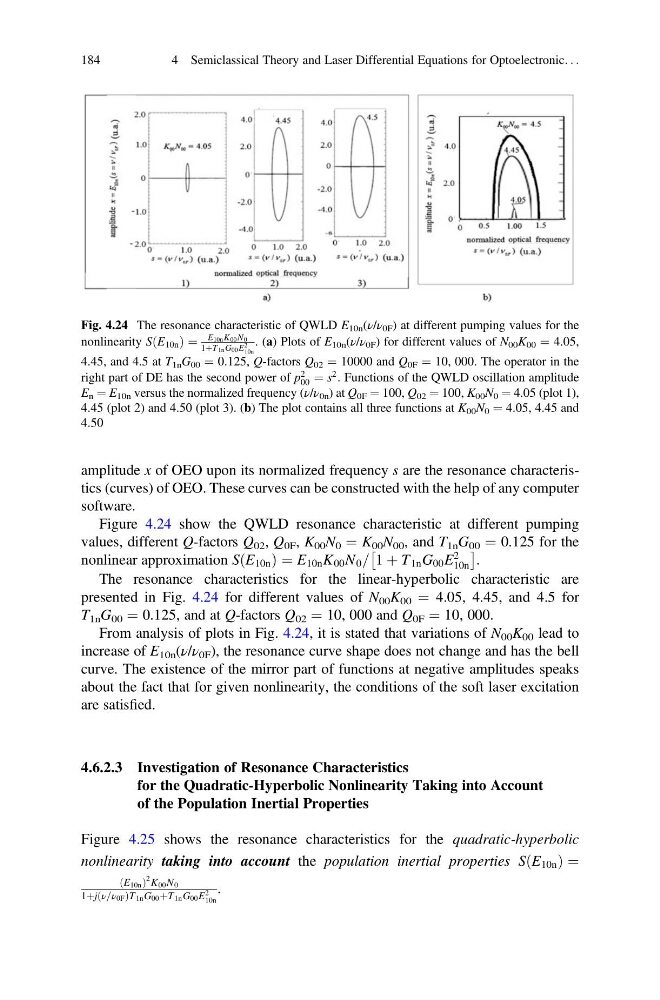
Figure 4.24 show the QWLD resonance characteristic at different pumping
values, different Q-factors Q 02 , Q 0F , K 00 N 0 ¼ K 00 N 00 , and T 1n G 00 ¼ 0.125 for the
nonlinear approximation S E 10n
ð
Þ ¼ E 10n K 00 N 0 = 1 þ T 1n G 00 E
2
10n
Â
Ã
.
The resonance characteristics for the linear-hyperbolic characteristic are
presented in Fig. 4.24 for different values of N 00 K 00 ¼ 4.05, 4.45, and 4.5 for
T 1n G 00 ¼ 0.125, and at Q-factors Q 02 ¼ 10, 000 and Q 0F ¼ 10, 000.
From analysis of plots in Fig. 4.24, it is stated that variations of N 00 K 00 lead to
increase of E 10n (ν/ν 0F ), the resonance curve shape does not change and has the bell
curve. The existence of the mirror part of functions at negative amplitudes speaks
about the fact that for given nonlinearity, the conditions of the soft laser excitation
are satisfied.
4.6.2.3 Investigation of Resonance Characteristics
for the Quadratic-Hyperbolic Nonlinearity Taking into Account
of the Population Inertial Properties
Figure 4.25 shows the resonance characteristics for the quadratic-hyperbolic
nonlinearity taking into account the population inertial properties S E 10n
ð
Þ ¼
E 10n
ð
Þ
2 K 00 N 0
1þj ν=ν 0F
ð
Þ T 1n G 00 þT 1n G 00 E
2
10n
.
Fig. 4.24 The resonance characteristic of QWLD E 10n (ν/ν 0F ) at different pumping values for the
nonlinearity S E 10n
ð
Þ¼
E10nK00N0
1þT1nG00E
2
10n
. (a) Plots of E 10n (ν/ν 0F ) for different values of N 00 K 00 ¼ 4.05,
4.45, and 4.5 at T 1n G 00 ¼ 0.125, Q-factors Q 02 ¼ 10000 and Q 0F ¼ 10, 000. The operator in the
right part of DE has the second power of p
2
00 ¼ s
2 . Functions of the QWLD oscillation amplitude
E n ¼ E 10n versus the normalized frequency (ν/ν 0n ) at Q 0F ¼ 100, Q 02 ¼ 100, K 00 N 0 ¼ 4.05 (plot 1),
4.45 (plot 2) and 4.50 (plot 3). (b) The plot contains all three functions at K 00 N 0 ¼ 4.05, 4.45 and
4.50
184
4 Semiclassical Theory and Laser Differential Equations for Optoelectronic. . .
software.
Figure 4.24 show the QWLD resonance characteristic at different pumping
values, different Q-factors Q 02 , Q 0F , K 00 N 0 ¼ K 00 N 00 , and T 1n G 00 ¼ 0.125 for the
nonlinear approximation S E 10n
ð
Þ ¼ E 10n K 00 N 0 = 1 þ T 1n G 00 E
2
10n
Â
Ã
.
The resonance characteristics for the linear-hyperbolic characteristic are
presented in Fig. 4.24 for different values of N 00 K 00 ¼ 4.05, 4.45, and 4.5 for
T 1n G 00 ¼ 0.125, and at Q-factors Q 02 ¼ 10, 000 and Q 0F ¼ 10, 000.
From analysis of plots in Fig. 4.24, it is stated that variations of N 00 K 00 lead to
increase of E 10n (ν/ν 0F ), the resonance curve shape does not change and has the bell
curve. The existence of the mirror part of functions at negative amplitudes speaks
about the fact that for given nonlinearity, the conditions of the soft laser excitation
are satisfied.
4.6.2.3 Investigation of Resonance Characteristics
for the Quadratic-Hyperbolic Nonlinearity Taking into Account
of the Population Inertial Properties
Figure 4.25 shows the resonance characteristics for the quadratic-hyperbolic
nonlinearity taking into account the population inertial properties S E 10n
ð
Þ ¼
E 10n
ð
Þ
2 K 00 N 0
1þj ν=ν 0F
ð
Þ T 1n G 00 þT 1n G 00 E
2
10n
.
Fig. 4.24 The resonance characteristic of QWLD E 10n (ν/ν 0F ) at different pumping values for the
nonlinearity S E 10n
ð
Þ¼
E10nK00N0
1þT1nG00E
2
10n
. (a) Plots of E 10n (ν/ν 0F ) for different values of N 00 K 00 ¼ 4.05,
4.45, and 4.5 at T 1n G 00 ¼ 0.125, Q-factors Q 02 ¼ 10000 and Q 0F ¼ 10, 000. The operator in the
right part of DE has the second power of p
2
00 ¼ s
2 . Functions of the QWLD oscillation amplitude
E n ¼ E 10n versus the normalized frequency (ν/ν 0n ) at Q 0F ¼ 100, Q 02 ¼ 100, K 00 N 0 ¼ 4.05 (plot 1),
4.45 (plot 2) and 4.50 (plot 3). (b) The plot contains all three functions at K 00 N 0 ¼ 4.05, 4.45 and
4.50
184
4 Semiclassical Theory and Laser Differential Equations for Optoelectronic. . .