

4.6.2.2 Construction of the QWLD Resonance Characteristics by
Solution of Symbolic Equations
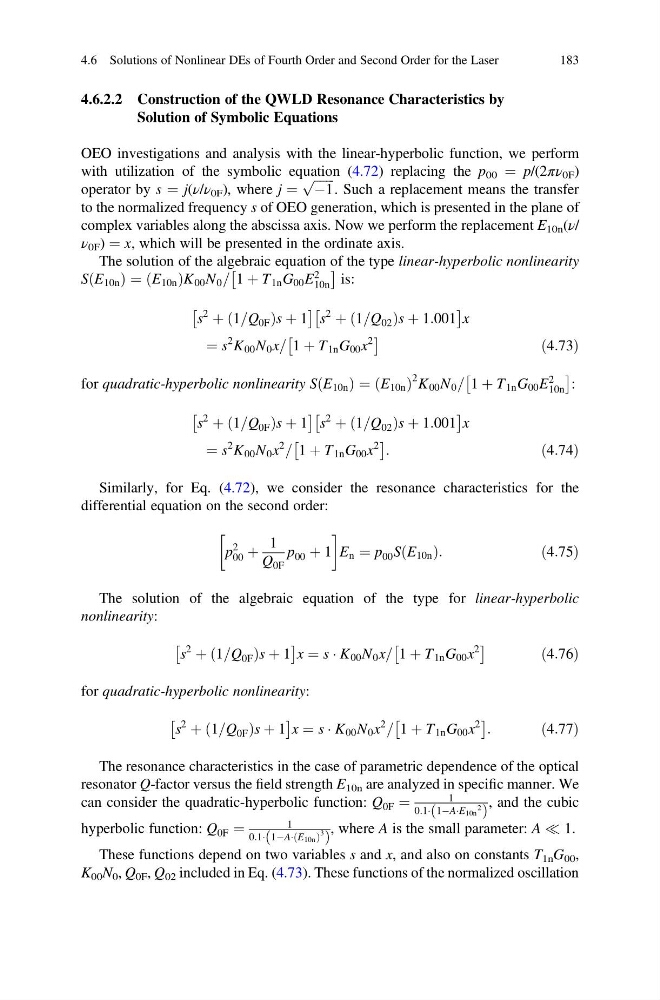
OEO investigations and analysis with the linear-hyperbolic function, we perform
with utilization of the symbolic equation (4.72) replacing the p 00 ¼ p/(2πν 0F )
operator by s ¼ j(ν/ν 0F ), where j ¼
ffiffiffiffiffiffi ffi
À1
p
. Such a replacement means the transfer
to the normalized frequency s of OEO generation, which is presented in the plane of
complex variables along the abscissa axis. Now we perform the replacement E 10n (ν/
ν 0F ) ¼ х, which will be presented in the ordinate axis.
The solution of the algebraic equation of the type linear-hyperbolic nonlinearity
S E 10n
ð
Þ ¼ E 10n
ð
ÞK 00 N 0 = 1 þ T 1n G 00 E
2
10n
Â
Ã
is:
s
2
þ 1=Q 0F
ð
Þs þ 1
Â
Ã
s
2
þ 1=Q 02
ð
Þs þ 1:001
Â
Ã
x
¼ s
2 K 00 N 0 x= 1 þ T 1n G 00 x
2
Â
Ã
ð4:73Þ
for quadratic-hyperbolic nonlinearity S E 10n
ð
Þ ¼ E 10n
ð
Þ
2 K 00 N 0 = 1 þ T 1n G 00 E
2
10n
Â
Ã
:
s
2
þ 1=Q 0F
ð
Þs þ 1
Â
Ã
s
2
þ 1=Q 02
ð
Þs þ 1:001
Â
Ã
x
¼ s
2 K 00 N 0 x
2
= 1 þ T 1n G 00 x
2
Â
Ã
:
ð4:74Þ
Similarly, for Eq. (4.72), we consider the resonance characteristics for the
differential equation on the second order:
p
2
00 þ
1
Q 0F
p 00 þ 1
!
E n ¼ p 00 S E 10n
ð
Þ:
ð4:75Þ
The solution of the algebraic equation of the type for linear-hyperbolic
nonlinearity:
s
2
þ 1=Q 0F
ð
Þs þ 1
Â
Ã
x ¼ s Á K 00 N 0 x= 1 þ T 1n G 00 x
2
Â
Ã
ð4:76Þ
for quadratic-hyperbolic nonlinearity:
s
2
þ 1=Q 0F
ð
Þs þ 1
Â
Ã
x ¼ s Á K 00 N 0 x
2
= 1 þ T 1n G 00 x
2
Â
Ã
:
ð4:77Þ
The resonance characteristics in the case of parametric dependence of the optical
resonator Q-factor versus the field strength E 10n are analyzed in specific manner. We
can consider the quadratic-hyperbolic function: Q 0F ¼
1
0:1Á 1ÀAÁE 10n
2
ð
Þ
, and the cubic
hyperbolic function: Q 0F ¼
1
0:1Á 1ÀAÁ E 10n
ð
Þ
3
ð
Þ
, where A is the small parameter: A ( 1.
These functions depend on two variables s and x, and also on constants T 1n G 00 ,
K 00 N 0 , Q 0F , Q 02 included in Eq. (4.73). These functions of the normalized oscillation
4.6 Solutions of Nonlinear DEs of Fourth Order and Second Order for the Laser
183
Solution of Symbolic Equations
OEO investigations and analysis with the linear-hyperbolic function, we perform
with utilization of the symbolic equation (4.72) replacing the p 00 ¼ p/(2πν 0F )
operator by s ¼ j(ν/ν 0F ), where j ¼
ffiffiffiffiffiffi ffi
À1
p
. Such a replacement means the transfer
to the normalized frequency s of OEO generation, which is presented in the plane of
complex variables along the abscissa axis. Now we perform the replacement E 10n (ν/
ν 0F ) ¼ х, which will be presented in the ordinate axis.
The solution of the algebraic equation of the type linear-hyperbolic nonlinearity
S E 10n
ð
Þ ¼ E 10n
ð
ÞK 00 N 0 = 1 þ T 1n G 00 E
2
10n
Â
Ã
is:
s
2
þ 1=Q 0F
ð
Þs þ 1
Â
Ã
s
2
þ 1=Q 02
ð
Þs þ 1:001
Â
Ã
x
¼ s
2 K 00 N 0 x= 1 þ T 1n G 00 x
2
Â
Ã
ð4:73Þ
for quadratic-hyperbolic nonlinearity S E 10n
ð
Þ ¼ E 10n
ð
Þ
2 K 00 N 0 = 1 þ T 1n G 00 E
2
10n
Â
Ã
:
s
2
þ 1=Q 0F
ð
Þs þ 1
Â
Ã
s
2
þ 1=Q 02
ð
Þs þ 1:001
Â
Ã
x
¼ s
2 K 00 N 0 x
2
= 1 þ T 1n G 00 x
2
Â
Ã
:
ð4:74Þ
Similarly, for Eq. (4.72), we consider the resonance characteristics for the
differential equation on the second order:
p
2
00 þ
1
Q 0F
p 00 þ 1
!
E n ¼ p 00 S E 10n
ð
Þ:
ð4:75Þ
The solution of the algebraic equation of the type for linear-hyperbolic
nonlinearity:
s
2
þ 1=Q 0F
ð
Þs þ 1
Â
Ã
x ¼ s Á K 00 N 0 x= 1 þ T 1n G 00 x
2
Â
Ã
ð4:76Þ
for quadratic-hyperbolic nonlinearity:
s
2
þ 1=Q 0F
ð
Þs þ 1
Â
Ã
x ¼ s Á K 00 N 0 x
2
= 1 þ T 1n G 00 x
2
Â
Ã
:
ð4:77Þ
The resonance characteristics in the case of parametric dependence of the optical
resonator Q-factor versus the field strength E 10n are analyzed in specific manner. We
can consider the quadratic-hyperbolic function: Q 0F ¼
1
0:1Á 1ÀAÁE 10n
2
ð
Þ
, and the cubic
hyperbolic function: Q 0F ¼
1
0:1Á 1ÀAÁ E 10n
ð
Þ
3
ð
Þ
, where A is the small parameter: A ( 1.
These functions depend on two variables s and x, and also on constants T 1n G 00 ,
K 00 N 0 , Q 0F , Q 02 included in Eq. (4.73). These functions of the normalized oscillation
4.6 Solutions of Nonlinear DEs of Fourth Order and Second Order for the Laser
183