

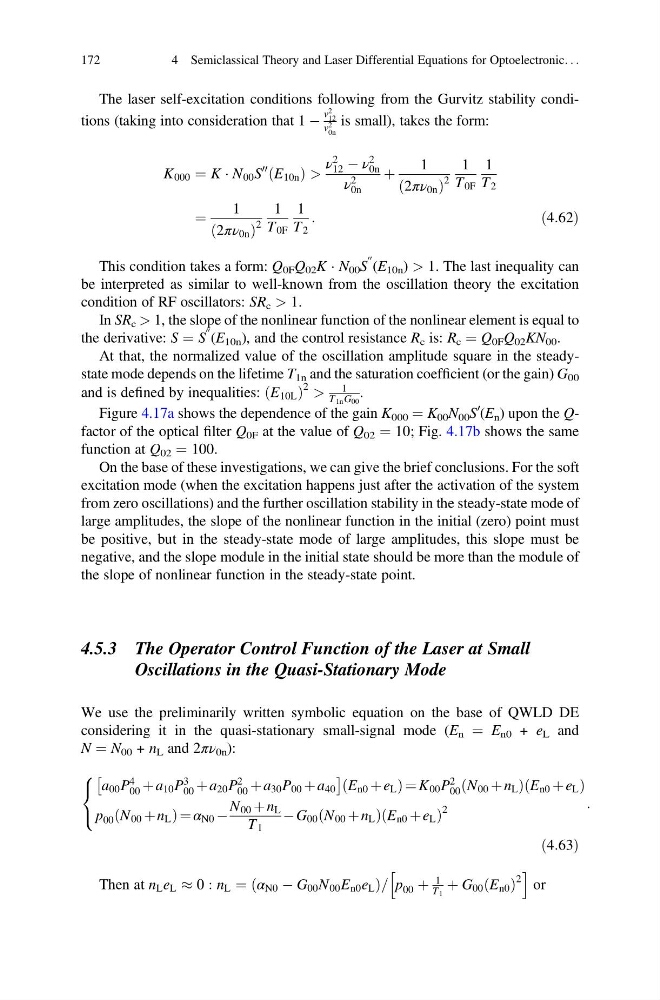
The laser self-excitation conditions following from the Gurvitz stability conditions (taking into consideration that 1 À
v
2
12
v 2
0n
is small), takes the form:
K 000 ¼ K Á N 00 S
00 E 10n
ð
Þ >
ν
2
12 À ν
2
0n
ν 2
0n
þ
1
2πν 0n
ð
Þ
2
1
T 0F
1
T 2
¼
1
2πν 0n
ð
Þ
2
1
T 0F
1
T 2
:
ð4:62Þ
This condition takes a form: Q 0F Q 02 K Á N 00 S
00
(E 10n ) > 1. The last inequality can
be interpreted as similar to well-known from the oscillation theory the excitation
condition of RF oscillators: SR c > 1.
In SR c > 1, the slope of the nonlinear function of the nonlinear element is equal to
the derivative: S ¼ S
00 (E 10n ), and the control resistance R c is: R c ¼ Q 0F Q 02 KN 00 .
At that, the normalized value of the oscillation amplitude square in the steadystate mode depends on the lifetime T 1n and the saturation coefficient (or the gain) G 00
and is defined by inequalities: E 10L
ð
Þ
2 >
1
T 1n G 00
.
Figure 4.17a shows the dependence of the gain K 000 ¼ K 00 N 00 S
0
(E n ) upon the Qfactor of the optical filter Q 0F at the value of Q 02 ¼ 10; Fig. 4.17b shows the same
function at Q 02 ¼ 100.
On the base of these investigations, we can give the brief conclusions. For the soft
excitation mode (when the excitation happens just after the activation of the system
from zero oscillations) and the further oscillation stability in the steady-state mode of
large amplitudes, the slope of the nonlinear function in the initial (zero) point must
be positive, but in the steady-state mode of large amplitudes, this slope must be
negative, and the slope module in the initial state should be more than the module of
the slope of nonlinear function in the steady-state point.
4.5.3 The Operator Control Function of the Laser at Small
Oscillations in the Quasi-Stationary Mode
We use the preliminarily written symbolic equation on the base of QWLD DE
considering it in the quasi-stationary small-signal mode (E n ¼ E n0 + e L and
N ¼ N 00 + n L and 2πν 0n ):
a 00 P
4
00 þ a 10 P
3
00 þ a 20 P
2
00 þ a 30 P 00 þ a 40
Â
Ã
E n0 þ e L
ð
Þ¼K 00 P
2
00 N 00 þ n L
ð
ÞE n0 þ e L
ð
Þ
p 00 N 00 þ n L
ð
Þ¼ α N0 À
N 00 þ n L
T 1
À G 00 N 00 þ n L
ð
ÞE n0 þ e L
ð
Þ
2
:
8
<
:
ð4:63Þ
Then at n L e L % 0 : n L ¼ α N0 À G 00 N 00 E n0 e L
ð
Þ = p 00 þ
1
T 1
þ G 00 E n0
ð Þ
2
h
i
or
172
4 Semiclassical Theory and Laser Differential Equations for Optoelectronic. . .
v
2
12
v 2
0n
is small), takes the form:
K 000 ¼ K Á N 00 S
00 E 10n
ð
Þ >
ν
2
12 À ν
2
0n
ν 2
0n
þ
1
2πν 0n
ð
Þ
2
1
T 0F
1
T 2
¼
1
2πν 0n
ð
Þ
2
1
T 0F
1
T 2
:
ð4:62Þ
This condition takes a form: Q 0F Q 02 K Á N 00 S
00
(E 10n ) > 1. The last inequality can
be interpreted as similar to well-known from the oscillation theory the excitation
condition of RF oscillators: SR c > 1.
In SR c > 1, the slope of the nonlinear function of the nonlinear element is equal to
the derivative: S ¼ S
00 (E 10n ), and the control resistance R c is: R c ¼ Q 0F Q 02 KN 00 .
At that, the normalized value of the oscillation amplitude square in the steadystate mode depends on the lifetime T 1n and the saturation coefficient (or the gain) G 00
and is defined by inequalities: E 10L
ð
Þ
2 >
1
T 1n G 00
.
Figure 4.17a shows the dependence of the gain K 000 ¼ K 00 N 00 S
0
(E n ) upon the Qfactor of the optical filter Q 0F at the value of Q 02 ¼ 10; Fig. 4.17b shows the same
function at Q 02 ¼ 100.
On the base of these investigations, we can give the brief conclusions. For the soft
excitation mode (when the excitation happens just after the activation of the system
from zero oscillations) and the further oscillation stability in the steady-state mode of
large amplitudes, the slope of the nonlinear function in the initial (zero) point must
be positive, but in the steady-state mode of large amplitudes, this slope must be
negative, and the slope module in the initial state should be more than the module of
the slope of nonlinear function in the steady-state point.
4.5.3 The Operator Control Function of the Laser at Small
Oscillations in the Quasi-Stationary Mode
We use the preliminarily written symbolic equation on the base of QWLD DE
considering it in the quasi-stationary small-signal mode (E n ¼ E n0 + e L and
N ¼ N 00 + n L and 2πν 0n ):
a 00 P
4
00 þ a 10 P
3
00 þ a 20 P
2
00 þ a 30 P 00 þ a 40
Â
Ã
E n0 þ e L
ð
Þ¼K 00 P
2
00 N 00 þ n L
ð
ÞE n0 þ e L
ð
Þ
p 00 N 00 þ n L
ð
Þ¼ α N0 À
N 00 þ n L
T 1
À G 00 N 00 þ n L
ð
ÞE n0 þ e L
ð
Þ
2
:
8
<
:
ð4:63Þ
Then at n L e L % 0 : n L ¼ α N0 À G 00 N 00 E n0 e L
ð
Þ = p 00 þ
1
T 1
þ G 00 E n0
ð Þ
2
h
i
or
172
4 Semiclassical Theory and Laser Differential Equations for Optoelectronic. . .