

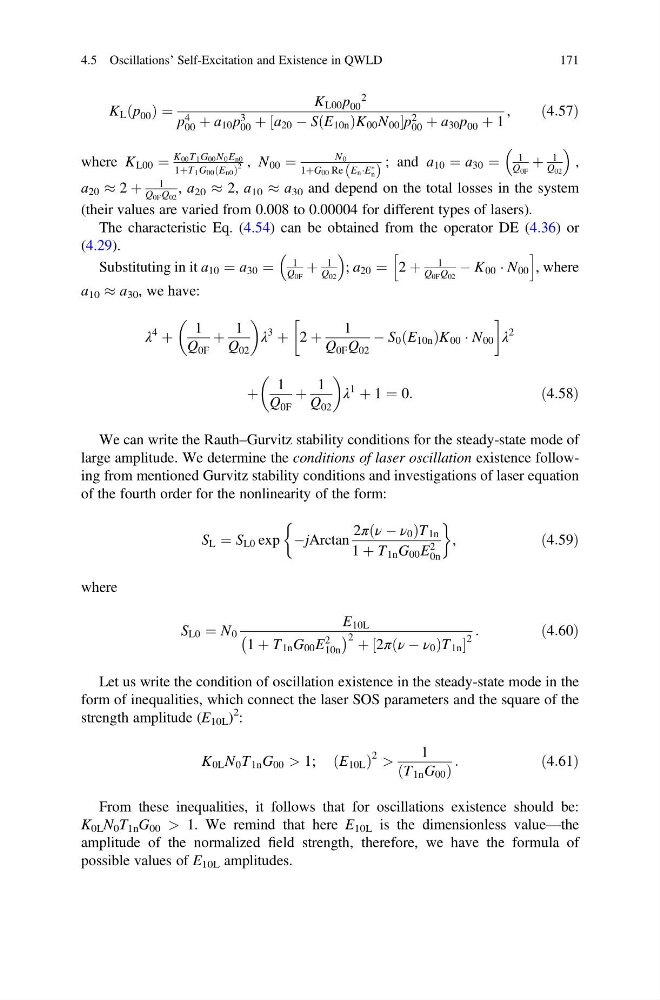
K L p 00
ð Þ ¼
K L00 p 00
2
p 4
00 þ а 10 p
3
00 þ а 20 À S E 10n
ð
ÞK 00 N 00
½
p 2
00 þ а 30 p 00 þ 1
,
ð4:57Þ
where K L00 ¼
K 00 T 1 G 00 N 0 E n0
1þT 1 G 00 E n0
ð Þ
2 , N 00 ¼
N 0
1þG 00 Re E n ÁE
Ã
n
ð
Þ
; and а 10 ¼ а 30 ¼
1
Q 0F
þ
1
Q 02
,
а 20 % 2 þ
1
Q 0F Q 02
, а 20 % 2, а 10 % а 30 and depend on the total losses in the system
(their values are varied from 0.008 to 0.00004 for different types of lasers).
The characteristic Eq. (4.54) can be obtained from the operator DE (4.36) or
(4.29).
Substituting in it а 10 ¼ а 30 ¼
1
Q 0F
þ
1
Q 02
; a 20 ¼ 2 þ
1
Q 0F Q 02
À K 00 Á N 00
h
i
, where
а 10 % а 30 , we have:
λ
4
þ
1
Q 0F
þ
1
Q 02
λ
3
þ 2 þ
1
Q 0F Q 02
À S 0 E 10n
ð
ÞK 00 Á N 00
!
λ
2
þ
1
Q 0F
þ
1
Q 02
λ
1
þ 1 ¼ 0:
ð4:58Þ
We can write the Rauth–Gurvitz stability conditions for the steady-state mode of
large amplitude. We determine the conditions of laser oscillation existence following from mentioned Gurvitz stability conditions and investigations of laser equation
of the fourth order for the nonlinearity of the form:
S L ¼ S L0 exp ÀjArctan
2π ν À ν 0
ð
ÞT 1n
1 þ T 1n G 00 E
2
0n
&
'
,
ð4:59Þ
where
S L0 ¼ N 0
E 10L
1 þ T 1n G 00 E
2
10n
À
Á 2 þ 2π ν À ν 0
ð
ÞT 1n
½
2
:
ð4:60Þ
Let us write the condition of oscillation existence in the steady-state mode in the
form of inequalities, which connect the laser SOS parameters and the square of the
strength amplitude (E 10L )
2 :
K 0L N 0 T 1n G 00 > 1;
E 10L
ð
Þ
2 >
1
T 1n G 00
ð
Þ
:
ð4:61Þ
From these inequalities, it follows that for oscillations existence should be:
K 0L N 0 T 1n G 00 > 1. We remind that here E 10L is the dimensionless value—the
amplitude of the normalized field strength, therefore, we have the formula of
possible values of E 10L amplitudes.
4.5 Oscillations’ Self-Excitation and Existence in QWLD
171
ð Þ ¼
K L00 p 00
2
p 4
00 þ а 10 p
3
00 þ а 20 À S E 10n
ð
ÞK 00 N 00
½
p 2
00 þ а 30 p 00 þ 1
,
ð4:57Þ
where K L00 ¼
K 00 T 1 G 00 N 0 E n0
1þT 1 G 00 E n0
ð Þ
2 , N 00 ¼
N 0
1þG 00 Re E n ÁE
Ã
n
ð
Þ
; and а 10 ¼ а 30 ¼
1
Q 0F
þ
1
Q 02
,
а 20 % 2 þ
1
Q 0F Q 02
, а 20 % 2, а 10 % а 30 and depend on the total losses in the system
(their values are varied from 0.008 to 0.00004 for different types of lasers).
The characteristic Eq. (4.54) can be obtained from the operator DE (4.36) or
(4.29).
Substituting in it а 10 ¼ а 30 ¼
1
Q 0F
þ
1
Q 02
; a 20 ¼ 2 þ
1
Q 0F Q 02
À K 00 Á N 00
h
i
, where
а 10 % а 30 , we have:
λ
4
þ
1
Q 0F
þ
1
Q 02
λ
3
þ 2 þ
1
Q 0F Q 02
À S 0 E 10n
ð
ÞK 00 Á N 00
!
λ
2
þ
1
Q 0F
þ
1
Q 02
λ
1
þ 1 ¼ 0:
ð4:58Þ
We can write the Rauth–Gurvitz stability conditions for the steady-state mode of
large amplitude. We determine the conditions of laser oscillation existence following from mentioned Gurvitz stability conditions and investigations of laser equation
of the fourth order for the nonlinearity of the form:
S L ¼ S L0 exp ÀjArctan
2π ν À ν 0
ð
ÞT 1n
1 þ T 1n G 00 E
2
0n
&
'
,
ð4:59Þ
where
S L0 ¼ N 0
E 10L
1 þ T 1n G 00 E
2
10n
À
Á 2 þ 2π ν À ν 0
ð
ÞT 1n
½
2
:
ð4:60Þ
Let us write the condition of oscillation existence in the steady-state mode in the
form of inequalities, which connect the laser SOS parameters and the square of the
strength amplitude (E 10L )
2 :
K 0L N 0 T 1n G 00 > 1;
E 10L
ð
Þ
2 >
1
T 1n G 00
ð
Þ
:
ð4:61Þ
From these inequalities, it follows that for oscillations existence should be:
K 0L N 0 T 1n G 00 > 1. We remind that here E 10L is the dimensionless value—the
amplitude of the normalized field strength, therefore, we have the formula of
possible values of E 10L amplitudes.
4.5 Oscillations’ Self-Excitation and Existence in QWLD
171