

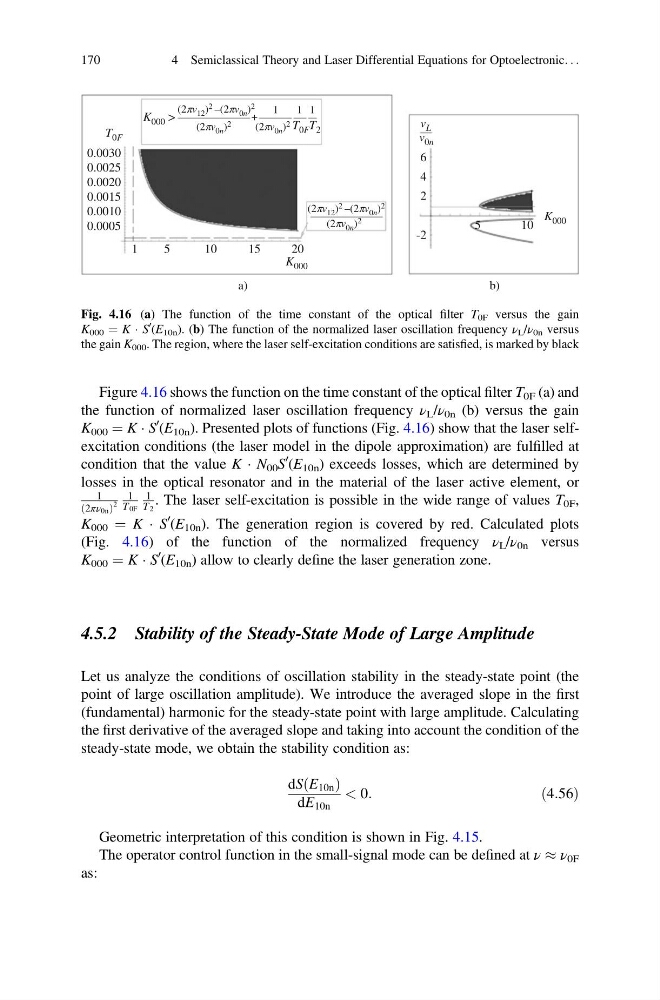
Figure 4.16 shows the function on the time constant of the optical filter T 0F (a) and
the function of normalized laser oscillation frequency ν L /ν 0n (b) versus the gain
K 000 ¼ K Á S
0 (E 10n ). Presented plots of functions (Fig. 4.16) show that the laser selfexcitation conditions (the laser model in the dipole approximation) are fulfilled at
condition that the value K Á N 00 S
0 (E 10n ) exceeds losses, which are determined by
losses in the optical resonator and in the material of the laser active element, or
1
2πν 0n
ð
Þ
2
1
T 0F
1
T 2
. The laser self-excitation is possible in the wide range of values T 0F ,
K 000 ¼ K Á S
0 (E 10n ). The generation region is covered by red. Calculated plots
(Fig. 4.16) of the function of the normalized frequency ν L /ν 0n versus
K 000 ¼ K Á S
0 (E 10n ) allow to clearly define the laser generation zone.
4.5.2 Stability of the Steady-State Mode of Large Amplitude
Let us analyze the conditions of oscillation stability in the steady-state point (the
point of large oscillation amplitude). We introduce the averaged slope in the first
(fundamental) harmonic for the steady-state point with large amplitude. Calculating
the first derivative of the averaged slope and taking into account the condition of the
steady-state mode, we obtain the stability condition as:
dS E 10n
ð
Þ
dE 10n
< 0:
ð4:56Þ
Geometric interpretation of this condition is shown in Fig. 4.15.
The operator control function in the small-signal mode can be defined at ν % ν 0F
as:
0.0030
0.0025
0.0020
0.0015
0.0010
0.0005
1
5
10
15
a)
b)
20
6
4
2
-2
5
1 0
(2pv 12 ) 2 –(2pv 0n ) 2
(2pv 12 ) 2 –(2pv 0n ) 2
(2pv 0n ) 2
(2pv 0n ) 2
(2pv 0n ) 2
K 000
K 000
K 000 >
T 0F
v L
v 0n
T 2
T 0F
+
1
1 1
Fig. 4.16 (a) The function of the time constant of the optical filter T 0F versus the gain
K 000 ¼ K Á S
0 (E 10n ). (b) The function of the normalized laser oscillation frequency ν L /ν 0n versus
the gain K 000 . The region, where the laser self-excitation conditions are satisfied, is marked by black
170
4 Semiclassical Theory and Laser Differential Equations for Optoelectronic. . .
the function of normalized laser oscillation frequency ν L /ν 0n (b) versus the gain
K 000 ¼ K Á S
0 (E 10n ). Presented plots of functions (Fig. 4.16) show that the laser selfexcitation conditions (the laser model in the dipole approximation) are fulfilled at
condition that the value K Á N 00 S
0 (E 10n ) exceeds losses, which are determined by
losses in the optical resonator and in the material of the laser active element, or
1
2πν 0n
ð
Þ
2
1
T 0F
1
T 2
. The laser self-excitation is possible in the wide range of values T 0F ,
K 000 ¼ K Á S
0 (E 10n ). The generation region is covered by red. Calculated plots
(Fig. 4.16) of the function of the normalized frequency ν L /ν 0n versus
K 000 ¼ K Á S
0 (E 10n ) allow to clearly define the laser generation zone.
4.5.2 Stability of the Steady-State Mode of Large Amplitude
Let us analyze the conditions of oscillation stability in the steady-state point (the
point of large oscillation amplitude). We introduce the averaged slope in the first
(fundamental) harmonic for the steady-state point with large amplitude. Calculating
the first derivative of the averaged slope and taking into account the condition of the
steady-state mode, we obtain the stability condition as:
dS E 10n
ð
Þ
dE 10n
< 0:
ð4:56Þ
Geometric interpretation of this condition is shown in Fig. 4.15.
The operator control function in the small-signal mode can be defined at ν % ν 0F
as:
0.0030
0.0025
0.0020
0.0015
0.0010
0.0005
1
5
10
15
a)
b)
20
6
4
2
-2
5
1 0
(2pv 12 ) 2 –(2pv 0n ) 2
(2pv 12 ) 2 –(2pv 0n ) 2
(2pv 0n ) 2
(2pv 0n ) 2
(2pv 0n ) 2
K 000
K 000
K 000 >
T 0F
v L
v 0n
T 2
T 0F
+
1
1 1
Fig. 4.16 (a) The function of the time constant of the optical filter T 0F versus the gain
K 000 ¼ K Á S
0 (E 10n ). (b) The function of the normalized laser oscillation frequency ν L /ν 0n versus
the gain K 000 . The region, where the laser self-excitation conditions are satisfied, is marked by black
170
4 Semiclassical Theory and Laser Differential Equations for Optoelectronic. . .