

abbreviated DEs of the laser and obtaining of steady-state values of oscillation
amplitudes and the laser frequency.
Further, we perform investigations of oscillation excitation and existence conditions for QWLD in the steady-state mode. At that, we shall use the Gurvitz criterion
for characteristic equations of fourth order.
4.5 Oscillations’ Self-Excitation and Existence in QWLD
4.5.1 Conditions of Oscillations’ Self-Excitation of QWLD
Differential equations allow considering a question about laser self-excitation. The
modern QWLDs operate at low threshold currents (less than 10 mA) at average
operating pumping currents of 50–80 mA and transient time of quasi-stationary
mode is small (less than 10 ns).
The self-excitation peculiarity is the fulfilling of two conditions following from
the first and second equation of (4.28), (4.37). For the first equation, we use the
Gurvitz stability criterion. For the second equation, we find the laser self-excitation
boundary in the steady-state point
d
i E n
dτ i ¼ 0 i ¼ 1, 2, 3, 4
ð
Þand
dN
dτ ¼ 0. From the
last condition, we see that pumping should be higher than the threshold value, i.e.,
the population difference on the upper operation level must be higher than the
threshold value: α N0 > N Á
1
T 1
.
Now we write the characteristic equation for our DEs transferring the term from
the right side into the left side and assuming for simplicity exp[Àj(2πν 0n T R )] ¼ 1 and
introducing the average slope S
0
(E n ) for the first harmonic K 000 ¼ K Á S
0 (E n ). Now we
write the final characteristic equation:
а 0 λ
4
þ а 1 λ
3
þ а 20 λ
2
þ а 3 λ þ а 4 ¼ 0,
ð4:54Þ
where λ is the complex root of characteristic equation and the new coefficient а 20 at
λ
2 is equal: a 20 ¼ (2πν 0n )
2 + (2πν 12 )
2 + [1/(T 0F T 2 )] À K 000 .
The Rauth–Gurvitz stability conditions for the steady-state mode (for small
amplitudes) for DE (4.37) are: a i > 0(i ¼ 0, . . ., 4), Δ 2 ¼ a 1 a 2 À a 0 a 3 > 0, Δ 3 ¼
a 1 a 2 a 3 À a
2
1 a 4 À a 0 a
2
3 > 0 , Δ 4 ¼ a 4 > 0. The laser self-excitation condition
following from the mentioned Gurvitz stability conditions and from the pumping
threshold condition for QWLD takes a form:
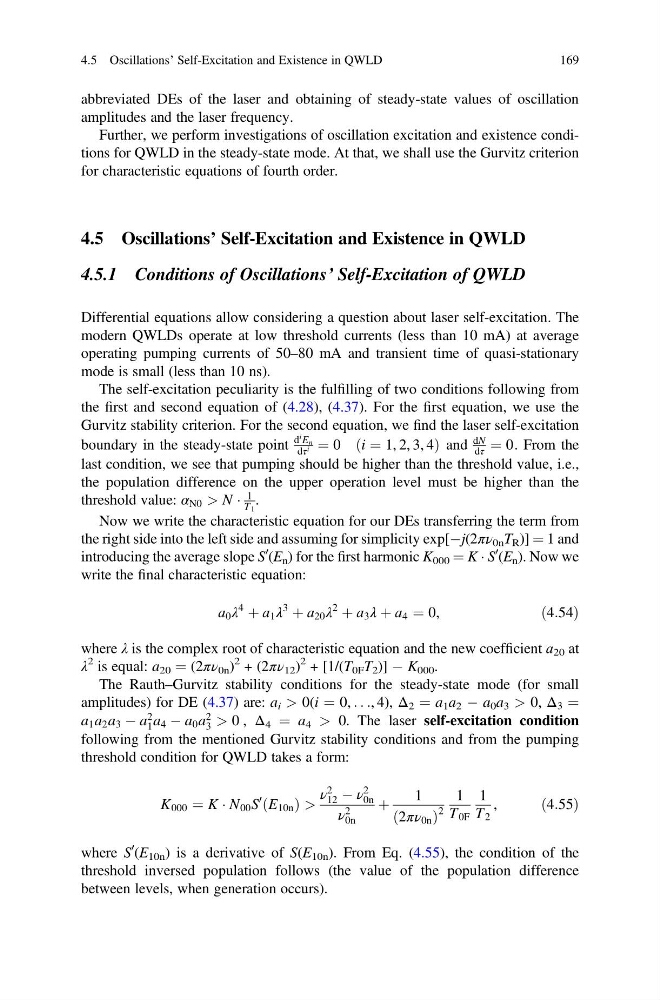
K 000 ¼ K Á N 00 S
0 E 10n
ð
Þ >
ν
2
12 À ν
2
0n
ν 2
0n
þ
1
2πν 0n
ð
Þ
2
1
T 0F
1
T 2
,
ð4:55Þ
where S
0 (E 10n ) is a derivative of S(E 10n ). From Eq. (4.55), the condition of the
threshold inversed population follows (the value of the population difference
between levels, when generation occurs).
4.5 Oscillations’ Self-Excitation and Existence in QWLD
169
amplitudes and the laser frequency.
Further, we perform investigations of oscillation excitation and existence conditions for QWLD in the steady-state mode. At that, we shall use the Gurvitz criterion
for characteristic equations of fourth order.
4.5 Oscillations’ Self-Excitation and Existence in QWLD
4.5.1 Conditions of Oscillations’ Self-Excitation of QWLD
Differential equations allow considering a question about laser self-excitation. The
modern QWLDs operate at low threshold currents (less than 10 mA) at average
operating pumping currents of 50–80 mA and transient time of quasi-stationary
mode is small (less than 10 ns).
The self-excitation peculiarity is the fulfilling of two conditions following from
the first and second equation of (4.28), (4.37). For the first equation, we use the
Gurvitz stability criterion. For the second equation, we find the laser self-excitation
boundary in the steady-state point
d
i E n
dτ i ¼ 0 i ¼ 1, 2, 3, 4
ð
Þand
dN
dτ ¼ 0. From the
last condition, we see that pumping should be higher than the threshold value, i.e.,
the population difference on the upper operation level must be higher than the
threshold value: α N0 > N Á
1
T 1
.
Now we write the characteristic equation for our DEs transferring the term from
the right side into the left side and assuming for simplicity exp[Àj(2πν 0n T R )] ¼ 1 and
introducing the average slope S
0
(E n ) for the first harmonic K 000 ¼ K Á S
0 (E n ). Now we
write the final characteristic equation:
а 0 λ
4
þ а 1 λ
3
þ а 20 λ
2
þ а 3 λ þ а 4 ¼ 0,
ð4:54Þ
where λ is the complex root of characteristic equation and the new coefficient а 20 at
λ
2 is equal: a 20 ¼ (2πν 0n )
2 + (2πν 12 )
2 + [1/(T 0F T 2 )] À K 000 .
The Rauth–Gurvitz stability conditions for the steady-state mode (for small
amplitudes) for DE (4.37) are: a i > 0(i ¼ 0, . . ., 4), Δ 2 ¼ a 1 a 2 À a 0 a 3 > 0, Δ 3 ¼
a 1 a 2 a 3 À a
2
1 a 4 À a 0 a
2
3 > 0 , Δ 4 ¼ a 4 > 0. The laser self-excitation condition
following from the mentioned Gurvitz stability conditions and from the pumping
threshold condition for QWLD takes a form:
K 000 ¼ K Á N 00 S
0 E 10n
ð
Þ >
ν
2
12 À ν
2
0n
ν 2
0n
þ
1
2πν 0n
ð
Þ
2
1
T 0F
1
T 2
,
ð4:55Þ
where S
0 (E 10n ) is a derivative of S(E 10n ). From Eq. (4.55), the condition of the
threshold inversed population follows (the value of the population difference
between levels, when generation occurs).
4.5 Oscillations’ Self-Excitation and Existence in QWLD
169