

Topics in Current Chemistry (2020) 378:35
1 3
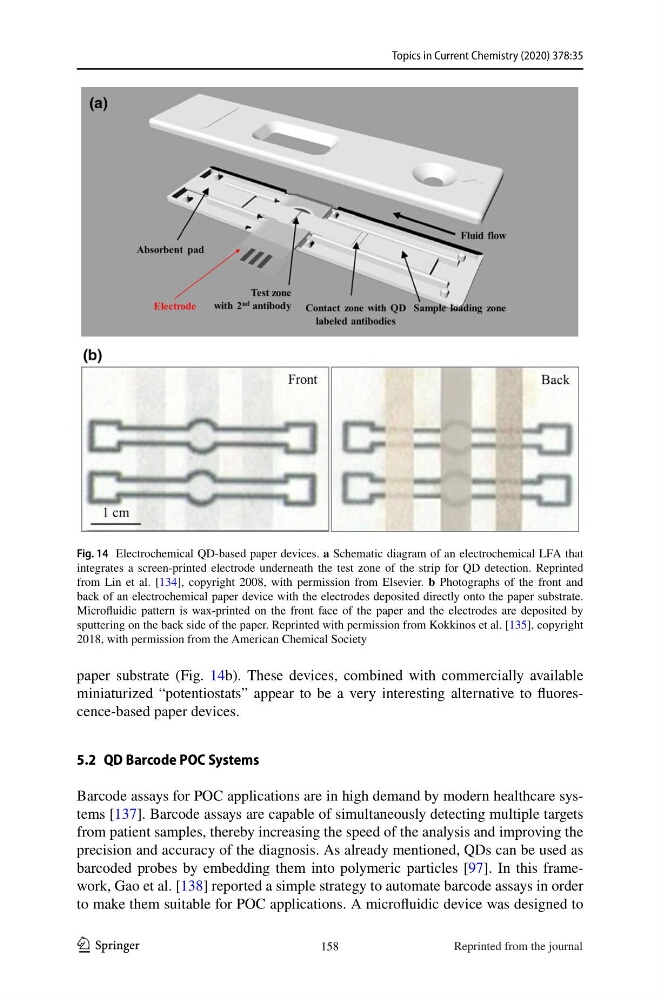
paper substrate (Fig. 14b). These devices, combined with commercially available
miniaturized “potentiostats” appear to be a very interesting alternative to fluorescence-based paper devices.
5.2 QD Barcode POC Systems
Barcode assays for POC applications are in high demand by modern healthcare systems [137]. Barcode assays are capable of simultaneously detecting multiple targets
from patient samples, thereby increasing the speed of the analysis and improving the
precision and accuracy of the diagnosis. As already mentioned, QDs can be used as
barcoded probes by embedding them into polymeric particles [97]. In this framework, Gao et al. [138] reported a simple strategy to automate barcode assays in order
to make them suitable for POC applications. A microfluidic device was designed to
Fig. 14 Electrochemical QD-based paper devices. a Schematic diagram of an electrochemical LFA that
integrates a screen-printed electrode underneath the test zone of the strip for QD detection. Reprinted
from Lin et al. [134], copyright 2008, with permission from Elsevier. b Photographs of the front and
back of an electrochemical paper device with the electrodes deposited directly onto the paper substrate.
Microfluidic pattern is wax-printed on the front face of the paper and the electrodes are deposited by
sputtering on the back side of the paper. Reprinted with permission from Kokkinos et al. [135], copyright
2018, with permission from the American Chemical Society
158
Reprinted from the journal
1 3
paper substrate (Fig. 14b). These devices, combined with commercially available
miniaturized “potentiostats” appear to be a very interesting alternative to fluorescence-based paper devices.
5.2 QD Barcode POC Systems
Barcode assays for POC applications are in high demand by modern healthcare systems [137]. Barcode assays are capable of simultaneously detecting multiple targets
from patient samples, thereby increasing the speed of the analysis and improving the
precision and accuracy of the diagnosis. As already mentioned, QDs can be used as
barcoded probes by embedding them into polymeric particles [97]. In this framework, Gao et al. [138] reported a simple strategy to automate barcode assays in order
to make them suitable for POC applications. A microfluidic device was designed to
Fig. 14 Electrochemical QD-based paper devices. a Schematic diagram of an electrochemical LFA that
integrates a screen-printed electrode underneath the test zone of the strip for QD detection. Reprinted
from Lin et al. [134], copyright 2008, with permission from Elsevier. b Photographs of the front and
back of an electrochemical paper device with the electrodes deposited directly onto the paper substrate.
Microfluidic pattern is wax-printed on the front face of the paper and the electrodes are deposited by
sputtering on the back side of the paper. Reprinted with permission from Kokkinos et al. [135], copyright
2018, with permission from the American Chemical Society
158
Reprinted from the journal