

1 3
Topics in Current Chemistry (2020) 378:35
perform all steps of the assay using barcoded polystyrene microbeads consisting of
magnetic NPs (FeO) and QDs (ZnS-capped CdSeS). An on-chip sandwich hybridization assay for the detection of genetic targets for human immunodeficiency virus
(HIV), hepatitis B and syphilis was successfully performed in only 20 min, with a
LOD of 1.2 nM. The POC application of this microfluidic device is, however, hindered due to the bulky instrumentation required for the fluorescence detection.
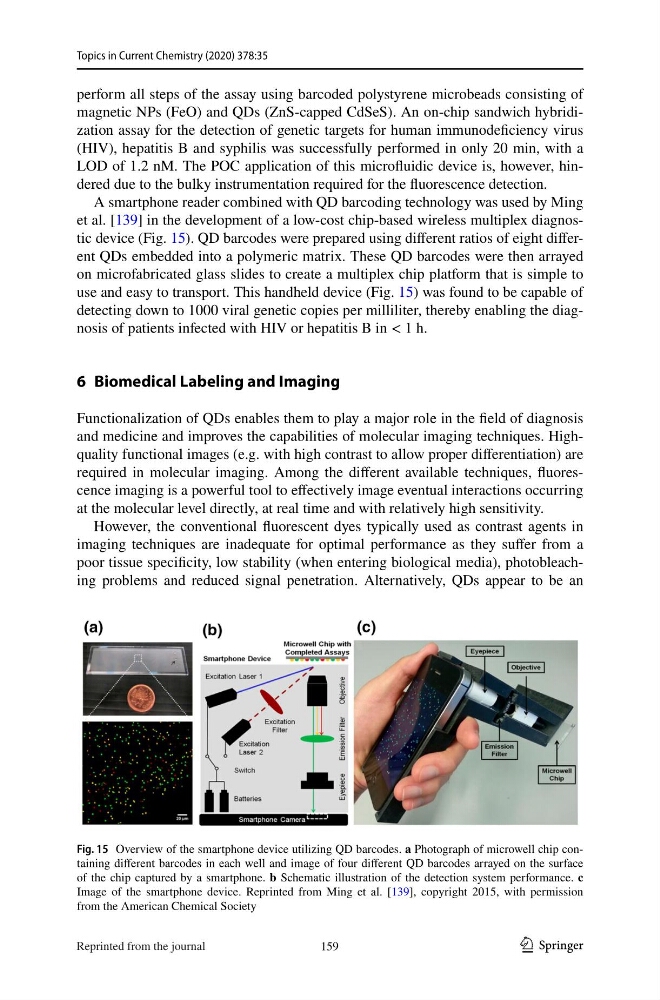
A smartphone reader combined with QD barcoding technology was used by Ming
et al. [139] in the development of a low-cost chip-based wireless multiplex diagnostic device (Fig. 15). QD barcodes were prepared using different ratios of eight different QDs embedded into a polymeric matrix. These QD barcodes were then arrayed
on microfabricated glass slides to create a multiplex chip platform that is simple to
use and easy to transport. This handheld device (Fig. 15) was found to be capable of
detecting down to 1000 viral genetic copies per milliliter, thereby enabling the diagnosis of patients infected with HIV or hepatitis B in < 1 h.
6 Biomedical Labeling and Imaging
Functionalization of QDs enables them to play a major role in the field of diagnosis
and medicine and improves the capabilities of molecular imaging techniques. Highquality functional images (e.g. with high contrast to allow proper differentiation) are
required in molecular imaging. Among the different available techniques, fluorescence imaging is a powerful tool to effectively image eventual interactions occurring
at the molecular level directly, at real time and with relatively high sensitivity.
However, the conventional fluorescent dyes typically used as contrast agents in
imaging techniques are inadequate for optimal performance as they suffer from a
poor tissue specificity, low stability (when entering biological media), photobleaching problems and reduced signal penetration. Alternatively, QDs appear to be an
Fig. 15 Overview of the smartphone device utilizing QD barcodes. a Photograph of microwell chip containing different barcodes in each well and image of four different QD barcodes arrayed on the surface
of the chip captured by a smartphone. b Schematic illustration of the detection system performance. c
Image of the smartphone device. Reprinted from Ming et al. [139], copyright 2015, with permission
from the American Chemical Society
159
Reprinted from the journal
Topics in Current Chemistry (2020) 378:35
perform all steps of the assay using barcoded polystyrene microbeads consisting of
magnetic NPs (FeO) and QDs (ZnS-capped CdSeS). An on-chip sandwich hybridization assay for the detection of genetic targets for human immunodeficiency virus
(HIV), hepatitis B and syphilis was successfully performed in only 20 min, with a
LOD of 1.2 nM. The POC application of this microfluidic device is, however, hindered due to the bulky instrumentation required for the fluorescence detection.
A smartphone reader combined with QD barcoding technology was used by Ming
et al. [139] in the development of a low-cost chip-based wireless multiplex diagnostic device (Fig. 15). QD barcodes were prepared using different ratios of eight different QDs embedded into a polymeric matrix. These QD barcodes were then arrayed
on microfabricated glass slides to create a multiplex chip platform that is simple to
use and easy to transport. This handheld device (Fig. 15) was found to be capable of
detecting down to 1000 viral genetic copies per milliliter, thereby enabling the diagnosis of patients infected with HIV or hepatitis B in < 1 h.
6 Biomedical Labeling and Imaging
Functionalization of QDs enables them to play a major role in the field of diagnosis
and medicine and improves the capabilities of molecular imaging techniques. Highquality functional images (e.g. with high contrast to allow proper differentiation) are
required in molecular imaging. Among the different available techniques, fluorescence imaging is a powerful tool to effectively image eventual interactions occurring
at the molecular level directly, at real time and with relatively high sensitivity.
However, the conventional fluorescent dyes typically used as contrast agents in
imaging techniques are inadequate for optimal performance as they suffer from a
poor tissue specificity, low stability (when entering biological media), photobleaching problems and reduced signal penetration. Alternatively, QDs appear to be an
Fig. 15 Overview of the smartphone device utilizing QD barcodes. a Photograph of microwell chip containing different barcodes in each well and image of four different QD barcodes arrayed on the surface
of the chip captured by a smartphone. b Schematic illustration of the detection system performance. c
Image of the smartphone device. Reprinted from Ming et al. [139], copyright 2015, with permission
from the American Chemical Society
159
Reprinted from the journal