

Topics in Current Chemistry (2020) 378:35
1 3
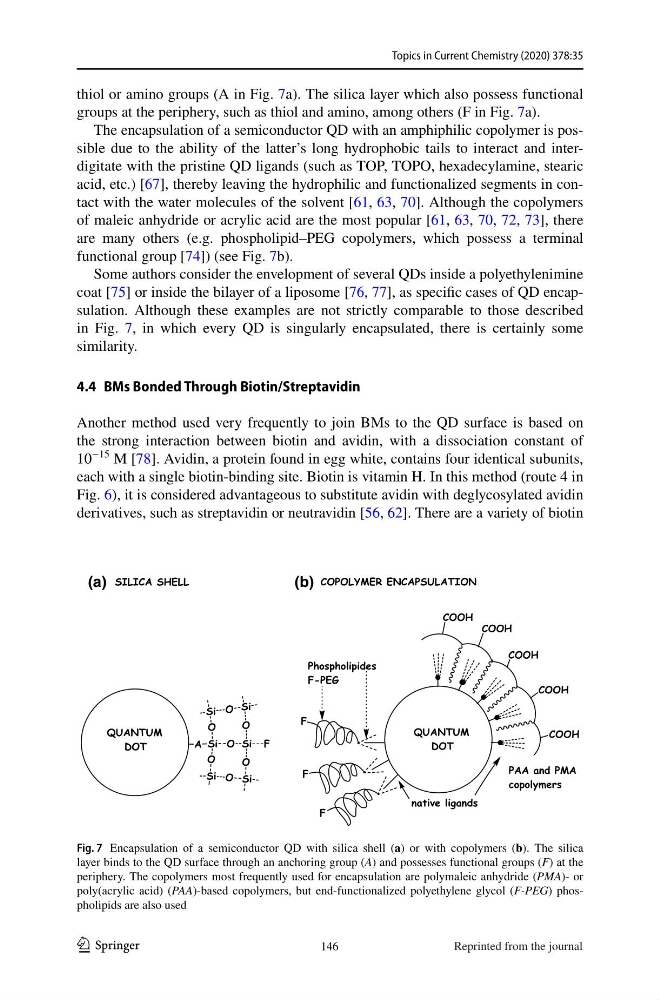
thiol or amino groups (A in Fig. 7a). The silica layer which also possess functional
groups at the periphery, such as thiol and amino, among others (F in Fig. 7a).
The encapsulation of a semiconductor QD with an amphiphilic copolymer is possible due to the ability of the latter’s long hydrophobic tails to interact and interdigitate with the pristine QD ligands (such as TOP, TOPO, hexadecylamine, stearic
acid, etc.) [67], thereby leaving the hydrophilic and functionalized segments in contact with the water molecules of the solvent [61, 63, 70]. Although the copolymers
of maleic anhydride or acrylic acid are the most popular [61, 63, 70, 72, 73], there
are many others (e.g. phospholipid–PEG copolymers, which possess a terminal
functional group [74]) (see Fig. 7b).
Some authors consider the envelopment of several QDs inside a polyethylenimine
coat [75] or inside the bilayer of a liposome [76, 77], as specific cases of QD encapsulation. Although these examples are not strictly comparable to those described
in Fig. 7, in which every QD is singularly encapsulated, there is certainly some
similarity.
4.4 BMs Bonded Through Biotin/Streptavidin
Another method used very frequently to join BMs to the QD surface is based on
the strong interaction between biotin and avidin, with a dissociation constant of
10
−15
M [78]. Avidin, a protein found in egg white, contains four identical subunits,
each with a single biotin-binding site. Biotin is vitamin H. In this method (route 4 in
Fig. 6), it is considered advantageous to substitute avidin with deglycosylated avidin
derivatives, such as streptavidin or neutravidin [56, 62]. There are a variety of biotin
A Si
O
O
O Si F
O
O
Si
Si
Si
Si
O
O
COOH
COOH
COOH
COOH
COOH
QUANTUM
DOT
QUANTUM
DOT
F
F
F
PAA and PMA
copolymers
Phospholipides
F-PEG
native ligands
(a)
(b)
SILICA SHELL
COPOLYMER ENCAPSULATION
Fig. 7 Encapsulation of a semiconductor QD with silica shell (a) or with copolymers (b). The silica
layer binds to the QD surface through an anchoring group (A) and possesses functional groups (F) at the
periphery. The copolymers most frequently used for encapsulation are polymaleic anhydride (PMA)- or
poly(acrylic acid) (PAA)-based copolymers, but end-functionalized polyethylene glycol (F-PEG) phospholipids are also used
146
Reprinted from the journal
1 3
thiol or amino groups (A in Fig. 7a). The silica layer which also possess functional
groups at the periphery, such as thiol and amino, among others (F in Fig. 7a).
The encapsulation of a semiconductor QD with an amphiphilic copolymer is possible due to the ability of the latter’s long hydrophobic tails to interact and interdigitate with the pristine QD ligands (such as TOP, TOPO, hexadecylamine, stearic
acid, etc.) [67], thereby leaving the hydrophilic and functionalized segments in contact with the water molecules of the solvent [61, 63, 70]. Although the copolymers
of maleic anhydride or acrylic acid are the most popular [61, 63, 70, 72, 73], there
are many others (e.g. phospholipid–PEG copolymers, which possess a terminal
functional group [74]) (see Fig. 7b).
Some authors consider the envelopment of several QDs inside a polyethylenimine
coat [75] or inside the bilayer of a liposome [76, 77], as specific cases of QD encapsulation. Although these examples are not strictly comparable to those described
in Fig. 7, in which every QD is singularly encapsulated, there is certainly some
similarity.
4.4 BMs Bonded Through Biotin/Streptavidin
Another method used very frequently to join BMs to the QD surface is based on
the strong interaction between biotin and avidin, with a dissociation constant of
10
−15
M [78]. Avidin, a protein found in egg white, contains four identical subunits,
each with a single biotin-binding site. Biotin is vitamin H. In this method (route 4 in
Fig. 6), it is considered advantageous to substitute avidin with deglycosylated avidin
derivatives, such as streptavidin or neutravidin [56, 62]. There are a variety of biotin
A Si
O
O
O Si F
O
O
Si
Si
Si
Si
O
O
COOH
COOH
COOH
COOH
COOH
QUANTUM
DOT
QUANTUM
DOT
F
F
F
PAA and PMA
copolymers
Phospholipides
F-PEG
native ligands
(a)
(b)
SILICA SHELL
COPOLYMER ENCAPSULATION
Fig. 7 Encapsulation of a semiconductor QD with silica shell (a) or with copolymers (b). The silica
layer binds to the QD surface through an anchoring group (A) and possesses functional groups (F) at the
periphery. The copolymers most frequently used for encapsulation are polymaleic anhydride (PMA)- or
poly(acrylic acid) (PAA)-based copolymers, but end-functionalized polyethylene glycol (F-PEG) phospholipids are also used
146
Reprinted from the journal