

1 3
Topics in Current Chemistry (2020) 378:35
derivatives that make the biotinylation of QDs and BMs a rather straightforward
process [56, 62]. QDs and BMs may be also functionalized with avidin, although
it should be noted that the attachment of avidin to the QD during initial modification will probably obscure one or more available biotin binding sites [56]; at a
later moment, however, avidin-functionalized QDs could be attached to biotinylated
BMs. Conversely, biotin-functionalized QDs can be used to join avidin-functionalized BMs. Even biotin-labeled QDs can be coupled to biotin-labeled BMs through
an intermediary avidin linker [56, 61] although unexpected results may be obtained
since the avidin can bind up to four biotin moieties [56, 61].
There are many more types of specific non-covalent affinity between pairs of molecules other than avidin/biotin interactions that are useful in bioconjugation; these
include histidine–nickel nitrilotriacetic acid interaction, barnase–barstar interaction
and antibody–ligand interaction [62].
4.5 Covalent Coupling Strategies
The focus in this section is on covalent bonding between ligands anchored onto the
QD surface (directly or attached to an encapsulating shell) and the incoming BMs.
In this regard, we consider biotin and avidin (or straptividin or neutravidin) to be
BMs.
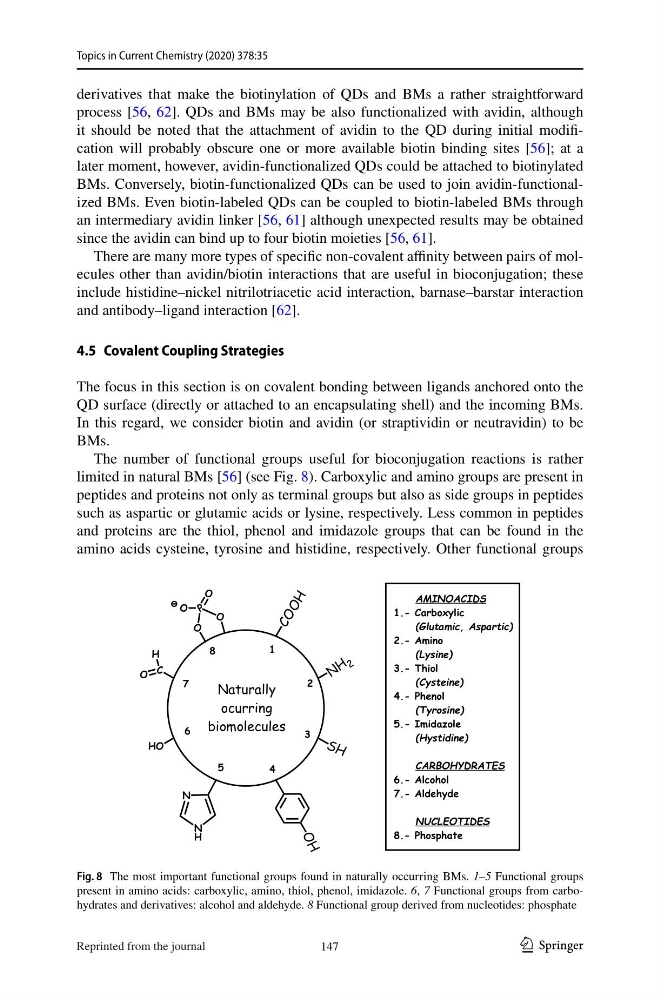
The number of functional groups useful for bioconjugation reactions is rather
limited in natural BMs [56] (see Fig. 8). Carboxylic and amino groups are present in
peptides and proteins not only as terminal groups but also as side groups in peptides
such as aspartic or glutamic acids or lysine, respectively. Less common in peptides
and proteins are the thiol, phenol and imidazole groups that can be found in the
amino acids cysteine, tyrosine and histidine, respectively. Other functional groups
Naturally
ocurring
biomolecules
N H 2
S H
HO
C
C O O H
O
H
N
N
H
O
O
P
O
O
O
H
1
2
3
4
5
6
7
8
AMINOACIDS
1.- Carboxylic
(Glutamic, Aspartic)
2.- Amino
(Lysine)
3.- Thiol
(Cysteine)
4.- Phenol
(Tyrosine)
5.- Imidazole
(Hystidine)
CARBOHYDRATES
6.- Alcohol
7.- Aldehyde
NUCLEOTIDES
8.- Phosphate
Fig. 8 The most important functional groups found in naturally occurring BMs. 1–5 Functional groups
present in amino acids: carboxylic, amino, thiol, phenol, imidazole. 6, 7 Functional groups from carbohydrates and derivatives: alcohol and aldehyde. 8 Functional group derived from nucleotides: phosphate
147
Reprinted from the journal
Topics in Current Chemistry (2020) 378:35
derivatives that make the biotinylation of QDs and BMs a rather straightforward
process [56, 62]. QDs and BMs may be also functionalized with avidin, although
it should be noted that the attachment of avidin to the QD during initial modification will probably obscure one or more available biotin binding sites [56]; at a
later moment, however, avidin-functionalized QDs could be attached to biotinylated
BMs. Conversely, biotin-functionalized QDs can be used to join avidin-functionalized BMs. Even biotin-labeled QDs can be coupled to biotin-labeled BMs through
an intermediary avidin linker [56, 61] although unexpected results may be obtained
since the avidin can bind up to four biotin moieties [56, 61].
There are many more types of specific non-covalent affinity between pairs of molecules other than avidin/biotin interactions that are useful in bioconjugation; these
include histidine–nickel nitrilotriacetic acid interaction, barnase–barstar interaction
and antibody–ligand interaction [62].
4.5 Covalent Coupling Strategies
The focus in this section is on covalent bonding between ligands anchored onto the
QD surface (directly or attached to an encapsulating shell) and the incoming BMs.
In this regard, we consider biotin and avidin (or straptividin or neutravidin) to be
BMs.
The number of functional groups useful for bioconjugation reactions is rather
limited in natural BMs [56] (see Fig. 8). Carboxylic and amino groups are present in
peptides and proteins not only as terminal groups but also as side groups in peptides
such as aspartic or glutamic acids or lysine, respectively. Less common in peptides
and proteins are the thiol, phenol and imidazole groups that can be found in the
amino acids cysteine, tyrosine and histidine, respectively. Other functional groups
Naturally
ocurring
biomolecules
N H 2
S H
HO
C
C O O H
O
H
N
N
H
O
O
P
O
O
O
H
1
2
3
4
5
6
7
8
AMINOACIDS
1.- Carboxylic
(Glutamic, Aspartic)
2.- Amino
(Lysine)
3.- Thiol
(Cysteine)
4.- Phenol
(Tyrosine)
5.- Imidazole
(Hystidine)
CARBOHYDRATES
6.- Alcohol
7.- Aldehyde
NUCLEOTIDES
8.- Phosphate
Fig. 8 The most important functional groups found in naturally occurring BMs. 1–5 Functional groups
present in amino acids: carboxylic, amino, thiol, phenol, imidazole. 6, 7 Functional groups from carbohydrates and derivatives: alcohol and aldehyde. 8 Functional group derived from nucleotides: phosphate
147
Reprinted from the journal