

1 3
Topics in Current Chemistry (2020) 378:35
to have selectively carboxylic, amine or other groups in their surface [65]. On the
contrary, native semiconductor QDs, with some exceptions being those prepared in
water [66, 67], do not have the appropriate ligands able to be robustly bonded to a
BM. However, this is not a problem because, as seen in the preceding section, the
original ligands can be replaced by others. The new ligands could be monodentate
or bidentate simple molecules, such as 3-mercaptopropionic acid (MPA) or dihydrolipoic acid (DHLA), respectively [68], that are attachable to the QD surface
through the thiol group(s) and which possess a free terminal carboxylic group to join
the BM. However, the new ligands are usually complex molecules with an anchoring group(s) (e.g. polythiol), a spacer chain (frequently a hydrophilic segment) and
a terminal functional group (carboxylic or amine groups among others) [69]. Very
often, the spacer chain is PEG, that is the whole ligand is a bifunctional PEG molecule [67] because PEG is biocompatible and highly soluble in water and stabilizes
QDs against aggregation.
4.3 BMs Bonded to an Encapsulating Shell
The native ligand exchange method is associated with a number of problems, such
as a relatively weaker bond between the thiol group and the metal of the QD surface,
reduced photoluminescent quantum yield, among others [61, 63]. An alternative is
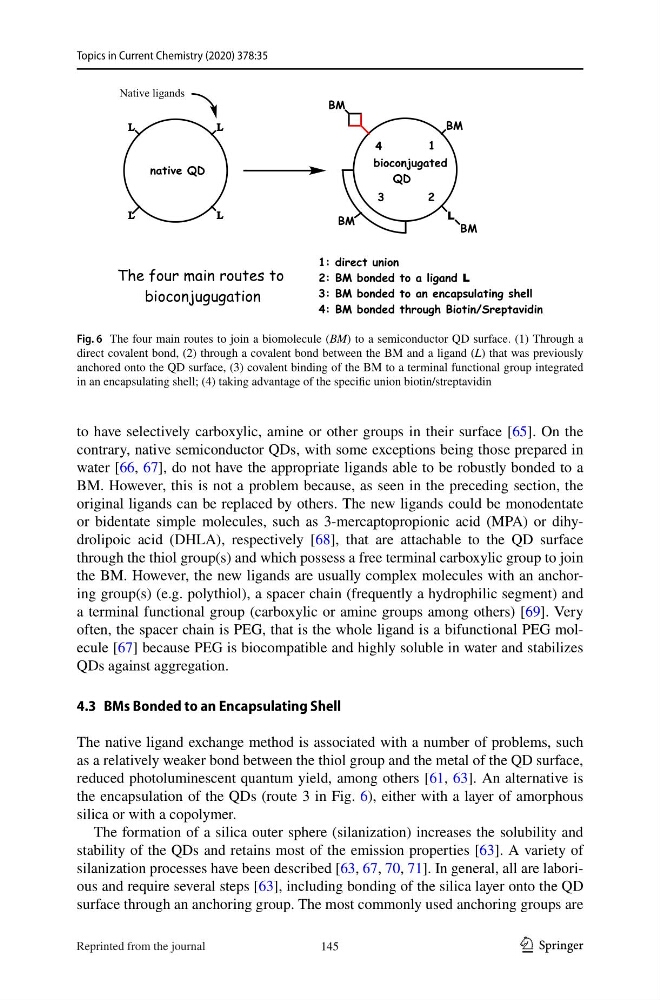
the encapsulation of the QDs (route 3 in Fig. 6), either with a layer of amorphous
silica or with a copolymer.
The formation of a silica outer sphere (silanization) increases the solubility and
stability of the QDs and retains most of the emission properties [63]. A variety of
silanization processes have been described [63, 67, 70, 71]. In general, all are laborious and require several steps [63], including bonding of the silica layer onto the QD
surface through an anchoring group. The most commonly used anchoring groups are
L
L
L
L
BM
L
BM
BM
BM
1
2
4
3
The four main routes to
bioconjugugation
1: direct union
2: BM bonded to a ligand L
3: BM bonded to an encapsulating shell
4: BM bonded through Biotin/Sreptavidin
native QD
bioconjugated
QD
Native ligands
Fig. 6 The four main routes to join a biomolecule (BM) to a semiconductor QD surface. (1) Through a
direct covalent bond, (2) through a covalent bond between the BM and a ligand (L) that was previously
anchored onto the QD surface, (3) covalent binding of the BM to a terminal functional group integrated
in an encapsulating shell; (4) taking advantage of the specific union biotin/streptavidin
145
Reprinted from the journal
Topics in Current Chemistry (2020) 378:35
to have selectively carboxylic, amine or other groups in their surface [65]. On the
contrary, native semiconductor QDs, with some exceptions being those prepared in
water [66, 67], do not have the appropriate ligands able to be robustly bonded to a
BM. However, this is not a problem because, as seen in the preceding section, the
original ligands can be replaced by others. The new ligands could be monodentate
or bidentate simple molecules, such as 3-mercaptopropionic acid (MPA) or dihydrolipoic acid (DHLA), respectively [68], that are attachable to the QD surface
through the thiol group(s) and which possess a free terminal carboxylic group to join
the BM. However, the new ligands are usually complex molecules with an anchoring group(s) (e.g. polythiol), a spacer chain (frequently a hydrophilic segment) and
a terminal functional group (carboxylic or amine groups among others) [69]. Very
often, the spacer chain is PEG, that is the whole ligand is a bifunctional PEG molecule [67] because PEG is biocompatible and highly soluble in water and stabilizes
QDs against aggregation.
4.3 BMs Bonded to an Encapsulating Shell
The native ligand exchange method is associated with a number of problems, such
as a relatively weaker bond between the thiol group and the metal of the QD surface,
reduced photoluminescent quantum yield, among others [61, 63]. An alternative is
the encapsulation of the QDs (route 3 in Fig. 6), either with a layer of amorphous
silica or with a copolymer.
The formation of a silica outer sphere (silanization) increases the solubility and
stability of the QDs and retains most of the emission properties [63]. A variety of
silanization processes have been described [63, 67, 70, 71]. In general, all are laborious and require several steps [63], including bonding of the silica layer onto the QD
surface through an anchoring group. The most commonly used anchoring groups are
L
L
L
L
BM
L
BM
BM
BM
1
2
4
3
The four main routes to
bioconjugugation
1: direct union
2: BM bonded to a ligand L
3: BM bonded to an encapsulating shell
4: BM bonded through Biotin/Sreptavidin
native QD
bioconjugated
QD
Native ligands
Fig. 6 The four main routes to join a biomolecule (BM) to a semiconductor QD surface. (1) Through a
direct covalent bond, (2) through a covalent bond between the BM and a ligand (L) that was previously
anchored onto the QD surface, (3) covalent binding of the BM to a terminal functional group integrated
in an encapsulating shell; (4) taking advantage of the specific union biotin/streptavidin
145
Reprinted from the journal