

Topics in Current Chemistry (2020) 378:35
1 3
2.2 Metal‑Doped QDs
In recent years, advances made in the rational design of nanomaterials have contributed to the development of hybrid NPs that combine the interesting size- and
shape-dependent properties of semiconductor QDs with a long-lived phosphorescence-type emission. In this context, the incorporation of suitable atoms or
ions into host lattices has generated a novel type of QDs that are very promising
for use in bioanalytical applications [30]. ZnS, ZnO, ZnSe, CdS and CdSe QDs
can be used as host lattices into which other transition-metal and lanthanide ions,
including Mn
2+
, Cu
2+
, Co
2+
, Ni
2+
, Ag
+
, Pb
2+
, Cr
3+
, Eu
3+
, Tb
3+
, Sm
3+
and Er
3+
,
are incorporated as dopant agents, giving rise to luminescent QDs with novel
properties [31]. Consequently, host lattices such as as ZnS and ZnO are being
widely studied because, first, they do not contain toxic metals and thus potentially
have a lower toxicity and, second, they are characterized by a larger energy band
gap, which allows the incorporation of more doping agents, which is very attractive in terms of developing dual-doped QDs [32, 33]. The introduction of the
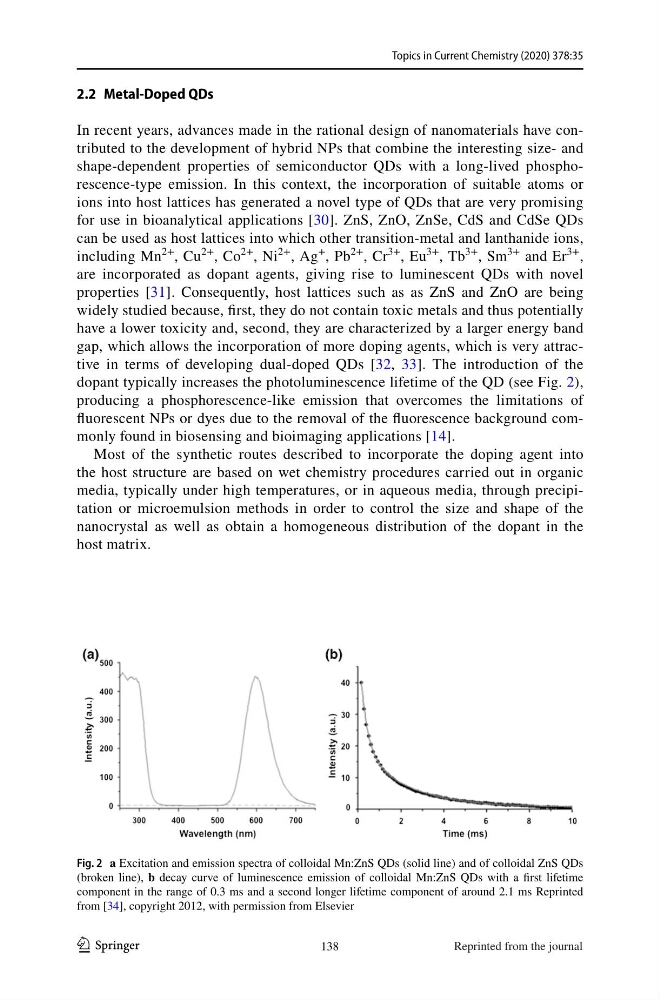
dopant typically increases the photoluminescence lifetime of the QD (see Fig. 2),
producing a phosphorescence-like emission that overcomes the limitations of
fluorescent NPs or dyes due to the removal of the fluorescence background commonly found in biosensing and bioimaging applications [14].
Most of the synthetic routes described to incorporate the doping agent into
the host structure are based on wet chemistry procedures carried out in organic
media, typically under high temperatures, or in aqueous media, through precipitation or microemulsion methods in order to control the size and shape of the
nanocrystal as well as obtain a homogeneous distribution of the dopant in the
host matrix.
Fig. 2 a Excitation and emission spectra of colloidal Mn:ZnS QDs (solid line) and of colloidal ZnS QDs
(broken line), b decay curve of luminescence emission of colloidal Mn:ZnS QDs with a first lifetime
component in the range of 0.3 ms and a second longer lifetime component of around 2.1 ms Reprinted
from [34], copyright 2012, with permission from Elsevier
138
Reprinted from the journal
1 3
2.2 Metal‑Doped QDs
In recent years, advances made in the rational design of nanomaterials have contributed to the development of hybrid NPs that combine the interesting size- and
shape-dependent properties of semiconductor QDs with a long-lived phosphorescence-type emission. In this context, the incorporation of suitable atoms or
ions into host lattices has generated a novel type of QDs that are very promising
for use in bioanalytical applications [30]. ZnS, ZnO, ZnSe, CdS and CdSe QDs
can be used as host lattices into which other transition-metal and lanthanide ions,
including Mn
2+
, Cu
2+
, Co
2+
, Ni
2+
, Ag
+
, Pb
2+
, Cr
3+
, Eu
3+
, Tb
3+
, Sm
3+
and Er
3+
,
are incorporated as dopant agents, giving rise to luminescent QDs with novel
properties [31]. Consequently, host lattices such as as ZnS and ZnO are being
widely studied because, first, they do not contain toxic metals and thus potentially
have a lower toxicity and, second, they are characterized by a larger energy band
gap, which allows the incorporation of more doping agents, which is very attractive in terms of developing dual-doped QDs [32, 33]. The introduction of the
dopant typically increases the photoluminescence lifetime of the QD (see Fig. 2),
producing a phosphorescence-like emission that overcomes the limitations of
fluorescent NPs or dyes due to the removal of the fluorescence background commonly found in biosensing and bioimaging applications [14].
Most of the synthetic routes described to incorporate the doping agent into
the host structure are based on wet chemistry procedures carried out in organic
media, typically under high temperatures, or in aqueous media, through precipitation or microemulsion methods in order to control the size and shape of the
nanocrystal as well as obtain a homogeneous distribution of the dopant in the
host matrix.
Fig. 2 a Excitation and emission spectra of colloidal Mn:ZnS QDs (solid line) and of colloidal ZnS QDs
(broken line), b decay curve of luminescence emission of colloidal Mn:ZnS QDs with a first lifetime
component in the range of 0.3 ms and a second longer lifetime component of around 2.1 ms Reprinted
from [34], copyright 2012, with permission from Elsevier
138
Reprinted from the journal