

1 3
Topics in Current Chemistry (2020) 378:35
2.3 Carbon‑Based QDs (C‑dots)
Inorganic semiconductor QDs have been intensely evaluated as luminescent nanomaterials for bioanalytical applications, but carbon-based NPs, such as CQDs and
graphene QDs (GQDs), have also drawn attention as attractive alternatives due to
their high photoluminescence quantum yields, low photobleaching effects, high
biocompatibility and low toxicity, while avoiding the use of heavy metals commonly found in semiconductor QDs [35]. Additionally, carbon-based NPs possess an exceptional colloidal stability in aqueous media as a consequence of their
small size, since Brownian motion provides sufficient energy to inhibit aggregation between them [36, 37].
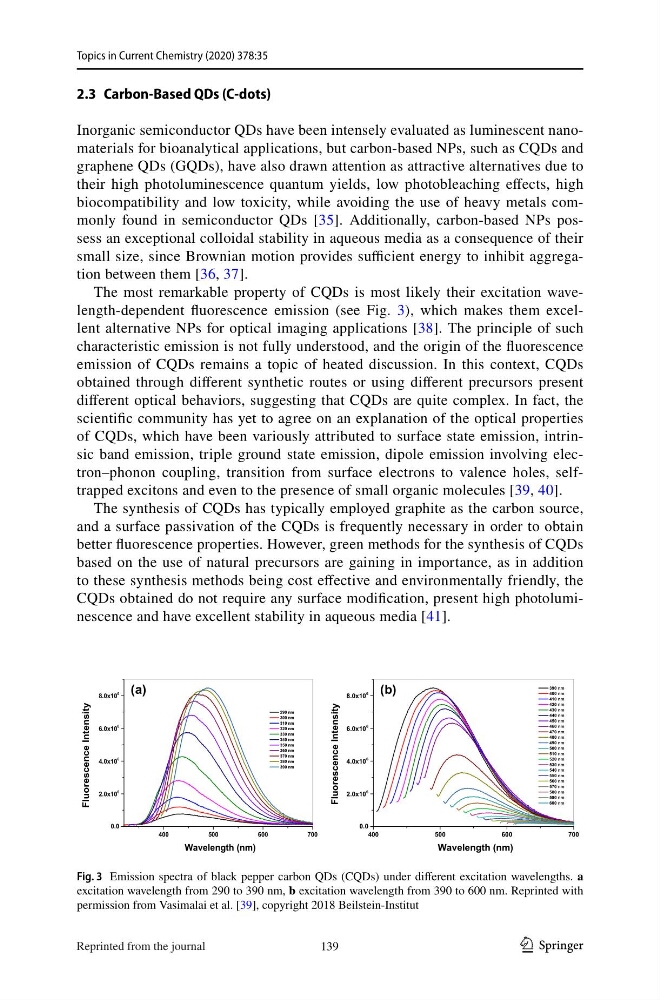
The most remarkable property of CQDs is most likely their excitation wavelength-dependent fluorescence emission (see Fig. 3), which makes them excellent alternative NPs for optical imaging applications [38]. The principle of such
characteristic emission is not fully understood, and the origin of the fluorescence
emission of CQDs remains a topic of heated discussion. In this context, CQDs
obtained through different synthetic routes or using different precursors present
different optical behaviors, suggesting that CQDs are quite complex. In fact, the
scientific community has yet to agree on an explanation of the optical properties
of CQDs, which have been variously attributed to surface state emission, intrinsic band emission, triple ground state emission, dipole emission involving electron–phonon coupling, transition from surface electrons to valence holes, selftrapped excitons and even to the presence of small organic molecules [39, 40].
The synthesis of CQDs has typically employed graphite as the carbon source,
and a surface passivation of the CQDs is frequently necessary in order to obtain
better fluorescence properties. However, green methods for the synthesis of CQDs
based on the use of natural precursors are gaining in importance, as in addition
to these synthesis methods being cost effective and environmentally friendly, the
CQDs obtained do not require any surface modification, present high photoluminescence and have excellent stability in aqueous media [41].
400
5 00
600
7 00
0.0
2.0x10 6
4.0x10 6
6.0x10 6
8.0x10 6
Wavelength (nm)
Fluorescence Intensity
390 nm
400 nm
410 nm
420 nm
430 nm
440 nm
450 nm
460 nm
470 nm
480 nm
490 nm
500 nm
510 nm
520 nm
530 nm
540 nm
550 nm
560 nm
570 nm
580 nm
590 nm
600 nm
(a)
( b)
400
5 00
600
700
0.0
2.0x10 6
4.0x10 6
6.0x10 6
8.0x10 6
Wavelength (nm)
Fluorescence Intensity
290 nm
300 nm
310 nm
320 nm
330 nm
340 nm
350 nm
360 nm
370 nm
380 nm
390 nm
Fig. 3 Emission spectra of black pepper carbon QDs (CQDs) under different excitation wavelengths. a
excitation wavelength from 290 to 390 nm, b excitation wavelength from 390 to 600 nm. Reprinted with
permission from Vasimalai et al. [39], copyright 2018 Beilstein-Institut
139
Reprinted from the journal
Topics in Current Chemistry (2020) 378:35
2.3 Carbon‑Based QDs (C‑dots)
Inorganic semiconductor QDs have been intensely evaluated as luminescent nanomaterials for bioanalytical applications, but carbon-based NPs, such as CQDs and
graphene QDs (GQDs), have also drawn attention as attractive alternatives due to
their high photoluminescence quantum yields, low photobleaching effects, high
biocompatibility and low toxicity, while avoiding the use of heavy metals commonly found in semiconductor QDs [35]. Additionally, carbon-based NPs possess an exceptional colloidal stability in aqueous media as a consequence of their
small size, since Brownian motion provides sufficient energy to inhibit aggregation between them [36, 37].
The most remarkable property of CQDs is most likely their excitation wavelength-dependent fluorescence emission (see Fig. 3), which makes them excellent alternative NPs for optical imaging applications [38]. The principle of such
characteristic emission is not fully understood, and the origin of the fluorescence
emission of CQDs remains a topic of heated discussion. In this context, CQDs
obtained through different synthetic routes or using different precursors present
different optical behaviors, suggesting that CQDs are quite complex. In fact, the
scientific community has yet to agree on an explanation of the optical properties
of CQDs, which have been variously attributed to surface state emission, intrinsic band emission, triple ground state emission, dipole emission involving electron–phonon coupling, transition from surface electrons to valence holes, selftrapped excitons and even to the presence of small organic molecules [39, 40].
The synthesis of CQDs has typically employed graphite as the carbon source,
and a surface passivation of the CQDs is frequently necessary in order to obtain
better fluorescence properties. However, green methods for the synthesis of CQDs
based on the use of natural precursors are gaining in importance, as in addition
to these synthesis methods being cost effective and environmentally friendly, the
CQDs obtained do not require any surface modification, present high photoluminescence and have excellent stability in aqueous media [41].
400
5 00
600
7 00
0.0
2.0x10 6
4.0x10 6
6.0x10 6
8.0x10 6
Wavelength (nm)
Fluorescence Intensity
390 nm
400 nm
410 nm
420 nm
430 nm
440 nm
450 nm
460 nm
470 nm
480 nm
490 nm
500 nm
510 nm
520 nm
530 nm
540 nm
550 nm
560 nm
570 nm
580 nm
590 nm
600 nm
(a)
( b)
400
5 00
600
700
0.0
2.0x10 6
4.0x10 6
6.0x10 6
8.0x10 6
Wavelength (nm)
Fluorescence Intensity
290 nm
300 nm
310 nm
320 nm
330 nm
340 nm
350 nm
360 nm
370 nm
380 nm
390 nm
Fig. 3 Emission spectra of black pepper carbon QDs (CQDs) under different excitation wavelengths. a
excitation wavelength from 290 to 390 nm, b excitation wavelength from 390 to 600 nm. Reprinted with
permission from Vasimalai et al. [39], copyright 2018 Beilstein-Institut
139
Reprinted from the journal