

1 3
Topics in Current Chemistry (2020) 378:35
PbS, InP, among others, all of which also affect their spectral properties. Such
features of QDs are very attractive because emission in a wide range of spectra,
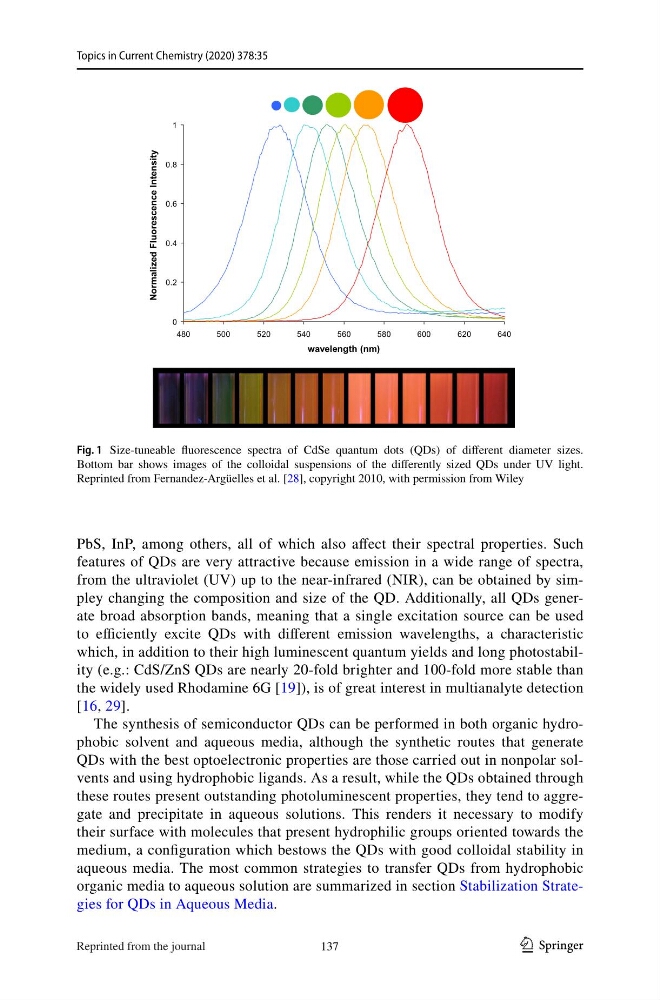
from the ultraviolet (UV) up to the near-infrared (NIR), can be obtained by simpley changing the composition and size of the QD. Additionally, all QDs generate broad absorption bands, meaning that a single excitation source can be used
to efficiently excite QDs with different emission wavelengths, a characteristic
which, in addition to their high luminescent quantum yields and long photostability (e.g.: CdS/ZnS QDs are nearly 20-fold brighter and 100-fold more stable than
the widely used Rhodamine 6G [19]), is of great interest in multianalyte detection
[16, 29].
The synthesis of semiconductor QDs can be performed in both organic hydrophobic solvent and aqueous media, although the synthetic routes that generate
QDs with the best optoelectronic properties are those carried out in nonpolar solvents and using hydrophobic ligands. As a result, while the QDs obtained through
these routes present outstanding photoluminescent properties, they tend to aggregate and precipitate in aqueous solutions. This renders it necessary to modify
their surface with molecules that present hydrophilic groups oriented towards the
medium, a configuration which bestows the QDs with good colloidal stability in
aqueous media. The most common strategies to transfer QDs from hydrophobic
organic media to aqueous solution are summarized in section Stabilization Strategies for QDs in Aqueous Media.
0
0.2
0.4
0.6
0.8
1
480
500
520
540
5 60
580
6 00
620
6 40
wavelength (nm)
Normalized Fluorescence Intensity
Fig. 1 Size-tuneable fluorescence spectra of CdSe quantum dots (QDs) of different diameter sizes.
Bottom bar shows images of the colloidal suspensions of the differently sized QDs under UV light.
Reprinted from Fernandez-Argüelles et al. [28], copyright 2010, with permission from Wiley
137
Reprinted from the journal
Topics in Current Chemistry (2020) 378:35
PbS, InP, among others, all of which also affect their spectral properties. Such
features of QDs are very attractive because emission in a wide range of spectra,
from the ultraviolet (UV) up to the near-infrared (NIR), can be obtained by simpley changing the composition and size of the QD. Additionally, all QDs generate broad absorption bands, meaning that a single excitation source can be used
to efficiently excite QDs with different emission wavelengths, a characteristic
which, in addition to their high luminescent quantum yields and long photostability (e.g.: CdS/ZnS QDs are nearly 20-fold brighter and 100-fold more stable than
the widely used Rhodamine 6G [19]), is of great interest in multianalyte detection
[16, 29].
The synthesis of semiconductor QDs can be performed in both organic hydrophobic solvent and aqueous media, although the synthetic routes that generate
QDs with the best optoelectronic properties are those carried out in nonpolar solvents and using hydrophobic ligands. As a result, while the QDs obtained through
these routes present outstanding photoluminescent properties, they tend to aggregate and precipitate in aqueous solutions. This renders it necessary to modify
their surface with molecules that present hydrophilic groups oriented towards the
medium, a configuration which bestows the QDs with good colloidal stability in
aqueous media. The most common strategies to transfer QDs from hydrophobic
organic media to aqueous solution are summarized in section Stabilization Strategies for QDs in Aqueous Media.
0
0.2
0.4
0.6
0.8
1
480
500
520
540
5 60
580
6 00
620
6 40
wavelength (nm)
Normalized Fluorescence Intensity
Fig. 1 Size-tuneable fluorescence spectra of CdSe quantum dots (QDs) of different diameter sizes.
Bottom bar shows images of the colloidal suspensions of the differently sized QDs under UV light.
Reprinted from Fernandez-Argüelles et al. [28], copyright 2010, with permission from Wiley
137
Reprinted from the journal