

Topics in Current Chemistry (2020) 378:12
1 3
on the electron transfer rate as a consequence of interfacial changes resulting
in electron tunneling through NP–NP and NP–electrode junctions [204]. It is
convenient to highlight that the electrochemical interpretation of bionanoconjugated systems is delicate, and results may be misinterpreted. Bartlett et al. [205]
argue that the vast majority of articles reporting biosensors with direct electron
transfer (DET) between native GOx and nanostructured electrodes are incorrect.
This is due to the lack of a critical and deep analysis of experimental evidence.
Bartlett and coauthors demonstrate their hypotheses by an exhaustive study of
experimental results, and suggest evidence that should be fulfilled in order to
support any serious claim of DET for GOx.
Several architectures are reported in the literature to conjugate biomolecules
with nanoparticles, such as a totally random distribution [206], a self-assembled monolayer (SAM) [147] or a layer-by-layer (LBL) assembly [174] (Fig. 9).
The main methods summarized in the section Conjugation of Biomolecules to
NPs: the Main Key to Further Applications are also employed for the preparation of electrochemical biosensors, viz. adsorption [207], encapsulation [208],
covalent binding [209], cross-linking [210] and supramolecular associations
[211]. Herein, we will focus on major issues regarding bioconjugates of AuNPs,
AgNPs and IONPs for bioelectrochemical applications.
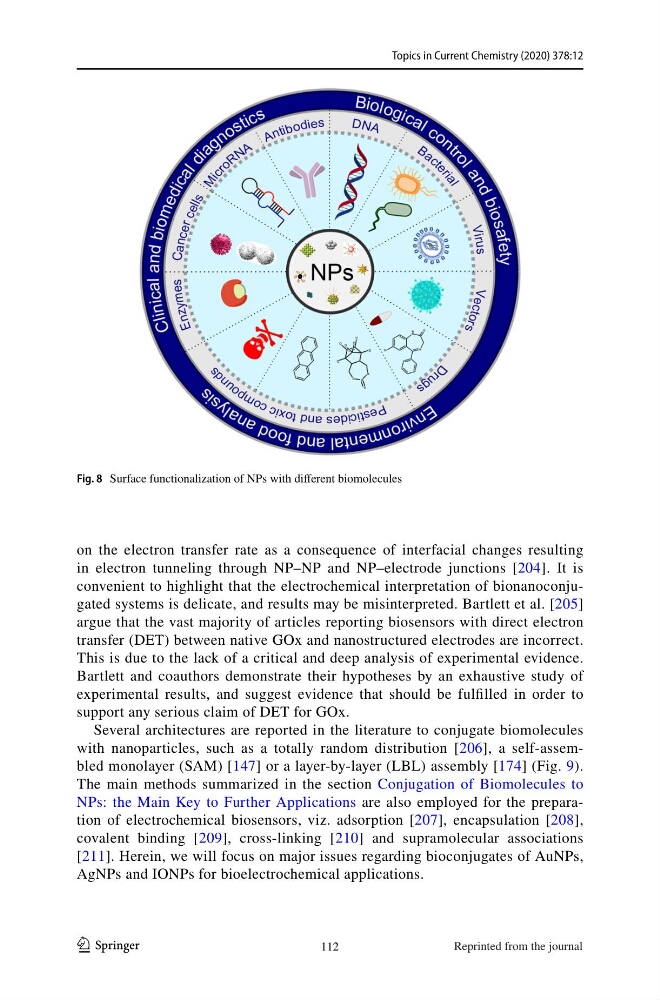
Fig. 8 Surface functionalization of NPs with different biomolecules
112
Reprinted from the journal
1 3
on the electron transfer rate as a consequence of interfacial changes resulting
in electron tunneling through NP–NP and NP–electrode junctions [204]. It is
convenient to highlight that the electrochemical interpretation of bionanoconjugated systems is delicate, and results may be misinterpreted. Bartlett et al. [205]
argue that the vast majority of articles reporting biosensors with direct electron
transfer (DET) between native GOx and nanostructured electrodes are incorrect.
This is due to the lack of a critical and deep analysis of experimental evidence.
Bartlett and coauthors demonstrate their hypotheses by an exhaustive study of
experimental results, and suggest evidence that should be fulfilled in order to
support any serious claim of DET for GOx.
Several architectures are reported in the literature to conjugate biomolecules
with nanoparticles, such as a totally random distribution [206], a self-assembled monolayer (SAM) [147] or a layer-by-layer (LBL) assembly [174] (Fig. 9).
The main methods summarized in the section Conjugation of Biomolecules to
NPs: the Main Key to Further Applications are also employed for the preparation of electrochemical biosensors, viz. adsorption [207], encapsulation [208],
covalent binding [209], cross-linking [210] and supramolecular associations
[211]. Herein, we will focus on major issues regarding bioconjugates of AuNPs,
AgNPs and IONPs for bioelectrochemical applications.
Fig. 8 Surface functionalization of NPs with different biomolecules
112
Reprinted from the journal