

1 3
Topics in Current Chemistry (2020) 378:12
6.1 Electrochemical Applications of Bioconjugates Based on AuNPs
AuNPs are attractive scaffolds due to their compatibility with the immobilization
of biomolecules while maintaining catalytic activity and providing a large specific surface area and good electrocatalytic properties [212, 213].
For instance, the use of AuNPs for the development of glucose biosensors
has been exploited extensively due to good electrical communication between
the transducer and the active redox site of the enzyme [214]. Rassas et al. [212]
recently reported the development of a nanobiosensor for glucose detection capable of detecting concentrations of the order 5 µM and a dynamic range between
10 µM and 7 μM. Here, the presence of AuNPs improved the performance of biosensor based on a mixed polysaccharide/GOx composite. This biosensor established improvements such as avoiding loss of selectivity, high sensitivity (283.9
µA/log[glucose]), allowing the application to real biological samples such as
saliva and serum [212].
Zou et al. [215] developed an electrochemical immunosensor for enzyme-free
detection of E.coli K12 by employing as nanocomposite AuNPs attached to the
polypyrrole (PPy)-RGO) surface through electrostatic adsorption. This serves as
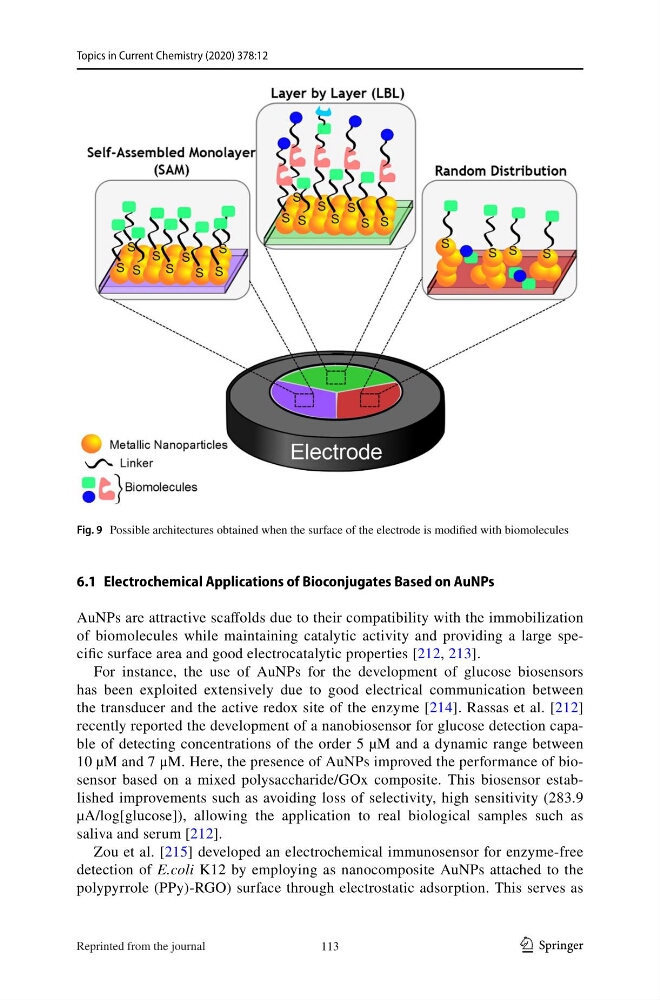
Fig. 9 Possible architectures obtained when the surface of the electrode is modified with biomolecules
113
Reprinted from the journal
Topics in Current Chemistry (2020) 378:12
6.1 Electrochemical Applications of Bioconjugates Based on AuNPs
AuNPs are attractive scaffolds due to their compatibility with the immobilization
of biomolecules while maintaining catalytic activity and providing a large specific surface area and good electrocatalytic properties [212, 213].
For instance, the use of AuNPs for the development of glucose biosensors
has been exploited extensively due to good electrical communication between
the transducer and the active redox site of the enzyme [214]. Rassas et al. [212]
recently reported the development of a nanobiosensor for glucose detection capable of detecting concentrations of the order 5 µM and a dynamic range between
10 µM and 7 μM. Here, the presence of AuNPs improved the performance of biosensor based on a mixed polysaccharide/GOx composite. This biosensor established improvements such as avoiding loss of selectivity, high sensitivity (283.9
µA/log[glucose]), allowing the application to real biological samples such as
saliva and serum [212].
Zou et al. [215] developed an electrochemical immunosensor for enzyme-free
detection of E.coli K12 by employing as nanocomposite AuNPs attached to the
polypyrrole (PPy)-RGO) surface through electrostatic adsorption. This serves as
Fig. 9 Possible architectures obtained when the surface of the electrode is modified with biomolecules
113
Reprinted from the journal