

Topics in Current Chemistry (2020) 378:12
1 3
may be extended to other nanometric systems such as AgNPs and noble metal alloys
[40].
For AuNPs and AgNPs, the resonance condition is satisfied at visible wavelengths. Thus, AuNPs of around 10 nm are red, possessing a maximum at approximately 510 nm; whereas AgNPs of similar size are yellow, corresponding to an
absorption maximum at around 400 nm. Multiple factors influence the maximum
of the SPR, including metal type [41], NP size [42], shape [43], functionality of the
nanostructure [44], composition [45], interparticle distance [46], ligand–NP interactions [47], the refractive index of the medium [48], pressure [49] and temperature
[50].
2.2 Iron Oxide NPs
Among metal oxides NPs, iron oxide NPs (IONPs) have attracted special interest
due to their attractive magnetic properties as well as their high biocompatibility and
low toxicity [51]. Magnetic materials are classified as ferromagnetic, ferrimagnetic,
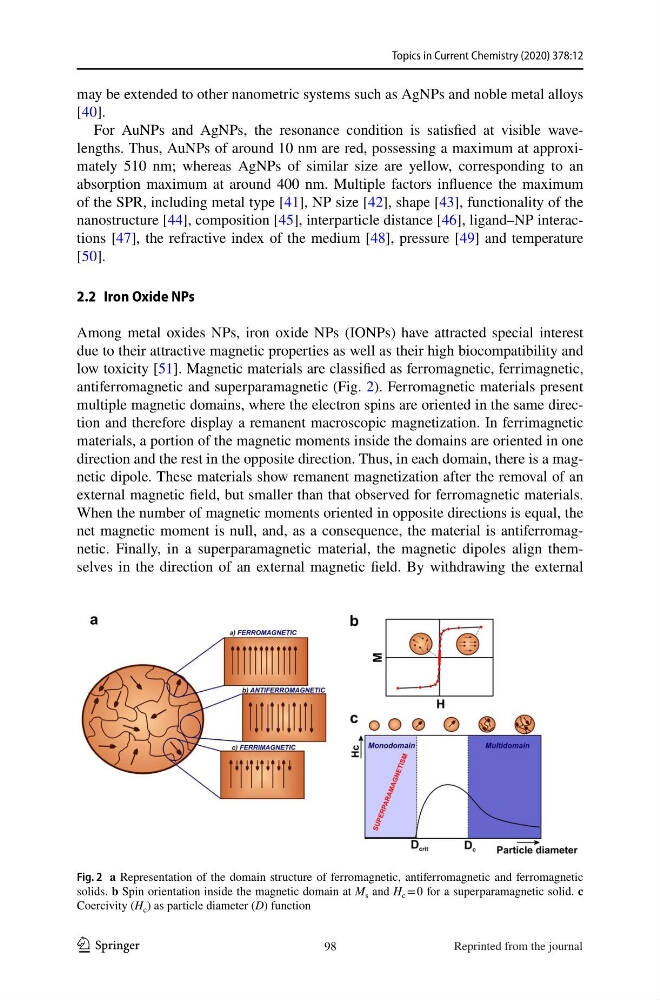
antiferromagnetic and superparamagnetic (Fig. 2). Ferromagnetic materials present
multiple magnetic domains, where the electron spins are oriented in the same direction and therefore display a remanent macroscopic magnetization. In ferrimagnetic
materials, a portion of the magnetic moments inside the domains are oriented in one
direction and the rest in the opposite direction. Thus, in each domain, there is a magnetic dipole. These materials show remanent magnetization after the removal of an
external magnetic field, but smaller than that observed for ferromagnetic materials.
When the number of magnetic moments oriented in opposite directions is equal, the
net magnetic moment is null, and, as a consequence, the material is antiferromagnetic. Finally, in a superparamagnetic material, the magnetic dipoles align themselves in the direction of an external magnetic field. By withdrawing the external
Fig. 2 a Representation of the domain structure of ferromagnetic, antiferromagnetic and ferromagnetic
solids. b Spin orientation inside the magnetic domain at M s and H c = 0 for a superparamagnetic solid. c
Coercivity (H c ) as particle diameter (D) function
98
Reprinted from the journal
1 3
may be extended to other nanometric systems such as AgNPs and noble metal alloys
[40].
For AuNPs and AgNPs, the resonance condition is satisfied at visible wavelengths. Thus, AuNPs of around 10 nm are red, possessing a maximum at approximately 510 nm; whereas AgNPs of similar size are yellow, corresponding to an
absorption maximum at around 400 nm. Multiple factors influence the maximum
of the SPR, including metal type [41], NP size [42], shape [43], functionality of the
nanostructure [44], composition [45], interparticle distance [46], ligand–NP interactions [47], the refractive index of the medium [48], pressure [49] and temperature
[50].
2.2 Iron Oxide NPs
Among metal oxides NPs, iron oxide NPs (IONPs) have attracted special interest
due to their attractive magnetic properties as well as their high biocompatibility and
low toxicity [51]. Magnetic materials are classified as ferromagnetic, ferrimagnetic,
antiferromagnetic and superparamagnetic (Fig. 2). Ferromagnetic materials present
multiple magnetic domains, where the electron spins are oriented in the same direction and therefore display a remanent macroscopic magnetization. In ferrimagnetic
materials, a portion of the magnetic moments inside the domains are oriented in one
direction and the rest in the opposite direction. Thus, in each domain, there is a magnetic dipole. These materials show remanent magnetization after the removal of an
external magnetic field, but smaller than that observed for ferromagnetic materials.
When the number of magnetic moments oriented in opposite directions is equal, the
net magnetic moment is null, and, as a consequence, the material is antiferromagnetic. Finally, in a superparamagnetic material, the magnetic dipoles align themselves in the direction of an external magnetic field. By withdrawing the external
Fig. 2 a Representation of the domain structure of ferromagnetic, antiferromagnetic and ferromagnetic
solids. b Spin orientation inside the magnetic domain at M s and H c = 0 for a superparamagnetic solid. c
Coercivity (H c ) as particle diameter (D) function
98
Reprinted from the journal