

1 3
Topics in Current Chemistry (2020) 378:12
field, thermal fluctuations cause disordered movement of the magnetic moments,
which causes a null magnetic moment. The superparamagnetic behavior of a material is the result of magnetic anisotropy. Two main contributions to anisotropy exist,
related to (1) crystal anisotropy and (2) particle shape and morphology. Crystal anisotropy is associated with the existence of different crystallographic directions along
which the spins of the electrons are aligned faster, and, therefore, the substance is
easily magnetized. The other anisotropic contribution is related to the size and morphology of the particles; for example, spherical particles are prone to present smaller
coercivity than elongated particles [52].
If the material size decreases toward the nanoscale, the number of spins that
can be oriented by an external magnetic field is increased. In this case, a tendency
toward superparamagnetic behavior is produced. It is known that IONPs can adopt
a superparamagnetic behavior above a critical diameter (Fig. 2c), i.e., the NPs are
attracted to the magnet but when the magnetic field is removed they lose magnetization [53]. The critical diameter where superparamagnetic behavior is observed is
around 15–20 nm for magnetite NPs [54].
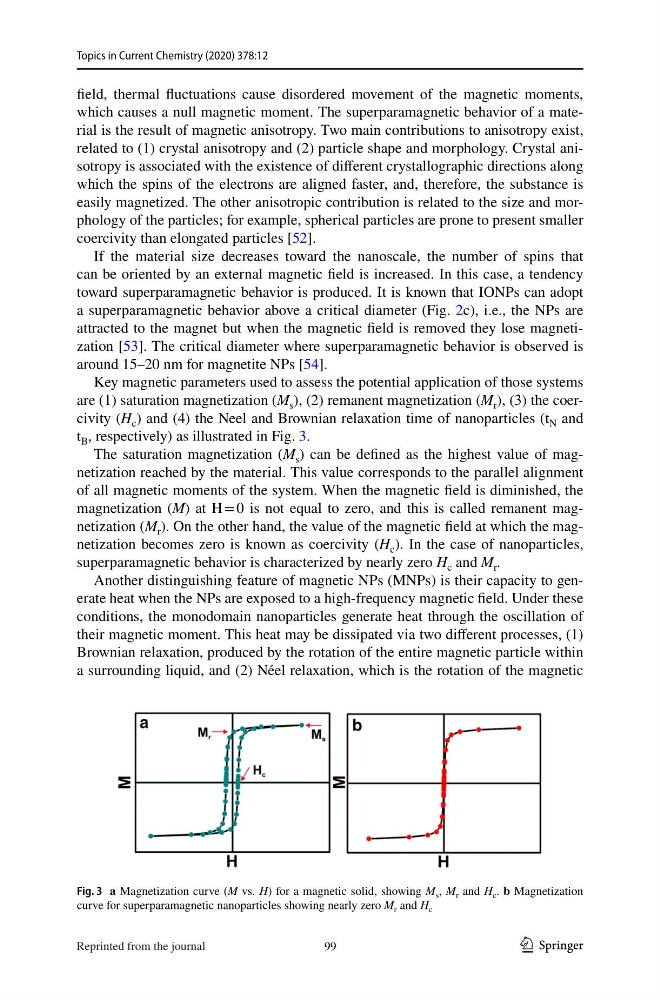
Key magnetic parameters used to assess the potential application of those systems
are (1) saturation magnetization (M s ), (2) remanent magnetization (M r ), (3) the coercivity (H c ) and (4) the Neel and Brownian relaxation time of nanoparticles (t N and
t B , respectively) as illustrated in Fig. 3.
The saturation magnetization (M s ) can be defined as the highest value of magnetization reached by the material. This value corresponds to the parallel alignment
of all magnetic moments of the system. When the magnetic field is diminished, the
magnetization (M) at H = 0 is not equal to zero, and this is called remanent magnetization (M r ). On the other hand, the value of the magnetic field at which the magnetization becomes zero is known as coercivity (H c ). In the case of nanoparticles,
superparamagnetic behavior is characterized by nearly zero H c and M r .
Another distinguishing feature of magnetic NPs (MNPs) is their capacity to generate heat when the NPs are exposed to a high-frequency magnetic field. Under these
conditions, the monodomain nanoparticles generate heat through the oscillation of
their magnetic moment. This heat may be dissipated via two different processes, (1)
Brownian relaxation, produced by the rotation of the entire magnetic particle within
a surrounding liquid, and (2) Néel relaxation, which is the rotation of the magnetic
Fig. 3 a Magnetization curve (M vs. H) for a magnetic solid, showing M s , M r and H c . b Magnetization
curve for superparamagnetic nanoparticles showing nearly zero M r and H c
99
Reprinted from the journal
Topics in Current Chemistry (2020) 378:12
field, thermal fluctuations cause disordered movement of the magnetic moments,
which causes a null magnetic moment. The superparamagnetic behavior of a material is the result of magnetic anisotropy. Two main contributions to anisotropy exist,
related to (1) crystal anisotropy and (2) particle shape and morphology. Crystal anisotropy is associated with the existence of different crystallographic directions along
which the spins of the electrons are aligned faster, and, therefore, the substance is
easily magnetized. The other anisotropic contribution is related to the size and morphology of the particles; for example, spherical particles are prone to present smaller
coercivity than elongated particles [52].
If the material size decreases toward the nanoscale, the number of spins that
can be oriented by an external magnetic field is increased. In this case, a tendency
toward superparamagnetic behavior is produced. It is known that IONPs can adopt
a superparamagnetic behavior above a critical diameter (Fig. 2c), i.e., the NPs are
attracted to the magnet but when the magnetic field is removed they lose magnetization [53]. The critical diameter where superparamagnetic behavior is observed is
around 15–20 nm for magnetite NPs [54].
Key magnetic parameters used to assess the potential application of those systems
are (1) saturation magnetization (M s ), (2) remanent magnetization (M r ), (3) the coercivity (H c ) and (4) the Neel and Brownian relaxation time of nanoparticles (t N and
t B , respectively) as illustrated in Fig. 3.
The saturation magnetization (M s ) can be defined as the highest value of magnetization reached by the material. This value corresponds to the parallel alignment
of all magnetic moments of the system. When the magnetic field is diminished, the
magnetization (M) at H = 0 is not equal to zero, and this is called remanent magnetization (M r ). On the other hand, the value of the magnetic field at which the magnetization becomes zero is known as coercivity (H c ). In the case of nanoparticles,
superparamagnetic behavior is characterized by nearly zero H c and M r .
Another distinguishing feature of magnetic NPs (MNPs) is their capacity to generate heat when the NPs are exposed to a high-frequency magnetic field. Under these
conditions, the monodomain nanoparticles generate heat through the oscillation of
their magnetic moment. This heat may be dissipated via two different processes, (1)
Brownian relaxation, produced by the rotation of the entire magnetic particle within
a surrounding liquid, and (2) Néel relaxation, which is the rotation of the magnetic
Fig. 3 a Magnetization curve (M vs. H) for a magnetic solid, showing M s , M r and H c . b Magnetization
curve for superparamagnetic nanoparticles showing nearly zero M r and H c
99
Reprinted from the journal