

1 3
Topics in Current Chemistry (2020) 378:12
In 1908, Gustav Mie provided the explanation for the visible-light absorption
of colloidal gold suspensions. Mie assumed small spherical and homogenous
NPs interacting with an electromagnetic field in order to solve Maxwell’s equations [37]. For NPs with a diameter comparable to the excitation wavelength, the
extinction coefficient C ext is governed by the dipolar absorption term in Mie’s
equation. This case is known as the quasi-static or dipolar approximation (Eq. 1)
[38].
where R is the radius of the spherical NP, is the wavelength, m is the dielectric constant of the medium related to the refraction index through the expression
m = m
2 . The terms r () and i () represent the real and imaginary component of
the dielectric function of the nanoparticle (Eq. 2).
Resonance is produced when i () is small, or depends poorly on the oscillation
frequency and, therefore, Eq. 3 holds.
The previous analysis describes the SPR maximum behavior only for NPs below
10 nm. However, the size of the NPs influences the position of the SPR due to the
dependence of the dielectric constant of the metal on NP size. The dielectric constant of the material may be adjusted for different sizes by introducing a relaxation
frequency parameter. Amendola et al. [39] developed a procedure to fit UV–Vis
spectra for AuNPs using Gans’ model (an extension of Mie’s theory for nonspherical
particles [40]) considering only the average radius of the NPs (R), a standard deviation with a Gaussian distribution, and the fraction of spherical to spheroidal AuNPs.
The method allows the size, concentration, and aggregation level of AuNPs to be
estimated with an accuracy of 6% for AuNPs between 4 and 25 nm. This procedure
(1)
C ext =
24
2 R 3
3 ∕ 2
m
i
r + 2 m
2 +
2
i
(2)
() = r () + i i ()
.
(3)
r () = −2 m
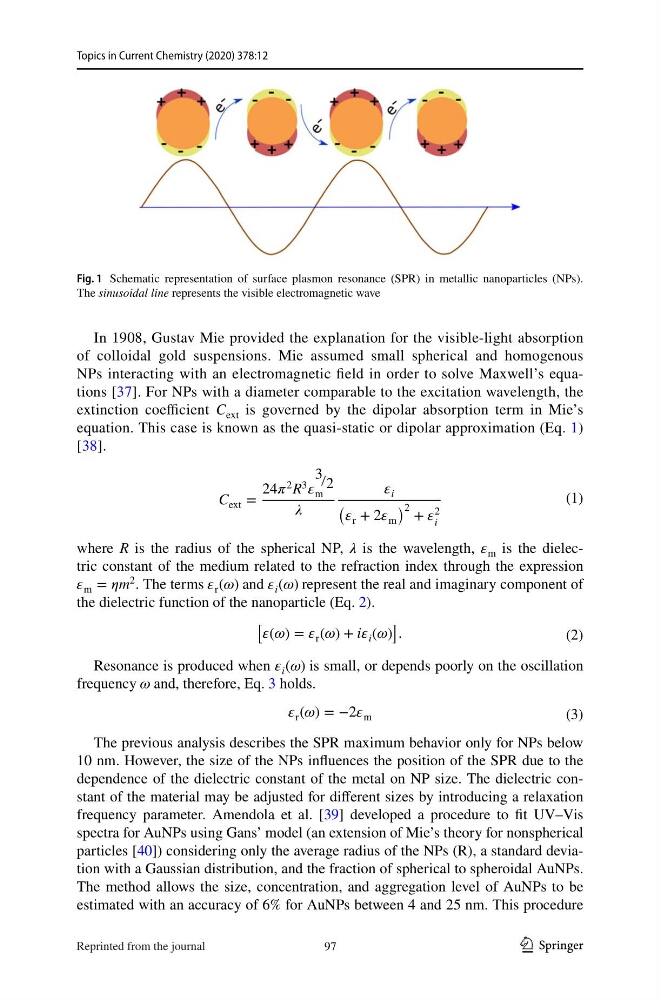
Fig. 1 Schematic representation of surface plasmon resonance (SPR) in metallic nanoparticles (NPs).
The sinusoidal line represents the visible electromagnetic wave
97
Reprinted from the journal
Topics in Current Chemistry (2020) 378:12
In 1908, Gustav Mie provided the explanation for the visible-light absorption
of colloidal gold suspensions. Mie assumed small spherical and homogenous
NPs interacting with an electromagnetic field in order to solve Maxwell’s equations [37]. For NPs with a diameter comparable to the excitation wavelength, the
extinction coefficient C ext is governed by the dipolar absorption term in Mie’s
equation. This case is known as the quasi-static or dipolar approximation (Eq. 1)
[38].
where R is the radius of the spherical NP, is the wavelength, m is the dielectric constant of the medium related to the refraction index through the expression
m = m
2 . The terms r () and i () represent the real and imaginary component of
the dielectric function of the nanoparticle (Eq. 2).
Resonance is produced when i () is small, or depends poorly on the oscillation
frequency and, therefore, Eq. 3 holds.
The previous analysis describes the SPR maximum behavior only for NPs below
10 nm. However, the size of the NPs influences the position of the SPR due to the
dependence of the dielectric constant of the metal on NP size. The dielectric constant of the material may be adjusted for different sizes by introducing a relaxation
frequency parameter. Amendola et al. [39] developed a procedure to fit UV–Vis
spectra for AuNPs using Gans’ model (an extension of Mie’s theory for nonspherical
particles [40]) considering only the average radius of the NPs (R), a standard deviation with a Gaussian distribution, and the fraction of spherical to spheroidal AuNPs.
The method allows the size, concentration, and aggregation level of AuNPs to be
estimated with an accuracy of 6% for AuNPs between 4 and 25 nm. This procedure
(1)
C ext =
24
2 R 3
3 ∕ 2
m
i
r + 2 m
2 +
2
i
(2)
() = r () + i i ()
.
(3)
r () = −2 m
Fig. 1 Schematic representation of surface plasmon resonance (SPR) in metallic nanoparticles (NPs).
The sinusoidal line represents the visible electromagnetic wave
97
Reprinted from the journal