

4.2 Laws for Fluids at Rest
83
k is a unit vector directed upward, g is the acceleration of gravity, and ρ is the
density of the body.
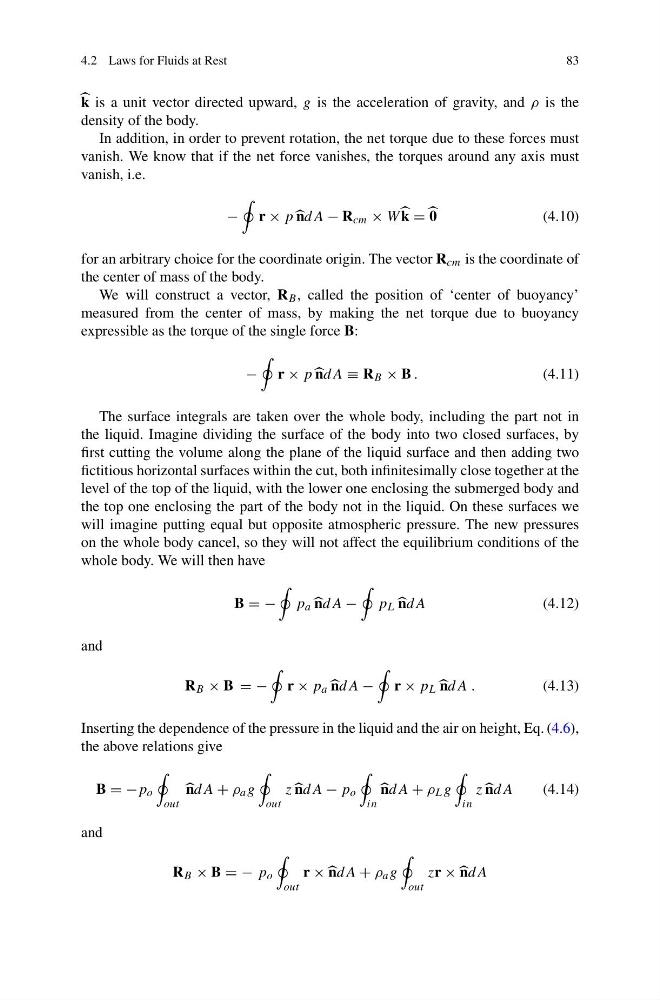
In addition, in order to prevent rotation, the net torque due to these forces must
vanish. We know that if the net force vanishes, the torques around any axis must
vanish, i.e.
−
r × p ndA − R cm × W k = 0
(4.10)
for an arbitrary choice for the coordinate origin. The vector R cm is the coordinate of
the center of mass of the body.
We will construct a vector, R B , called the position of ‘center of buoyancy’
measured from the center of mass, by making the net torque due to buoyancy
expressible as the torque of the single force B:
−
r × p ndA ≡ R B × B .
(4.11)
The surface integrals are taken over the whole body, including the part not in
the liquid. Imagine dividing the surface of the body into two closed surfaces, by
first cutting the volume along the plane of the liquid surface and then adding two
fictitious horizontal surfaces within the cut, both infinitesimally close together at the
level of the top of the liquid, with the lower one enclosing the submerged body and
the top one enclosing the part of the body not in the liquid. On these surfaces we
will imagine putting equal but opposite atmospheric pressure. The new pressures
on the whole body cancel, so they will not affect the equilibrium conditions of the
whole body. We will then have
B = −
p a ndA −
p L ndA
(4.12)
and
R B × B = −
r × p a ndA −
r × p L ndA .
(4.13)
Inserting the dependence of the pressure in the liquid and the air on height, Eq. (4.6),
the above relations give
B = −p o
out
ndA + ρ a g
out
z ndA − p o
in
ndA + ρ L g
in
z ndA
(4.14)
and
R B × B = − p o
out
r × ndA + ρ a g
out
zr × ndA
83
k is a unit vector directed upward, g is the acceleration of gravity, and ρ is the
density of the body.
In addition, in order to prevent rotation, the net torque due to these forces must
vanish. We know that if the net force vanishes, the torques around any axis must
vanish, i.e.
−
r × p ndA − R cm × W k = 0
(4.10)
for an arbitrary choice for the coordinate origin. The vector R cm is the coordinate of
the center of mass of the body.
We will construct a vector, R B , called the position of ‘center of buoyancy’
measured from the center of mass, by making the net torque due to buoyancy
expressible as the torque of the single force B:
−
r × p ndA ≡ R B × B .
(4.11)
The surface integrals are taken over the whole body, including the part not in
the liquid. Imagine dividing the surface of the body into two closed surfaces, by
first cutting the volume along the plane of the liquid surface and then adding two
fictitious horizontal surfaces within the cut, both infinitesimally close together at the
level of the top of the liquid, with the lower one enclosing the submerged body and
the top one enclosing the part of the body not in the liquid. On these surfaces we
will imagine putting equal but opposite atmospheric pressure. The new pressures
on the whole body cancel, so they will not affect the equilibrium conditions of the
whole body. We will then have
B = −
p a ndA −
p L ndA
(4.12)
and
R B × B = −
r × p a ndA −
r × p L ndA .
(4.13)
Inserting the dependence of the pressure in the liquid and the air on height, Eq. (4.6),
the above relations give
B = −p o
out
ndA + ρ a g
out
z ndA − p o
in
ndA + ρ L g
in
z ndA
(4.14)
and
R B × B = − p o
out
r × ndA + ρ a g
out
zr × ndA