

84
4 Fluid Mechanics Applied to Biosystems
− p o
in
r × ndA + ρ L g
in
zr × ndA .
(4.15)
The subscript on the integral signs, ‘in’ or ‘out’, refer to integrations over the surface
of the body segments in the liquid or out of the liquid. The evaluations of the closedsurface integrals are simpler if we apply Gauss’ expression
B · dS ≡
∇ · B dV
to each, in the forms
F ndA ≡
∇F dV and
F × ndA ≡
∇ × F dV . (See
Appendix G.5). In this way, we see that several of the integrals vanish:
ndA ≡ 0
and
r × ndA ≡ 0. We are left with
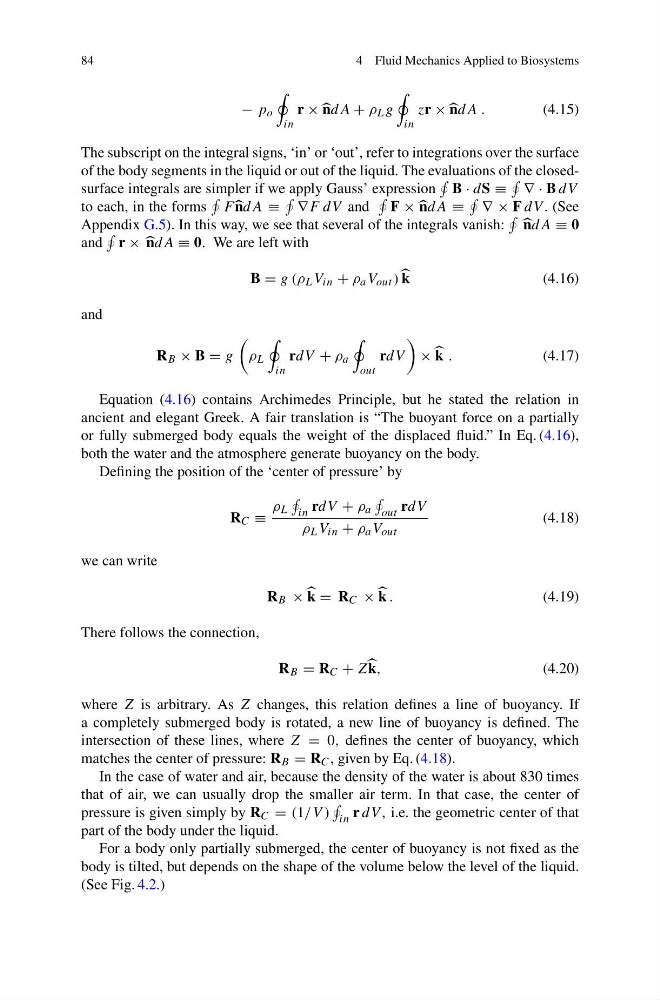
B = g (ρ L V in + ρ a V out ) k
(4.16)
and
R B × B = g
ρ L
in
rdV + ρ a
out
rdV
× k .
(4.17)
Equation (4.16) contains Archimedes Principle, but he stated the relation in
ancient and elegant Greek. A fair translation is “The buoyant force on a partially
or fully submerged body equals the weight of the displaced fluid.” In Eq. (4.16),
both the water and the atmosphere generate buoyancy on the body.
Defining the position of the ‘center of pressure’ by
R C ≡
ρ L
in rdV + ρ a
out rdV
ρ L V in + ρ a V out
(4.18)
we can write
R B × k = R C × k .
(4.19)
There follows the connection,
R B = R C + Z k,
(4.20)
where Z is arbitrary. As Z changes, this relation defines a line of buoyancy. If
a completely submerged body is rotated, a new line of buoyancy is defined. The
intersection of these lines, where Z = 0, defines the center of buoyancy, which
matches the center of pressure: R B = R C , given by Eq. (4.18).
In the case of water and air, because the density of the water is about 830 times
that of air, we can usually drop the smaller air term. In that case, the center of
pressure is given simply by R C = (1/V )
in r dV , i.e. the geometric center of that
part of the body under the liquid.
For a body only partially submerged, the center of buoyancy is not fixed as the
body is tilted, but depends on the shape of the volume below the level of the liquid.
(See Fig. 4.2.)
4 Fluid Mechanics Applied to Biosystems
− p o
in
r × ndA + ρ L g
in
zr × ndA .
(4.15)
The subscript on the integral signs, ‘in’ or ‘out’, refer to integrations over the surface
of the body segments in the liquid or out of the liquid. The evaluations of the closedsurface integrals are simpler if we apply Gauss’ expression
B · dS ≡
∇ · B dV
to each, in the forms
F ndA ≡
∇F dV and
F × ndA ≡
∇ × F dV . (See
Appendix G.5). In this way, we see that several of the integrals vanish:
ndA ≡ 0
and
r × ndA ≡ 0. We are left with
B = g (ρ L V in + ρ a V out ) k
(4.16)
and
R B × B = g
ρ L
in
rdV + ρ a
out
rdV
× k .
(4.17)
Equation (4.16) contains Archimedes Principle, but he stated the relation in
ancient and elegant Greek. A fair translation is “The buoyant force on a partially
or fully submerged body equals the weight of the displaced fluid.” In Eq. (4.16),
both the water and the atmosphere generate buoyancy on the body.
Defining the position of the ‘center of pressure’ by
R C ≡
ρ L
in rdV + ρ a
out rdV
ρ L V in + ρ a V out
(4.18)
we can write
R B × k = R C × k .
(4.19)
There follows the connection,
R B = R C + Z k,
(4.20)
where Z is arbitrary. As Z changes, this relation defines a line of buoyancy. If
a completely submerged body is rotated, a new line of buoyancy is defined. The
intersection of these lines, where Z = 0, defines the center of buoyancy, which
matches the center of pressure: R B = R C , given by Eq. (4.18).
In the case of water and air, because the density of the water is about 830 times
that of air, we can usually drop the smaller air term. In that case, the center of
pressure is given simply by R C = (1/V )
in r dV , i.e. the geometric center of that
part of the body under the liquid.
For a body only partially submerged, the center of buoyancy is not fixed as the
body is tilted, but depends on the shape of the volume below the level of the liquid.
(See Fig. 4.2.)