

4.2 Laws for Fluids at Rest
85
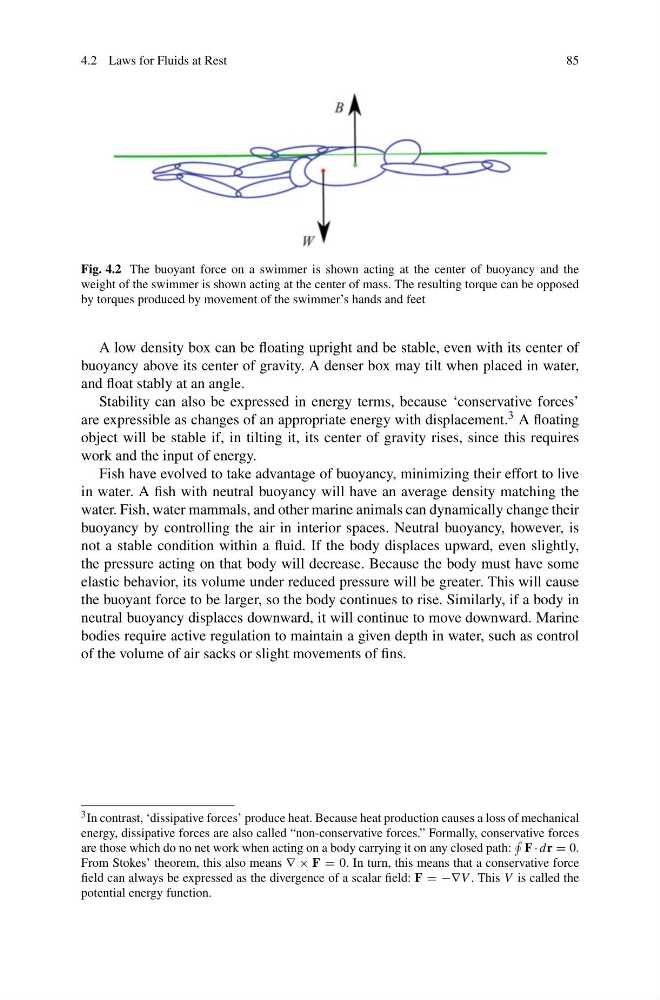
Fig. 4.2 The buoyant force on a swimmer is shown acting at the center of buoyancy and the
weight of the swimmer is shown acting at the center of mass. The resulting torque can be opposed
by torques produced by movement of the swimmer’s hands and feet
A low density box can be floating upright and be stable, even with its center of
buoyancy above its center of gravity. A denser box may tilt when placed in water,
and float stably at an angle.
Stability can also be expressed in energy terms, because ‘conservative forces’
are expressible as changes of an appropriate energy with displacement. 3 A floating
object will be stable if, in tilting it, its center of gravity rises, since this requires
work and the input of energy.
Fish have evolved to take advantage of buoyancy, minimizing their effort to live
in water. A fish with neutral buoyancy will have an average density matching the
water. Fish, water mammals, and other marine animals can dynamically change their
buoyancy by controlling the air in interior spaces. Neutral buoyancy, however, is
not a stable condition within a fluid. If the body displaces upward, even slightly,
the pressure acting on that body will decrease. Because the body must have some
elastic behavior, its volume under reduced pressure will be greater. This will cause
the buoyant force to be larger, so the body continues to rise. Similarly, if a body in
neutral buoyancy displaces downward, it will continue to move downward. Marine
bodies require active regulation to maintain a given depth in water, such as control
of the volume of air sacks or slight movements of fins.
3 In contrast, ‘dissipative forces’ produce heat. Because heat production causes a loss of mechanical
energy, dissipative forces are also called “non-conservative forces.” Formally, conservative forces
are those which do no net work when acting on a body carrying it on any closed path:
F · dr = 0.
From Stokes’ theorem, this also means ∇ × F = 0. In turn, this means that a conservative force
field can always be expressed as the divergence of a scalar field: F = −∇V . This V is called the
potential energy function.
85
Fig. 4.2 The buoyant force on a swimmer is shown acting at the center of buoyancy and the
weight of the swimmer is shown acting at the center of mass. The resulting torque can be opposed
by torques produced by movement of the swimmer’s hands and feet
A low density box can be floating upright and be stable, even with its center of
buoyancy above its center of gravity. A denser box may tilt when placed in water,
and float stably at an angle.
Stability can also be expressed in energy terms, because ‘conservative forces’
are expressible as changes of an appropriate energy with displacement. 3 A floating
object will be stable if, in tilting it, its center of gravity rises, since this requires
work and the input of energy.
Fish have evolved to take advantage of buoyancy, minimizing their effort to live
in water. A fish with neutral buoyancy will have an average density matching the
water. Fish, water mammals, and other marine animals can dynamically change their
buoyancy by controlling the air in interior spaces. Neutral buoyancy, however, is
not a stable condition within a fluid. If the body displaces upward, even slightly,
the pressure acting on that body will decrease. Because the body must have some
elastic behavior, its volume under reduced pressure will be greater. This will cause
the buoyant force to be larger, so the body continues to rise. Similarly, if a body in
neutral buoyancy displaces downward, it will continue to move downward. Marine
bodies require active regulation to maintain a given depth in water, such as control
of the volume of air sacks or slight movements of fins.
3 In contrast, ‘dissipative forces’ produce heat. Because heat production causes a loss of mechanical
energy, dissipative forces are also called “non-conservative forces.” Formally, conservative forces
are those which do no net work when acting on a body carrying it on any closed path:
F · dr = 0.
From Stokes’ theorem, this also means ∇ × F = 0. In turn, this means that a conservative force
field can always be expressed as the divergence of a scalar field: F = −∇V . This V is called the
potential energy function.