

86
4 Fluid Mechanics Applied to Biosystems
4.3 Fluid Dynamics
When physical principles are applied to understand the motion of fluids, the subject
of the study is fluid dynamics. Examples abound in biology. Blood flow is an evident
one. But there are many other important applications: How animals move through
water, how birds and bees fly, and how fluids in cells circulate. While tackling these
applications, we will use the underlying physical principles.
We will apply Newton’s laws to describe biologically important fluid dynamics.
These laws, together with the relationships between the physical properties of the
fluid (known as the equations of state) contain all the classical predictions, including
conservation laws and limitations on the behavior of fluids. Many of the predictions
simply follow from simple circumstances. However, we should also appreciate that
because Newton’s laws for fluids are non-linear in the fluid velocity, they can have
solutions involving chaotic states. (See Sect. 13.2 for a description of chaos.)
During fluid motion, one layer of fluid can slip over another. Such slipping
introduces a short-range force of one layer onto the other in a way analogous to the
material shearing force we have studied, except that instead of a static displacement
of one layer relative to another in the solid, there is a continuous displacement of
one layer relative to its neighboring layer.
4.3.1 Viscosity
Pressure forces of one fluid element on another are defined to be perpendicular to
the element surface. But fluid elements can also slip past one another, creating a
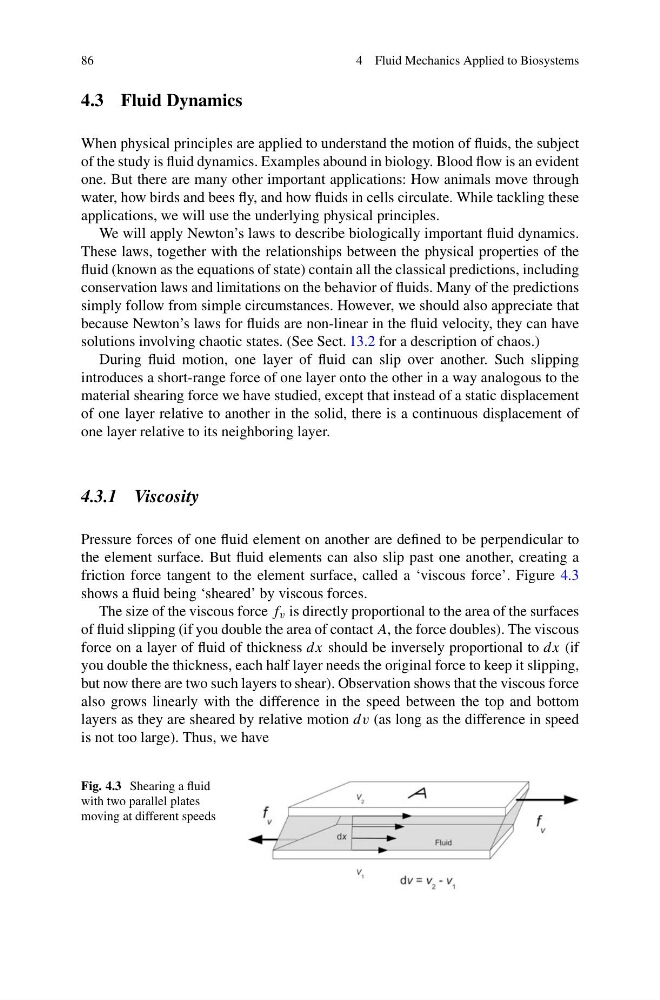
friction force tangent to the element surface, called a ‘viscous force’. Figure 4.3
shows a fluid being ‘sheared’ by viscous forces.
The size of the viscous force f v is directly proportional to the area of the surfaces
of fluid slipping (if you double the area of contact A, the force doubles). The viscous
force on a layer of fluid of thickness dx should be inversely proportional to dx (if
you double the thickness, each half layer needs the original force to keep it slipping,
but now there are two such layers to shear). Observation shows that the viscous force
also grows linearly with the difference in the speed between the top and bottom
layers as they are sheared by relative motion dv (as long as the difference in speed
is not too large). Thus, we have
Fig. 4.3 Shearing a fluid
with two parallel plates
moving at different speeds
4 Fluid Mechanics Applied to Biosystems
4.3 Fluid Dynamics
When physical principles are applied to understand the motion of fluids, the subject
of the study is fluid dynamics. Examples abound in biology. Blood flow is an evident
one. But there are many other important applications: How animals move through
water, how birds and bees fly, and how fluids in cells circulate. While tackling these
applications, we will use the underlying physical principles.
We will apply Newton’s laws to describe biologically important fluid dynamics.
These laws, together with the relationships between the physical properties of the
fluid (known as the equations of state) contain all the classical predictions, including
conservation laws and limitations on the behavior of fluids. Many of the predictions
simply follow from simple circumstances. However, we should also appreciate that
because Newton’s laws for fluids are non-linear in the fluid velocity, they can have
solutions involving chaotic states. (See Sect. 13.2 for a description of chaos.)
During fluid motion, one layer of fluid can slip over another. Such slipping
introduces a short-range force of one layer onto the other in a way analogous to the
material shearing force we have studied, except that instead of a static displacement
of one layer relative to another in the solid, there is a continuous displacement of
one layer relative to its neighboring layer.
4.3.1 Viscosity
Pressure forces of one fluid element on another are defined to be perpendicular to
the element surface. But fluid elements can also slip past one another, creating a
friction force tangent to the element surface, called a ‘viscous force’. Figure 4.3
shows a fluid being ‘sheared’ by viscous forces.
The size of the viscous force f v is directly proportional to the area of the surfaces
of fluid slipping (if you double the area of contact A, the force doubles). The viscous
force on a layer of fluid of thickness dx should be inversely proportional to dx (if
you double the thickness, each half layer needs the original force to keep it slipping,
but now there are two such layers to shear). Observation shows that the viscous force
also grows linearly with the difference in the speed between the top and bottom
layers as they are sheared by relative motion dv (as long as the difference in speed
is not too large). Thus, we have
Fig. 4.3 Shearing a fluid
with two parallel plates
moving at different speeds